
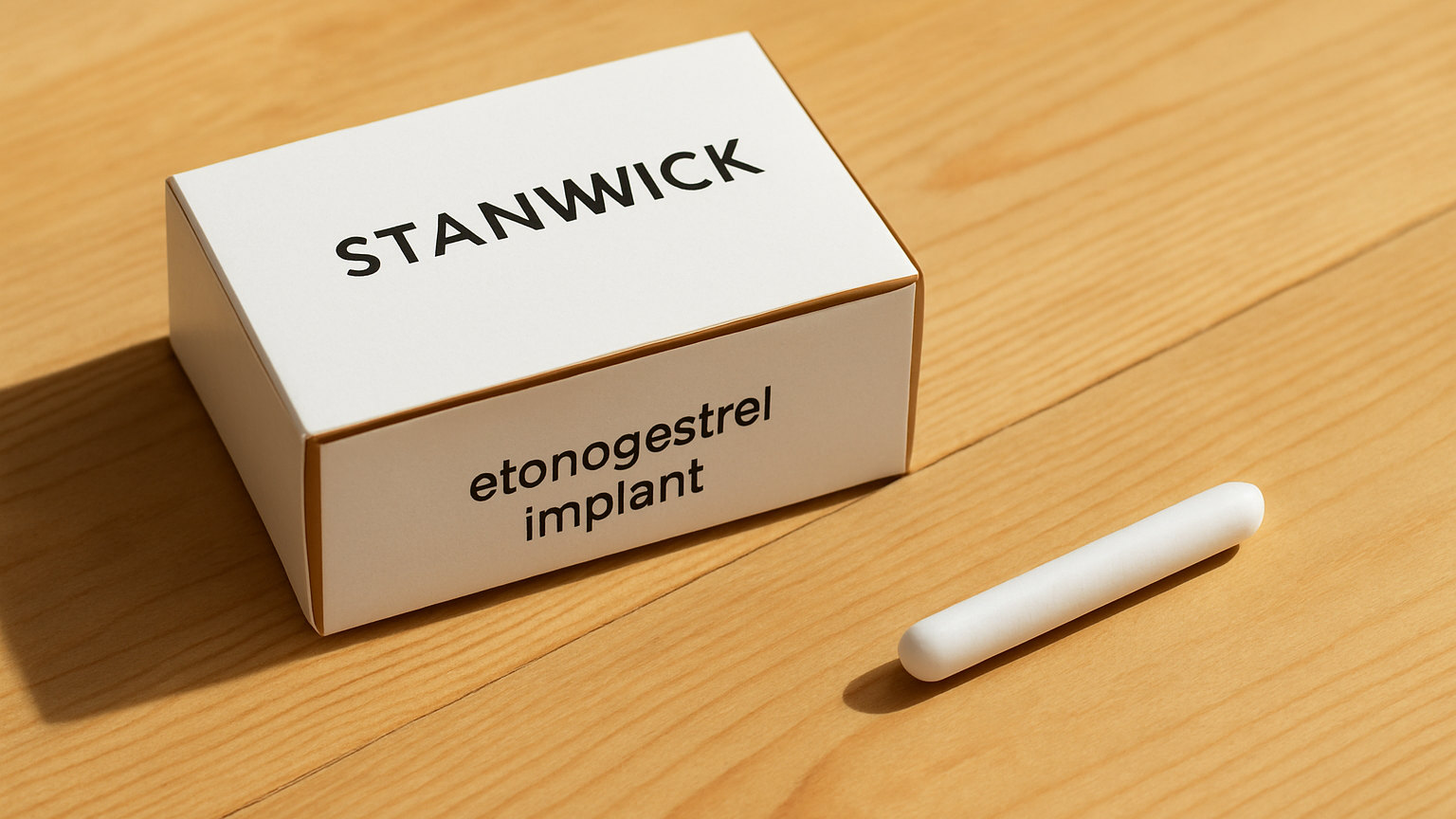
Etonogestrel is the progestogen in the contraceptive implant - a small flexible rod placed under the skin of the upper arm, releasing hormone steadily for three years. It is the most effective reversible contraception available, with a failure rate well under one in a thousand. That effectiveness comes almost entirely from removing you from the process: there is nothing to remember, nothing to take, and no window to miss.
Follow the advice your clinic gave you. This guide contains no doses.
How it works
It prevents ovulation, thickens cervical mucus and thins the womb lining. Ovulation suppression is the main mechanism, which is why it is so reliable.
Because there is no absorption from the gut, vomiting and diarrhoea do not affect it - unlike pills, where they count as missed doses. See missed contraceptive pill for the contrast.
Bleeding is the main drawback
Bleeding patterns become unpredictable, and this is by far the commonest reason for early removal.
Roughly speaking, about one in five stop bleeding altogether, about one in five have frequent or prolonged bleeding, and the rest fall somewhere in between. Whatever pattern emerges in the first few months tends to be the pattern you keep.
That is worth knowing before insertion, because it is genuinely unpredictable and nobody can tell you in advance which group you will be in.
Troublesome bleeding can sometimes be managed - a short course of a combined pill or other treatment is occasionally used - so it is worth asking before having it removed.
See your clinician about bleeding after sex, or bleeding that starts after a long settled period, since those need assessing rather than attributing to the implant.
Insertion and removal
Insertion takes a few minutes under local anaesthetic, just under the skin on the inner upper arm. Bruising, tenderness and a small scar are usual.
You should be able to feel the rod under your skin, and you should check for it periodically. If you cannot feel it, use additional contraception and contact your clinic - a non-palpable implant needs locating by ultrasound or X-ray before removal, and occasionally it has migrated.
Removal is also a short procedure under local anaesthetic. A new one can be fitted at the same time through the same incision.
Fertility returns quickly after removal - within weeks - so if you are stopping to avoid pregnancy you need another method straight away.
Who it suits
It contains no oestrogen, so it can be used by people for whom the combined pill is unsuitable: migraine with aura, a history of clots, breastfeeding, smokers over 35, high blood pressure, higher BMI.
It suits anyone who finds daily tablets difficult, and it is discreet - nothing to keep at home and nothing anyone else would notice.
Our guide to desogestrel covers the same progestogen family in pill form.
Medicines that reduce its effectiveness
This is the one real gap in its reliability. Enzyme-inducing drugs speed up the breakdown of etonogestrel and reduce the implant's effectiveness.
They include rifampicin and rifabutin, several anti-epileptics including carbamazepine and oxcarbazepine, some HIV medicines, modafinil, and St John's wort.
See carbamazepine, modafinil and supplements that interfere with your medicines.
If you need one of these long-term, a method unaffected by enzyme inducers - the copper coil, hormonal coil or injection - is usually recommended instead. For a short course, additional precautions are needed during it and for a period afterwards.
Most antibiotics do not affect it - see antibiotics and the pill.
Other side effects
Headache, acne, breast tenderness, mood changes, weight change and reduced libido. Acne can improve or worsen and is unpredictable.
Ovarian cysts occur more often and are usually harmless.
The evidence on mood and hormonal contraception is mixed and contested. If you notice a clear change since insertion, take it seriously - removal is straightforward and there are alternatives.
Seek urgent help for severe one-sided abdominal pain, which needs ectopic pregnancy excluded, or for signs of infection at the insertion site.
If it needs removing early
You can have an implant removed at any point and for any reason, including simply not liking it. You do not need to justify the decision or persist for a set period.
That said, if bleeding is the problem, it is worth asking about treatment for the bleeding before removal - and worth knowing that the pattern in the first three months often improves. Removing at week six on the basis of a pattern that would have settled is a common regret.
Practical points
Note the expiry date - three years from insertion - and put it somewhere you will find it. Implants left in beyond their duration are a recognised cause of unplanned pregnancy.
You should be given a card with the date. Photograph it.
It does not protect against sexually transmitted infections, so condoms remain relevant for that.
Tell anyone arranging an MRI or arm surgery that you have one.
If this was useful, Orlistat: How It Works and What to Expect is worth reading next, and Medicines collects the rest.


