What Does "Take With Food" Actually Mean?
Some instructions protect your stomach, some control how much of the drug is absorbed, and only the second kind will actually change how well your medicine works. Knowing which is which is the useful part.
What "take with food" is really for, the medicines affected by grapefruit, dairy or caffeine, and why timing around meals sometimes matters.
Some instructions protect your stomach, some control how much of the drug is absorbed, and only the second kind will actually change how well your medicine works. Knowing which is which is the useful part.
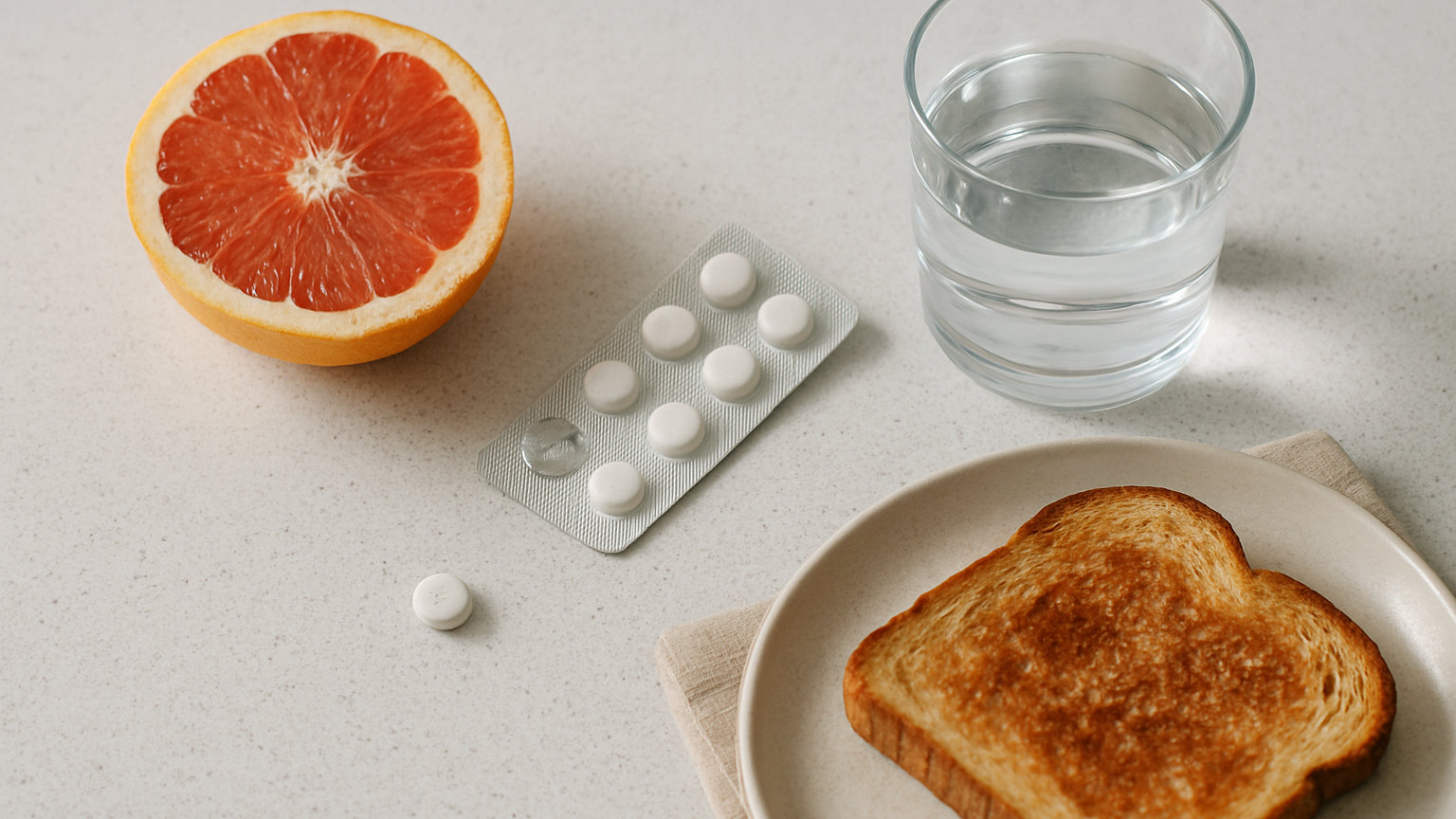
It is not a folk myth and it is not about acidity. Grapefruit disables an enzyme in your gut wall, and the effect outlasts any attempt to space it out.
Most regimens can be adapted, and many people simply stop taking things rather than asking. The conversation takes minutes and the alternatives are usually straightforward.
Nothing is harmed and nothing reacts. The drug simply forms a complex the gut cannot absorb, and the treatment quietly fails.
It is a drug that most people take several times a day without counting it, and it is quietly present in a number of things on the pharmacy shelf.
Grapefruit gets all the attention, and it is not the only thing in your kitchen that matters.
It does not mean simply before breakfast. It means a defined gap on both sides, and for some medicines the gap is the treatment.
Several interactions are purely physical, and the entire fix is a gap of a couple of hours.
Gelatine, lactose and stearates are everywhere in medicines, and pharmacists are rarely asked about them.
Dehydration turns several ordinary medicines into a problem, and it usually happens during an illness nobody thought was serious.
Most adult doses ignore your weight entirely, and for a specific handful that is a problem.
A short list has real evidence for specific groups, and the rest is mostly expensive urine.