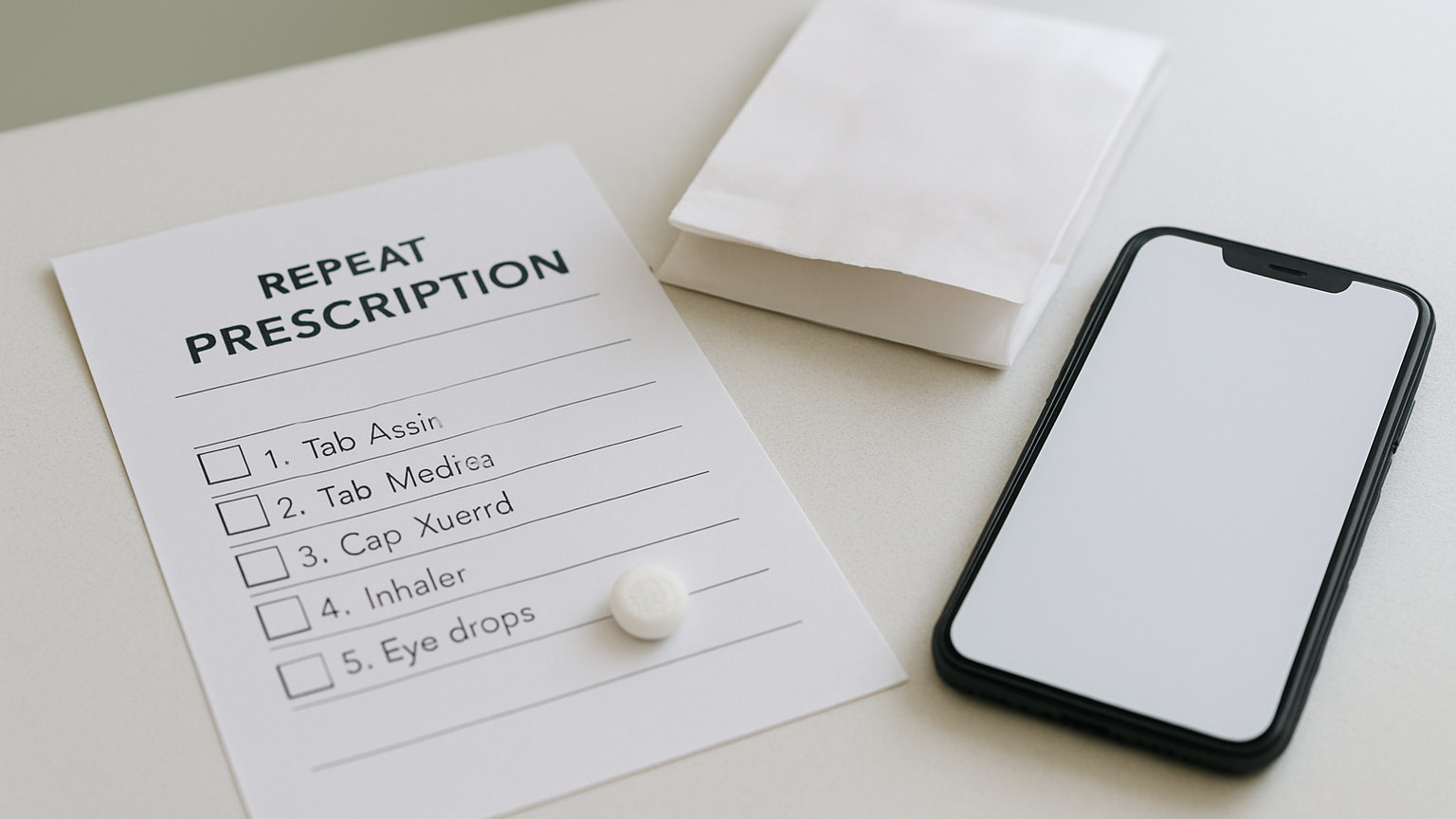
A repeat prescription is a medicine your GP practice has authorised you to reorder without a new consultation each time. You can usually order through the NHS App, through your practice's online system, in writing at the surgery, or in some cases through your pharmacy. Allow several working days between ordering and collecting - longer around bank holidays. Running out is a far more common cause of missed doses than forgetting to take them.
The ways to order
The NHS App is the most direct route for most people in England. It shows your repeat list, lets you order, and shows the status of the request. It requires a one-off identity verification, which is worth doing before you need it rather than at the point you have run out.
Your practice's online system works similarly and may be linked from their website.
The paper slip that comes with your medicines - tick what you need and hand it in.
Your pharmacy may offer a managed repeat service, ordering on your behalf. Convenient, but keep an eye on it: these services sometimes order everything on the list every month, which produces stockpiles of things you have stopped taking and disguises the fact that a review is overdue.
Most practices do not take repeat requests by phone, to avoid transcription errors.
How long it takes
Two to three working days is a common turnaround at the practice, and the pharmacy then needs time to dispense - so allow the best part of a week. Order when you have about a week to ten days of medicine left rather than when you are down to the last few days.
Bank holidays compress everything. If a long weekend is coming and you would be ordering within the next fortnight, order early.
Items not on your repeat list, controlled drugs, and anything requiring a review will take longer.
Why a request gets held up
A medication review is due. Repeats are authorised for a set number of issues, after which the practice must review before reauthorising. It is a safety mechanism rather than an obstruction, and it is the most common cause of a delayed repeat. Book the review as soon as you are told one is needed.
You ordered too early. Practices decline requests that arrive well before you should have run out, partly to avoid stockpiling and partly because early ordering can indicate a dose being taken differently from how it was prescribed. If you need an early supply for a genuine reason - travel, for instance - say so, and see our guide to travelling with medicines.
A blood test or monitoring is outstanding. Some medicines are only reauthorised once results are back.
The item has been stopped or changed by a hospital team, and the list has not caught up.
If you have run out
Speak to your pharmacy first. Pharmacists can supply an emergency quantity of a regular medicine at their professional discretion, and for anything you cannot safely miss - epilepsy medicines, insulin, heart medicines, inhalers - that is the fastest route. Outside hours, call 111.
Do not simply go without, and do not spread out what you have left to make it last unless you have been told to. Our guide to missed doses covers which medicines are least forgiving.
Repeat dispensing, for stable long-term medicines
Repeat dispensing - sometimes called batch prescribing - issues one authorisation covering several months, with the pharmacy releasing each instalment when it is due. It removes the monthly ordering step entirely and reduces the chance of running out.
It suits people on stable long-term medicines. Ask your practice whether you are eligible; it is under-used and few people are offered it unprompted.
Keeping the list clean
Repeat lists accumulate. Items get added and rarely removed, and people end up ordering things they stopped taking months ago, or holding several months' surplus of one item and none of another.
Order only what you actually need each time rather than ticking everything. Once a year, go through the list with a pharmacist or at your review and ask what is still needed - most people over 65 on multiple medicines have at least one item that could go, and a structured medicines review exists precisely for this.
Return anything you no longer need to a pharmacy rather than binning it, and never pass it to someone else. Reducing the number of items also reduces what you pay in England, which our guide to prescription charges covers.
Finally, keep your nominated pharmacy up to date. If you move, or switch pharmacy, change the nomination - prescriptions sent to a pharmacy across town are a routine and entirely avoidable cause of running out.
See also Getting Extra Medicine Before a Holiday, and the Prescriptions section for more on prescriptions and pharmacy services.