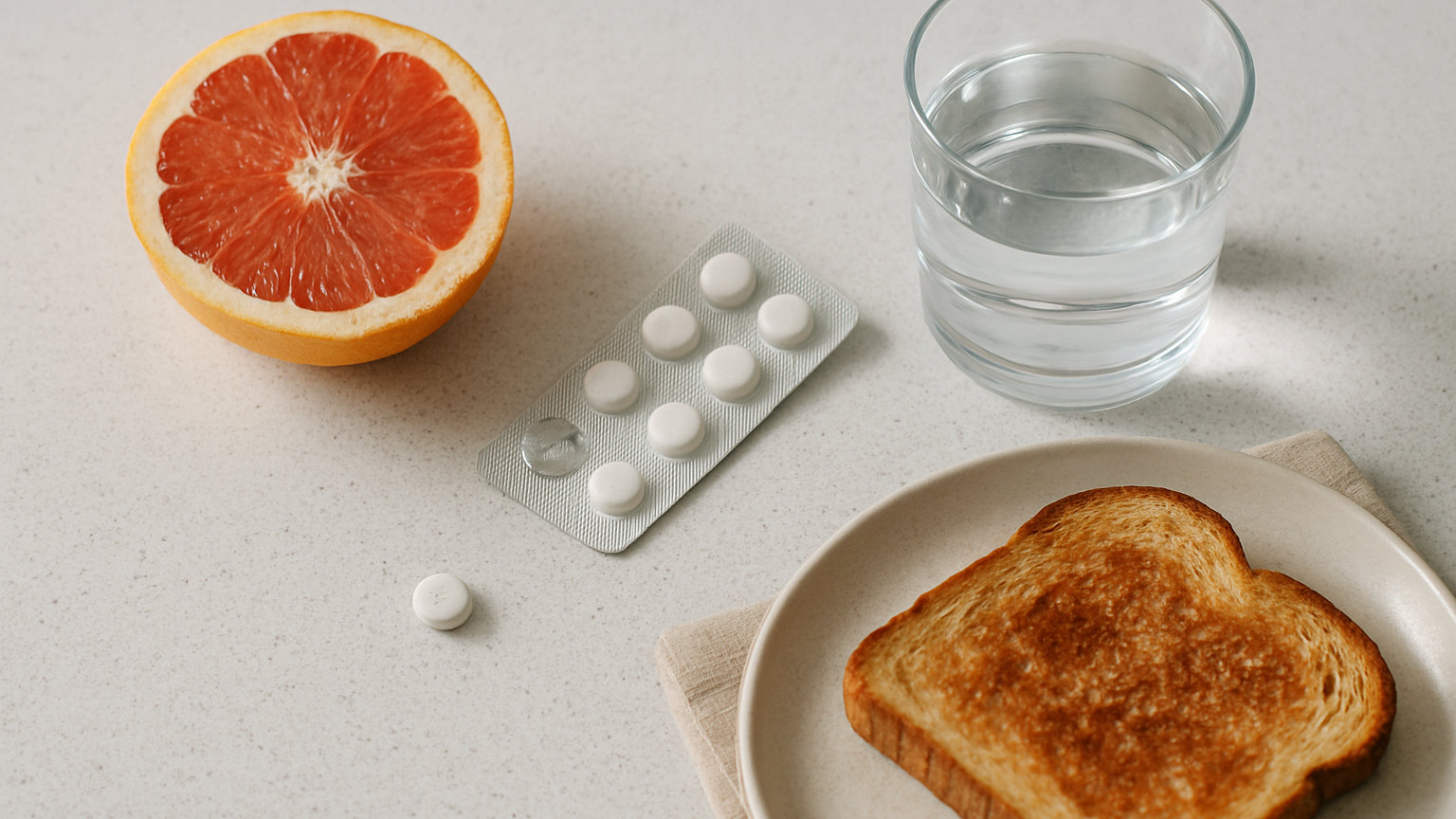
Grapefruit interacts with a substantial list of medicines, and the mechanism is specific rather than vague. It contains compounds that irreversibly block an enzyme in the wall of the small intestine which normally breaks down many drugs before they reach the bloodstream. Disable that enzyme and considerably more of the drug gets through than the dose intended - effectively an unplanned increase. The effect can last a day or more, so taking your tablet at a different time of day does not solve it.
Check the leaflet for your specific medicine, or ask your pharmacist. Do not assume it applies to everything, and do not assume it applies to nothing.
How it actually works
The enzyme is one of the cytochrome P450 family, found in the gut wall as well as the liver. Its job in the intestine is to metabolise a proportion of certain drugs on the way in, so the licensed dose already takes that first-pass loss into account.
Grapefruit compounds bind to the enzyme and inactivate it permanently. Your body has to make new enzyme to recover, which takes time - typically a day or more, sometimes longer. That is why spacing your tablet away from your breakfast grapefruit achieves nothing: the enzyme is still out of action.
It is also why the effect is not proportional to how much you drink in a predictable way, and why a single glass can be enough with some medicines.
Which fruits
Affected: grapefruit and grapefruit juice, Seville oranges - the bitter kind used in marmalade - pomelo, and tangelo.
Not affected: ordinary sweet oranges, satsumas, clementines, lemons and limes.
Watch for grapefruit in things you would not think to check: mixed fruit juices, breakfast juice blends, some fizzy drinks and mixers, marmalade made with Seville oranges, and some supplements.
Which medicines
The list is long, and the size of the effect varies enormously between drugs in the same class - which is exactly why generic advice is unhelpful and the leaflet is worth reading. Categories where interactions are recognised include:
- Some statins. Simvastatin and atorvastatin are affected; pravastatin and rosuvastatin are largely not. Raised levels increase the risk of muscle problems, covered in our guide to statins and muscle pain.
- Some calcium channel blockers used for blood pressure and angina - see amlodipine and swollen ankles.
- Some immunosuppressants, including ciclosporin and tacrolimus, where levels are tightly controlled.
- Some anti-arrhythmic and heart medicines.
- Some sedatives and anti-anxiety medicines.
- Some medicines for erectile dysfunction.
- Some anticoagulants and some medicines for HIV and hepatitis.
The consequences depend on the drug. For a statin it means a higher risk of muscle injury; for an immunosuppressant it can mean toxicity; for a sedative, excessive drowsiness.
What to do
If your leaflet says avoid grapefruit, avoid it entirely rather than trying to time it. There is no safe gap.
If you eat grapefruit regularly and have been started on something new, say so at the point of prescribing. In several cases an equivalent drug in the same class is unaffected, so the practical answer may be a switch rather than giving up a food you like.
If you have already had grapefruit alongside an affected medicine, do not panic - a single exposure is rarely dangerous with most of these. Ring your pharmacist or 111 for advice if you are on an immunosuppressant or another drug with a narrow safety margin.
It is not the only food that does this
Grapefruit is the best-known example of a broader phenomenon. Other foods and drinks that affect medicines include:
- Green leafy vegetables and warfarin - the issue is consistency of vitamin K intake rather than avoidance, as our guide to warfarin and the newer blood thinners explains.
- Dairy, calcium and iron binding certain antibiotics and thyroid medicines, which is a timing problem rather than an avoidance one.
- Caffeine, whose breakdown is slowed by some medicines.
- Cranberry juice and liquorice, both of which interact with particular drugs.
- Alcohol, covered in our guide to medicines and alcohol.
Our guide to what "take with food" actually means covers the wider question of timing around meals.
The practical rule
Read the leaflet section on food and drink when you start anything new - it is short, and it is the one part people skip. If it mentions grapefruit, take that seriously; the warning is there because a measurable interaction was demonstrated, not as a general precaution.
And mention your diet if it is unusual in any relevant way. Pharmacists ask about medicines and supplements as standard but rarely ask what you eat, so this is one of the few interactions you generally have to raise yourself.
Related reading: Taking Medicines When You Are Fasting, with more on taking medicines day to day in Usage.