
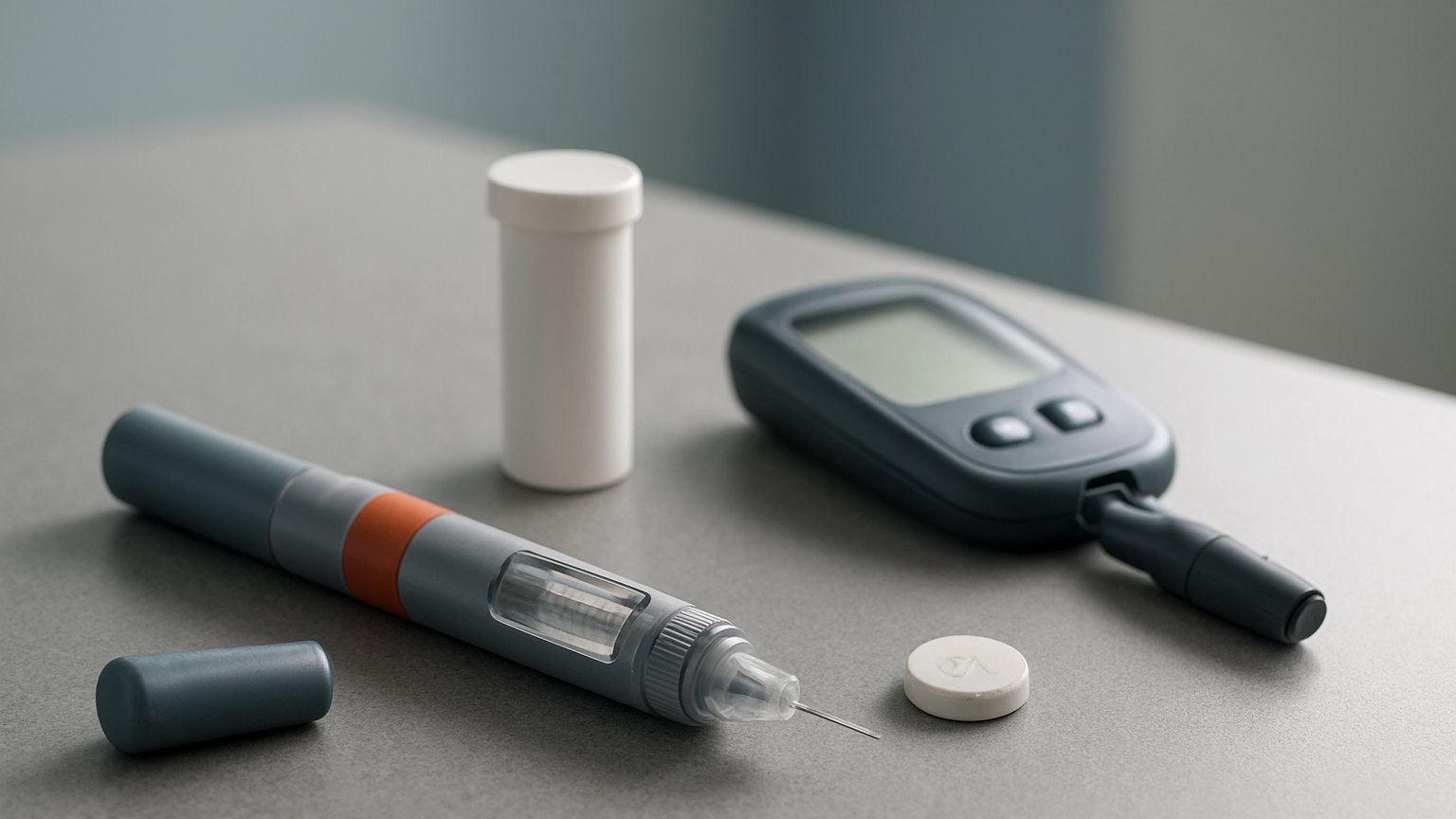
Glucagon is the hormone the pancreas releases when blood glucose falls. It tells the liver to break down stored glycogen and release glucose. Given as an injection or a nasal powder it raises blood sugar within about ten to fifteen minutes, and it is the rescue treatment for severe hypoglycaemia - a hypo where the person is unconscious, having a seizure, or too confused to swallow safely.
Follow the instructions given by your diabetes team. This guide contains no doses.
Someone else gives it
By definition, if glucagon is needed you cannot give it to yourself.
That makes it unlike every other medicine you take, and it has a consequence people miss: the people around you have to know that it exists, where it is kept, and how to use it.
Partners, family, housemates and close colleagues should be shown - not told, shown. Diabetes teams will train family members, and it takes minutes.
A device in a drawer that nobody knows about is no use at all.
When to use it
Glucagon is for severe hypoglycaemia:
- Unconscious or unrousable
- Having a seizure
- Too confused or agitated to take anything by mouth safely
Never put food or drink into the mouth of someone who is not fully conscious - it can be inhaled.
For a hypo where the person can swallow, fast-acting carbohydrate by mouth is faster and simpler - glucose tablets or a sugary drink, followed by longer-acting carbohydrate.
Glucose gel rubbed inside the cheek is an option for someone drowsy but still able to protect their airway.
What to do
Call 999. Give the glucagon. Put the person in the recovery position.
Glucagon is not a substitute for an ambulance. It buys time, and severe hypoglycaemia needs assessing - particularly to work out why it happened.
Recovery usually takes ten to fifteen minutes. Nausea and vomiting afterwards are common.
When they are fully awake and able to swallow, give carbohydrate - both fast-acting and longer-acting.
That last step is essential. Glucagon empties the liver's glycogen store, and without replacing it the person can go low again within hours.
When it will not work well
Glucagon works by releasing stored glycogen. If the store is empty, there is nothing to release.
It is therefore unreliable after:
- Alcohol, which suppresses liver glucose release - a common cause of severe hypos
- Prolonged fasting or starvation
- Repeated hypos in quick succession, where the store has already been used
- Significant liver disease
In those situations intravenous glucose is what works - another reason to call 999 rather than relying on glucagon alone.
The nasal form
Glucagon nasal powder is puffed into one nostril and absorbed through the lining. It requires no mixing, no needle and no injection technique.
It works even if the person is not breathing through their nose - it does not need to be inhaled.
For a frightened family member, that is considerably easier than reconstituting a vial and drawing up an injection, which is the main argument for it.
Pre-filled glucagon pens and syringes are also available and have largely replaced the older reconstitution kits.
Who should have it
Anyone treated with insulin should have glucagon available, and be able to say where it is.
It is also worth considering for people on sulfonylureas who have had severe hypos - though sulfonylurea hypos are prolonged and tend to recur, so hospital observation matters more there.
See insulin aspart, insulin degludec and glimepiride.
Check the expiry
Glucagon sits unused for years, which is the point - and it expires.
Check the date periodically, keep it somewhere obvious rather than buried, and replace it when it runs out or after it has been used.
Store as directed and keep one where you spend most time. Some people keep a second at work or with a relative.
Afterwards
A severe hypo is a reason to review, not just an event to recover from.
Things to look at: insulin doses and timing, injection sites and lipohypertrophy, alcohol, exercise patterns, kidney function, and whether hypoglycaemia unawareness has developed.
Unawareness is reversible with a period of deliberately avoiding lows, and it must be reported to the DVLA - as must any severe hypo requiring another person's help.
Continuous glucose monitoring with alarms substantially reduces severe hypos and is available on the NHS for many people - worth asking about if you have had one.
Other uses
Glucagon is used in hospital for beta blocker and calcium channel blocker overdose, and to relax the gut during some scans and procedures.
Those are quite separate from its use in diabetes.
Related reading: Insulin Types and How They Differ, with more on what medicines are prescribed for in Conditions.


