
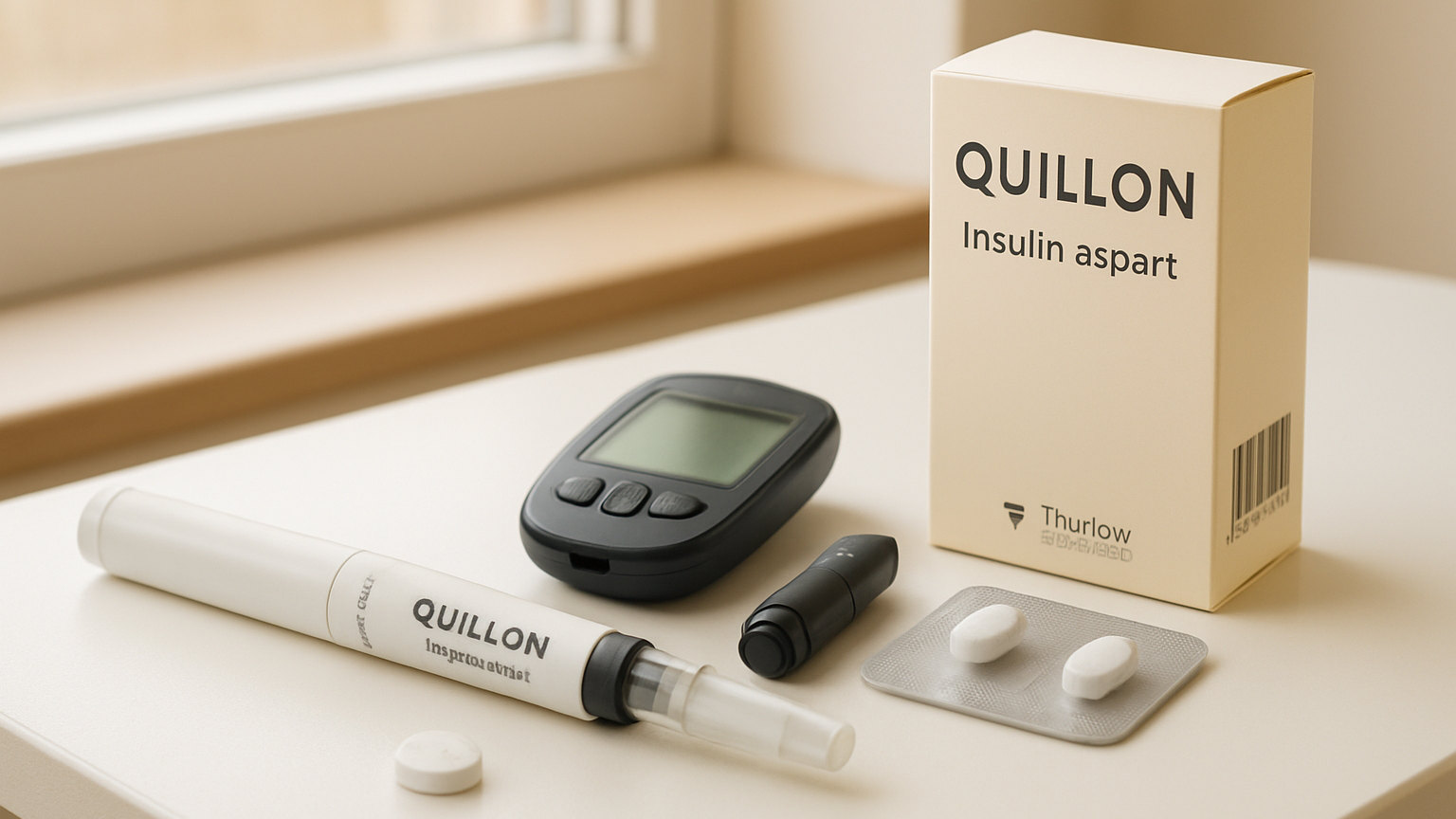
Insulin aspart is a rapid-acting insulin analogue, engineered so that the molecules separate quickly after injection rather than clumping together. It starts working within about ten to twenty minutes, peaks at one to three hours and is largely gone by four to five. It is the mealtime - bolus - insulin, covering the glucose rise from food, and it is used alongside a long-acting background insulin or in a pump.
Follow the plan your diabetes team gave you. This guide contains no doses.
Timing is the skill
Because food starts raising glucose within minutes, insulin injected at the first mouthful arrives slightly late.
Most people are advised to inject around fifteen minutes before eating, which lets the insulin get ahead of the meal and substantially improves post-meal glucose.
There are exceptions: if your glucose is already low, if you are unsure how much you will eat, or with a young child whose intake is unpredictable, injecting at or just after the meal is safer.
Faster-acting versions of aspart exist, absorbed more quickly, which reduces the need for that pre-meal gap.
Do not stack doses
Insulin aspart keeps working for four to five hours. Taking a correction dose two hours after a meal, while the mealtime dose is still active, is the commonest way people go low.
That is insulin stacking, and avoiding it means accounting for insulin still on board. Pumps and some smart pens calculate this automatically; otherwise it is a matter of waiting long enough before correcting.
If your glucose is high two hours after a meal, that usually means the mealtime dose or its timing needs adjusting rather than an immediate top-up.
Matching dose to food
Carbohydrate counting - matching the dose to the carbohydrate in a meal using a personal ratio - gives far better control than fixed doses and far more dietary freedom.
Structured education courses teach this properly and are free on the NHS. If you have never been offered one, ask - the difference in both control and quality of life is substantial.
Fat and protein slow absorption, so a high-fat meal raises glucose later and for longer, which is why pizza is a recurring problem. Split or extended dosing helps, and is something to work out with your team.
Recognising and treating a hypo
Sweating, trembling, hunger, palpitations, anxiety and tingling lips, progressing to confusion, slurred speech and difficulty concentrating.
Treat immediately with fast-acting carbohydrate - glucose tablets, a sugary drink or glucose gel - then follow with longer-acting carbohydrate.
Carry treatment at all times and tell the people around you where it is and what to look for. Glucagon should be available at home for severe hypos, and someone should know how to give it.
Hypoglycaemia unawareness - losing the early warning symptoms - is important, reversible, and affects driving eligibility. Report it.
Beta blockers can mask the warning signs - see bisoprolol.
Exercise and alcohol
Exercise increases insulin sensitivity and can cause hypoglycaemia during activity and for many hours afterwards - overnight hypos following evening exercise are common.
Doses and carbohydrate usually need adjusting around activity, and that adjustment is individual.
Alcohol suppresses the liver's release of glucose, so hypoglycaemia can occur several hours after drinking, often overnight. Eat carbohydrate when drinking and check before bed - see medicines and alcohol.
Injection sites
Abdomen absorbs fastest, then upper arms, then thighs and buttocks - which is why the abdomen is often preferred for mealtime insulin.
Rotate systematically. Repeated injection into the same spot causes lipohypertrophy, a painless lump of thickened tissue from which absorption is erratic and reduced - a frequent and unrecognised cause of unexplained glucose swings.
Moving to healthy tissue delivers considerably more insulin, so doses usually need reducing. Feel your sites, and ask for them to be examined at review. Use a new needle each time.
Never stop insulin when unwell
Illness raises glucose even when you are eating less, and stopping insulin in type 1 diabetes leads to ketoacidosis.
Continue insulin during illness, check glucose more often, test ketones, and keep drinking. Extra correction doses are usually needed rather than fewer.
Seek urgent help for ketones rising, persistent vomiting, rapid deep breathing or confusion.
See insulin glargine and sick day rules.
Storage and safety
Unopened pens in the fridge, never frozen. In use, at room temperature for a set number of weeks then discarded - write the date on it. Heat destroys insulin.
Never draw insulin out of a pen with a syringe, and check you have the right pen - rapid-acting and long-acting insulins from the same manufacturer often have similar names, and mixing them up is dangerous in both directions.
Used needles go in a sharps bin - see needles and sharps disposal.
If this was useful, Insulin Degludec: Ultra-Long-Acting Insulin is worth reading next, and Medicines collects the rest.


