
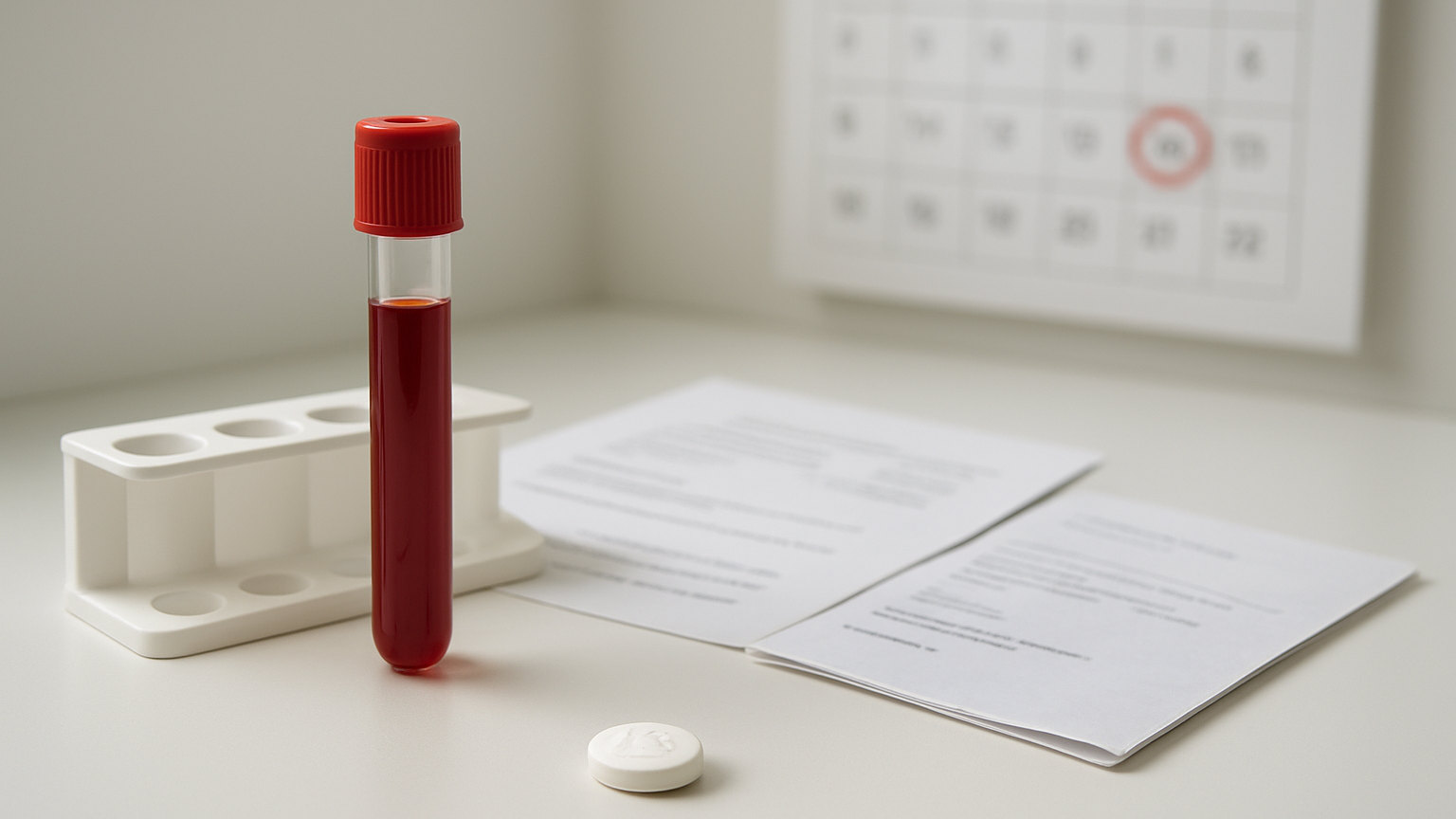
Many long-term medicines require periodic blood tests, and a prescription held up pending one is a safety mechanism rather than administrative friction. The tests generally check things that produce no symptoms until they are well advanced - kidney function, liver enzymes, blood counts, salts, thyroid levels, or the level of the drug itself. That is precisely why they are done on a schedule rather than when you feel unwell.
Book the test as soon as you are asked. It is the single most common reason repeats are delayed.
What is being checked, and why
Kidney function and salts. Required for ACE inhibitors, ARBs, diuretics, metformin, lithium and many others. Kidney function declines silently, and several medicines are cleared by the kidneys - so reduced function means the drug accumulates. Potassium matters too, since several of these push it up and a high level affects heart rhythm.
Liver enzymes. Checked for statins, methotrexate, some epilepsy medicines and others. Mild rises are common and rarely mean stopping; larger ones prompt a review.
Full blood count. Required for methotrexate, azathioprine, carbimazole and other medicines affecting the bone marrow. A falling white cell count leaves you vulnerable to infection before you notice anything.
Thyroid function. For levothyroxine, to confirm the dose is right, and for amiodarone and lithium, which can disturb the thyroid.
Drug levels. For lithium, digoxin, some epilepsy medicines and others with a narrow margin between effective and toxic. Timing relative to your dose matters here - ask when your dose should be taken on test day, because a sample taken at the wrong point gives a misleading result.
INR for warfarin, checking clotting.
HbA1c, blood pressure, cholesterol, eye and foot checks for diabetes - see our guide to diabetes medicines.
Vitamin B12 periodically for people on long-term metformin, which reduces absorption.
Why a repeat gets held until the test is done
It looks like the prescription is being withheld to force compliance. What is actually happening is that reauthorising a repeat is a clinical decision, and for these medicines it cannot be made without a current result - the whole purpose of the test is to detect a change you would not otherwise notice.
The practical answer is to book the test as soon as you are asked rather than when you are running low, and to allow a few days for results to reach the practice. If you will run short in the meantime, your pharmacist can often help while you wait.
Medicines that come with an alert card
Some medicines are issued with a card to carry: steroids, anticoagulants, lithium, methotrexate, and certain immune-suppressing drugs among them. Carry it, and show it in any medical setting - the card tells whoever is treating you something that changes what is safe to do, particularly in an emergency where you may not be able to explain.
Anyone on long-term steroid tablets should know that the dose may need increasing during serious illness or surgery, and that stopping abruptly is dangerous - covered in our guide to stopping a medicine.
Sick day rules
Certain medicines are paused during an illness involving vomiting, diarrhoea or fever severe enough to cause dehydration - typically some blood pressure tablets, diuretics, metformin and SGLT2 inhibitors. Others, notably steroids, may need increasing rather than pausing.
Ask your practice whether you have sick day rules and which medicines they cover. Knowing in advance is far better than trying to work it out while unwell.
The annual review
Anyone on several long-term medicines should have a structured review at least yearly. It is not a formality, and it is worth preparing for.
Take everything you actually take - including things bought over the counter, supplements and herbal products, which our guide to interactions explains matter more than people assume. Take your inhalers so technique can be checked. Take home blood pressure readings if you record them.
Questions worth asking:
- Is each of these still doing something I need?
- Could anything be stopped, reduced or simplified?
- What monitoring am I due, and when?
- Are any of these interacting with each other?
- What should I stop if I get a vomiting illness?
Deprescribing is part of good care
Lists accumulate. A medicine started appropriately years ago may no longer be needed, may have been intended as a short course, or may now be causing more trouble than benefit - particularly in older people, where the risks of several drugs together rise.
Asking whether something can come off is a reasonable and increasingly routine request. It is done in a planned way, one change at a time, with review.
If monitoring keeps getting missed
Ask the practice to put you on a recall system, and check whether your test can be booked at the same time each year alongside another appointment. If a prescription is refused pending a test, book the test rather than trying to get the prescription released - and if you are going to run short in the meantime, speak to your pharmacist, who can often supply an emergency quantity while you wait, as our guide to repeat prescriptions explains.
The Side Effects section covers more on side effects and safety - When You Are On Too Many Medicines is closely related to this one.


