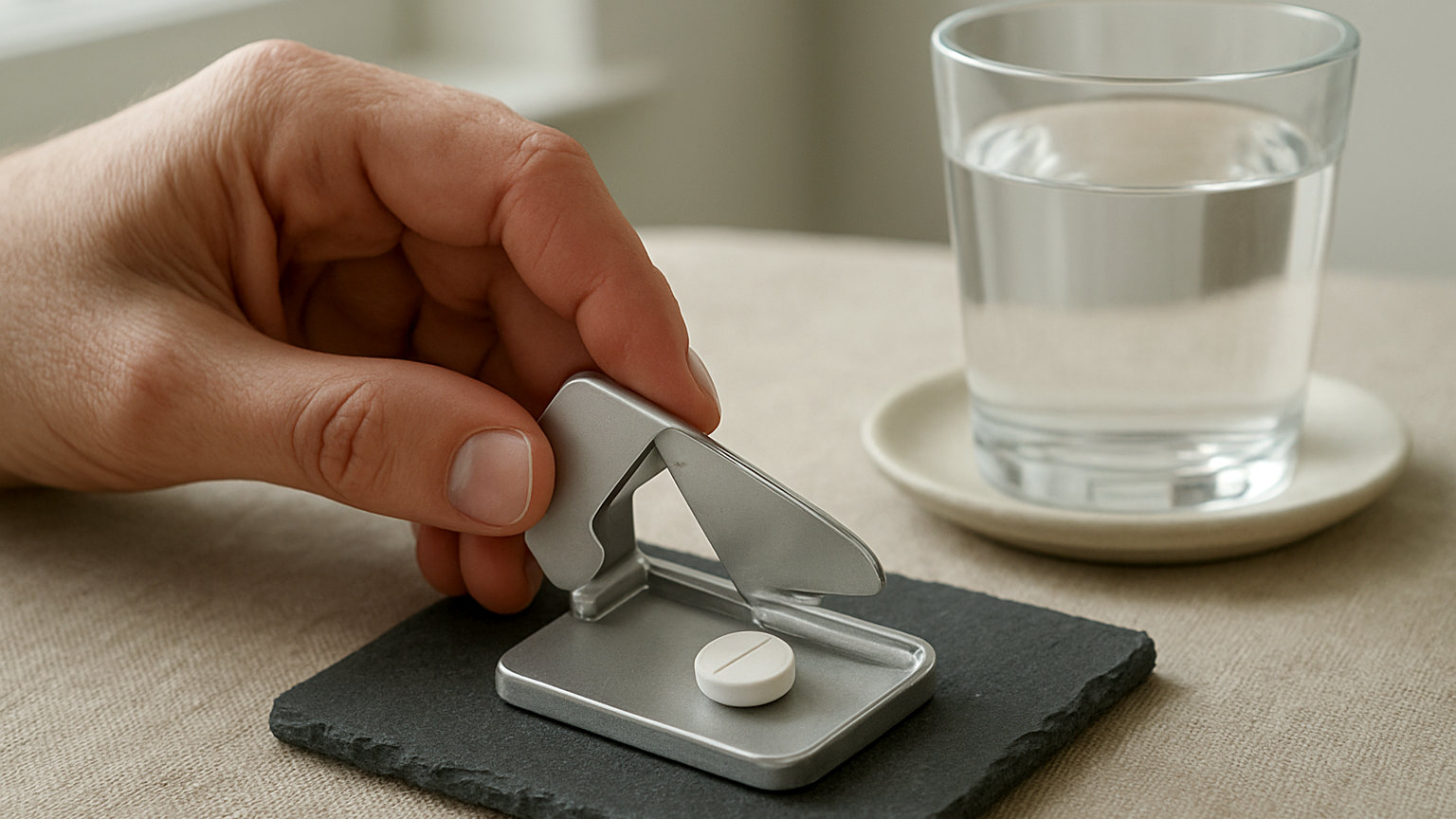
Some tablets can be safely split or crushed and some cannot. The ones that cannot include modified-release tablets, where crushing can deliver a whole day's medicine at once, and enteric-coated tablets, where the coating protects the drug from stomach acid or protects your stomach from the drug. A score line down the middle means a tablet is designed to be halved; the absence of one means nothing either way. The reliable answer for your specific medicine takes your pharmacist about a minute, and it is worth asking rather than guessing.
Why some tablets must stay whole
Modified-release. Look for MR, SR, XL, LA, CR, PR or Retard in the name. These are built to release the drug gradually over many hours, often so a once-daily tablet can replace three or four. The mechanism is physical - a matrix or a membrane - and crushing destroys it. The result is the entire day's dose absorbed at once, which for a blood pressure tablet can mean collapse and for an opioid can be life-threatening.
Enteric-coated. Often marked EC or "gastro-resistant". The coating stops the tablet dissolving until it is past the stomach, either because acid would destroy the drug or because the drug would irritate the stomach lining. Crush it and you lose the protection in whichever direction it was working.
Film-coated for taste or safety. Some coatings mask a genuinely unpleasant taste; some contain drugs that should not be handled or inhaled as powder, including certain hormone and cytotoxic medicines. Those should not be crushed by anyone, and particularly not by someone pregnant.
Capsules vary. Some can be opened and the contents sprinkled on soft food; others contain modified-release granules that must not be chewed. Do not assume.
Splitting: what a score line does and does not mean
A score line indicates the manufacturer intends the tablet to be divided, usually into halves. Even then, accuracy is imperfect - studies of tablet splitting consistently find real variation between the two halves, which matters most for drugs with a narrow margin between too little and too much.
Quartering a tablet scored only for halves is unreliable. Splitting a capsule or a coated tablet is not appropriate at all. And if you have been prescribed half a tablet, that is your prescriber's decision, not a licence to split anything else in the same way.
A tablet cutter from a pharmacy is more accurate and safer than a knife, and much safer than your teeth.
How to check yours
- Look at the name on the box for MR, SR, XL, LA, CR, PR or EC.
- Read the leaflet - there is usually a line about whether it can be halved, crushed or chewed.
- Ask your pharmacist. This is the reliable step, and it takes no appointment.
Never rely on what was true of a previous brand. Generic products differ in formulation, and one manufacturer's version may be splittable where another's is not - which is one of the practical reasons your tablets sometimes look different, covered in our guide to generic and branded medicines.
If swallowing tablets is the problem
Difficulty swallowing is common and under-reported, and improvising at home is the worst of the available options. There is almost always a better answer:
- a liquid, syrup or oral solution of the same drug
- a dispersible or orodispersible form that melts on the tongue
- a patch, injection or inhaled form for some medicines
- a different strength, so one smaller tablet replaces a larger one
- a licensed alternative in the same class that comes in an easier form
Technique helps too. Take tablets with a full glass of water rather than a sip, stay upright, and try the lean-forward method for tablets or the head-back method for capsules - your pharmacist can talk you through both.
Persistent difficulty swallowing, or food sticking, is worth reporting to your GP in its own right rather than only as a medicines problem.
Giving medicines to someone else
If you look after a relative and are crushing tablets into food, raise it with their pharmacist or GP. Crushing a medicine that was not designed for it is common in home care, usually well-intentioned, and one of the more frequent causes of avoidable harm. A pharmacist can review the whole list and often convert several items to forms that do not need crushing at all.
It is also worth asking whether every item is still needed. Simplifying a long list is usually easier than solving each tablet individually, and a medicines review exists for exactly this.
If you have already crushed something you should not have, and the person is drowsy, confused, breathing slowly or unwell, treat it as a possible overdose: call 111, or 999 if they are seriously unwell, and have the packaging to hand. Our guide to missed and doubled doses covers why acting early matters even when someone seems fine.
See also How to Remember to Take Your Medicine, and the Usage section for more on taking medicines day to day.