
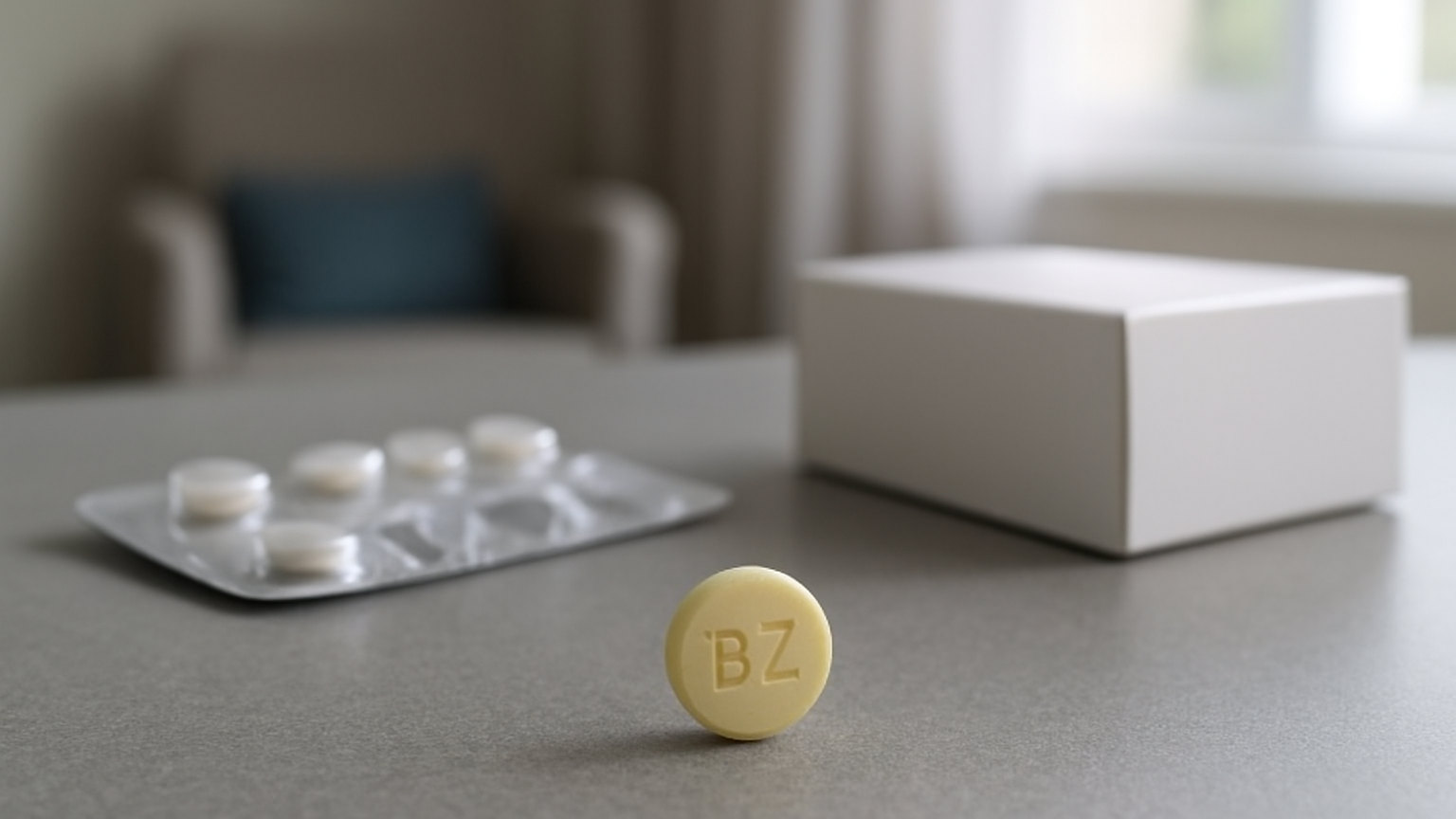
Buspirone is a partial agonist at serotonin 5-HT1A receptors, and it is unrelated to the benzodiazepines in structure and in behaviour. It reduces anxiety without sedation, without muscle relaxation, without impairing coordination and without causing dependence or withdrawal. The trade-off is that it does nothing immediately - and people expecting something that works like diazepam are reliably disappointed.
Follow the instructions on your label. This guide contains no doses.
It takes weeks
Buspirone needs two to four weeks of regular dosing before benefit appears, sometimes longer.
That is the single most important thing to know about it, because there is no perceptible effect from an individual dose - so someone taking it for a fortnight and concluding it does nothing has stopped during the period when it was starting to work.
It is taken regularly, several times a day, not when you feel anxious.
It is not for panic attacks
Because it has no acute effect, buspirone is useless taken during a panic attack, and it is not effective for panic disorder generally.
Its licensed use is generalised anxiety disorder - the persistent, background, worrying kind rather than acute episodic surges.
It does not help benzodiazepine withdrawal
This is a specific and frequently made mistake. Buspirone does not act on GABA receptors, so it does not substitute for a benzodiazepine and does not relieve withdrawal symptoms.
Someone switched abruptly from a benzodiazepine to buspirone will experience full withdrawal.
Worse, people who have previously taken benzodiazepines tend to respond less well to buspirone, possibly because they are expecting a sedating effect that never comes.
Coming off a benzodiazepine is done by gradual reduction of that drug - see clonazepam and lorazepam.
What it avoids
The reasons buspirone is worth considering are largely about what it does not do:
- No dependence, tolerance or withdrawal
- No sedation - so no next-day grogginess and far less impact on driving
- No memory impairment and no added falls risk in older people
- No interaction with alcohol in terms of sedation, though alcohol still worsens anxiety over time
- Few sexual side effects, unlike SSRIs - it is occasionally added to an antidepressant partly for this
For an older person with anxiety where a benzodiazepine would mean falls and confusion, that profile is genuinely useful - see medicines and your memory.
Where it sits
Buspirone is second-line in UK practice. An SSRI or SNRI, alongside psychological therapy, remains first choice for generalised anxiety disorder.
Buspirone is used where those have not worked or are not tolerated, or as an addition.
Its effect size is modest, and it works less well for severe anxiety.
See escitalopram and duloxetine.
Psychological therapy does more
Cognitive behavioural therapy has better long-term outcomes for anxiety than any medication, and crucially the benefit persists after treatment ends - which is not true of drugs.
You can usually self-refer to NHS talking therapies without going through your GP.
Grapefruit
Buspirone is cleared by CYP3A4, and it has poor bioavailability to start with because most of a dose is destroyed on first pass through the liver.
Grapefruit juice can raise buspirone levels severalfold, since blocking that enzyme removes the first-pass barrier.
Avoid grapefruit and grapefruit juice - see grapefruit and medicines.
The same applies to clarithromycin, erythromycin, some antifungals and HIV boosters - see erythromycin.
Rifampicin and carbamazepine reduce levels substantially, which can make it ineffective.
Take it consistently with regard to food
Food increases buspirone absorption by reducing first-pass metabolism.
The instruction is to take it consistently - either always with food or always without - rather than varying, since switching changes how much reaches you.
Side effects
Dizziness is the commonest, particularly early. Headache, nausea, nervousness and light-headedness.
Excitement or restlessness occurs in some people.
Buspirone has serotonergic activity, so combining it with other serotonergic medicines carries a risk of serotonin syndrome - see serotonin syndrome. Monoamine oxidase inhibitors are contraindicated.
Stopping it
Buspirone can be stopped without a taper, since there is no physical dependence - one of its clearest advantages.
The anxiety it was treating may return, which is a different matter from withdrawal.
Why it is not more widely used
Buspirone has been available for decades and remains a niche choice, which is partly about its modest effect size and partly about expectation.
A drug that does nothing perceptible for a month, must be taken several times a day, and never produces the immediate relief people associate with anxiety treatment is a hard sell - even though those same properties are exactly why it carries no dependence risk.
What else helps
Reducing caffeine and alcohol both make a measurable difference to anxiety and are frequently overlooked. Regular exercise has reasonable evidence.
If you are struggling, Samaritans are free on 116 123 at any hour, or you can text SHOUT to 85258.
See also Temazepam: A Sleeping Tablet With Limits, and the Conditions section for more on what medicines are prescribed for.


