
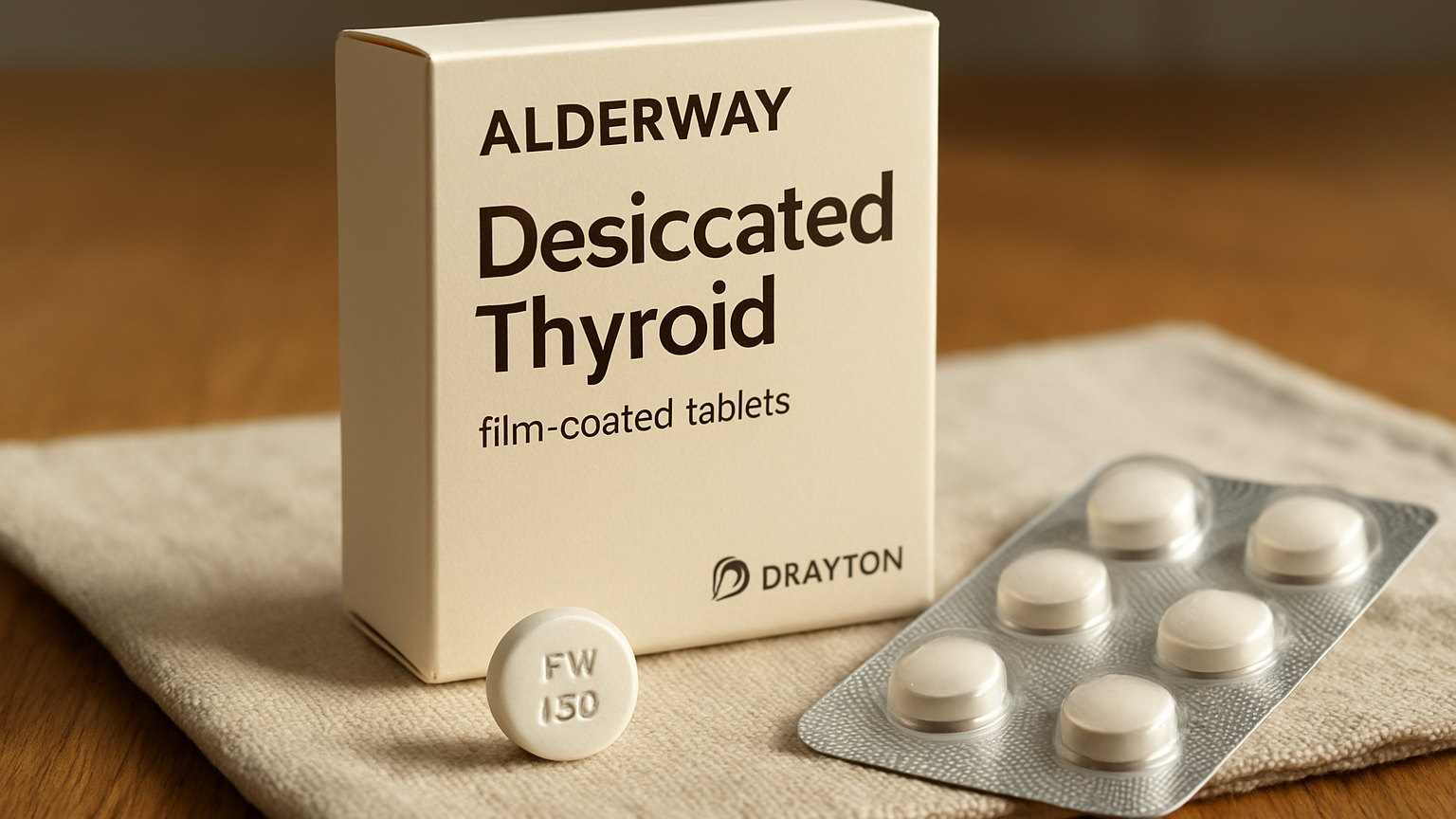
Desiccated thyroid extract - often called natural desiccated thyroid or NDT - is made from dried pig thyroid gland and contains both T4 and T3. It has been used for over a century, it is promoted heavily online, and a great many people who remain unwell on levothyroxine want to try it. It is not licensed as a medicine in the UK and is not recommended in UK guidance. The objections are specific rather than reflexive, and they are worth understanding whichever conclusion you reach.
Follow the plan your prescriber gave you. This guide contains no doses.
The hormone ratio is not human
Pig thyroid contains roughly four parts T4 to one part T3. A human thyroid produces around fourteen parts T4 to one part T3.
So desiccated thyroid delivers considerably more T3, proportionally, than a human gland does. That is not automatically wrong, but it is not the physiological replacement it is often described as - and the extra T3 is what produces the peaks and the cardiac and bone risks below.
The marketing language of "natural" and "body-identical" does not survive contact with that arithmetic.
Consistency
Licensed medicines are manufactured to tight specifications with batch testing and regulatory oversight. Unlicensed products are not held to the same standard, and historical variability in potency between batches is documented.
For a hormone where small differences in dose produce measurable effects, that inconsistency matters more than it would for many drugs.
Products bought online from outside the UK carry an additional problem: no assurance of what is actually in them.
Monitoring becomes difficult
T3 has a short half-life, so blood levels peak and fall through the day. Results depend heavily on when the last dose was taken, and TSH is frequently suppressed on T3-containing treatment.
That makes interpreting thyroid function tests considerably harder, and a suppressed TSH is itself associated with atrial fibrillation and bone loss over time.
Our guide to liothyronine covers the same issues for pure T3, including the evidence on combination therapy - which, taken together, has not shown consistent benefit over levothyroxine alone.
The risks of too much thyroid hormone
Excess causes palpitations, tremor, sweating, anxiety, weight loss and insomnia, and over time raises the risk of atrial fibrillation and bone thinning.
Those risks are greater with T3-containing preparations because of the peaks, and greater again in older people and anyone with heart disease.
Report palpitations, tremor, unexplained weight loss or chest pain. See atrial fibrillation and medicines and bone health.
Combination products
Some products combine desiccated thyroid with other ingredients, and others marketed as "thyroid support" or "glandular" supplements contain thyroid hormone without declaring it clearly.
Those are a particular problem, because someone taking one alongside prescribed levothyroxine can end up considerably over-replaced without either party knowing why the results look odd. If you take any supplement aimed at thyroid function, bring the bottle to your appointment - see supplements that interfere with your medicines.
Tell your GP if you take it
This is the practical request. People frequently obtain desiccated thyroid privately or online and do not mention it, either because they expect disapproval or because they do not think of it as a medicine.
The consequence is that nobody can interpret your thyroid results, and nobody knows what you are taking if you become unwell.
Telling your GP does not oblige you to stop. It allows monitoring to be meaningful, and it puts the information on your record where it belongs.
Buying it online
Because it cannot be prescribed on the NHS, most people who take desiccated thyroid obtain it privately or from overseas websites.
That means no prescriber oversight, no assurance of content, and no route to report a problem. It also means a supply that can disappear without notice, and stopping thyroid replacement abruptly is not a small event - see checking an online pharmacy is legitimate.
Why people want it
Because a substantial minority of people on levothyroxine continue to feel tired, foggy and low despite results in range. That experience is real and the frustration is legitimate.
What is worth doing before concluding the thyroid treatment is at fault:
- Check how the levothyroxine is being taken - timing relative to food, coffee, calcium, iron and acid-reducing medicines makes a large difference. See levothyroxine.
- Exclude anaemia, low B12, low vitamin D and coeliac disease, all common alongside autoimmune thyroid disease - see cyanocobalamin.
- Consider sleep apnoea, which causes exactly these symptoms and is frequently missed.
- Consider depression, which overlaps almost completely.
- Review other medicines - see why your medicine makes you tired.
Asking for those to be excluded properly is a more productive route than a product with no regulatory oversight - and if they have all been done and you are still unwell, that is a stronger basis for a specialist referral.
Lamivudine: HIV, Hepatitis B and the Stopping Risk covers a related point, and the Medicines section has the rest of these guides.


