
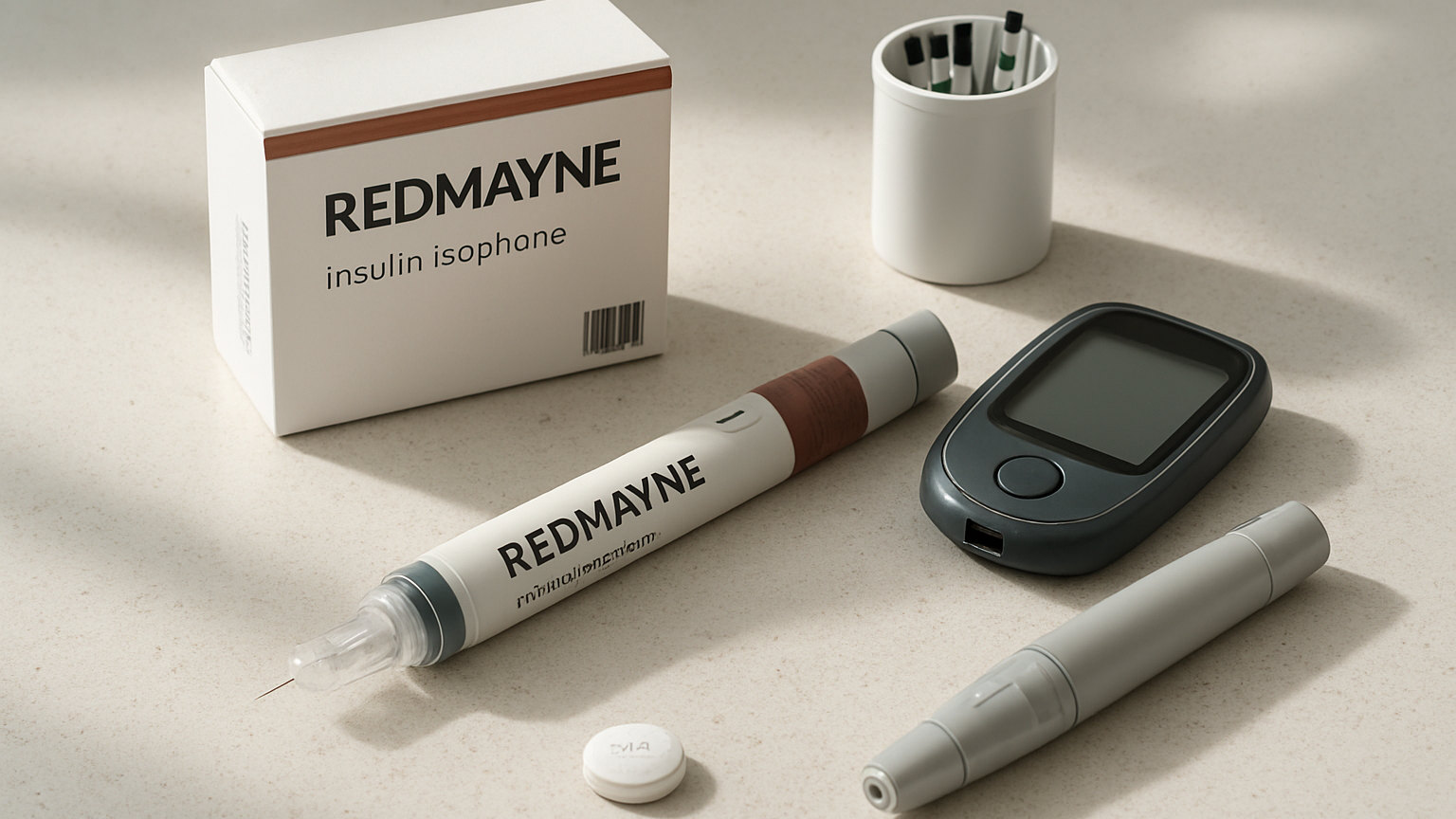
Insulin isophane - also called NPH - is an intermediate-acting insulin. Protamine and zinc are added so that it forms a suspension of crystals that dissolve slowly after injection, giving an onset of an hour or two, a peak at around four to six hours, and a duration of twelve to eighteen. Two things distinguish it from the modern analogues, and both have practical consequences: it is cloudy and must be mixed before every dose, and it has a pronounced peak.
Follow the plan your diabetes team gave you. This guide contains no doses.
Resuspending it properly
Isophane is a suspension, and it separates on standing - the crystals settle and clear fluid sits above them.
Injecting without mixing delivers either mostly liquid or mostly crystal, so the dose bears little relation to the number you dialled. This is a genuine and common cause of unexplained glucose swings.
Before every dose, roll the pen gently between your palms and tilt it up and down repeatedly - most manufacturers specify around ten to twenty cycles - until the liquid is uniformly cloudy with no clumps or clear layer.
Do not shake vigorously, which damages the insulin and creates bubbles.
Look at it. If it is not evenly milky, keep mixing. If you can see clumps or a frosted appearance on the cartridge wall, discard it.
The peak matters
Glargine and degludec are essentially flat. Isophane peaks at four to six hours, which has two consequences.
A dose taken at bedtime peaks in the middle of the night, which is why nocturnal hypoglycaemia is more common with isophane than with the long-acting analogues.
And the peak means it must be matched to food - it cannot be treated as pure background cover in the way a flat insulin can.
This is the main reason the analogues largely displaced it. See insulin glargine and insulin degludec.
Where it still fits
It is considerably cheaper, which matters globally and increasingly in the UK.
It has the longest safety record of any insulin, and is widely used in pregnancy, where experience with it is greatest.
It is often given twice daily, and the peak can be useful where it aligns with a predictable meal pattern.
Biphasic mixes
Isophane is also the slow component of premixed biphasic insulins, which combine it with a rapid-acting insulin in fixed proportions in one pen.
These suit people who cannot manage multiple daily injections, and they are simpler - but the fixed ratio means the mealtime and background components cannot be adjusted separately, so meals need to be reasonably consistent in timing and size.
Mixes are cloudy too and need resuspending exactly as above.
The numbers in the product name describe the proportion of rapid-acting insulin, and products with different ratios are not interchangeable. Check what you have been given.
Recognising and treating a hypo
Sweating, trembling, hunger, palpitations, anxiety and tingling lips, progressing to confusion, slurred speech and difficulty concentrating.
Treat immediately with fast-acting carbohydrate - glucose tablets or a sugary drink - then follow with longer-acting carbohydrate.
With isophane, the timing of the peak means a hypo several hours after the dose is the pattern to anticipate, including overnight. A bedtime snack is sometimes advised.
Report hypoglycaemia unawareness - losing the early warning symptoms. It is reversible and it affects driving eligibility.
Beta blockers mask the warning signs - see bisoprolol.
Injection sites
Rotate systematically, moving a couple of centimetres each time. Repeated injection into one spot causes lipohypertrophy - a painless lump from which absorption is erratic and reduced.
Moving to healthy tissue delivers considerably more insulin, so doses often need reducing. Feel your sites and ask for them to be checked at review. Use a new needle each time.
Never stop insulin when unwell
Illness raises glucose even if you are eating less, and stopping insulin in type 1 diabetes leads to ketoacidosis.
Continue your insulin during illness, check glucose more often, test for ketones and keep drinking.
Seek urgent help for ketones rising, persistent vomiting, rapid deep breathing or confusion - see sick day rules.
Storage and safety
Unopened pens in the fridge, never frozen. In use, at room temperature for a set number of weeks then discarded - write the date on the pen.
Never draw insulin from a pen with a syringe, and check you have the right pen - cloudy and clear insulins from the same manufacturer often have similar packaging, and the cloudy appearance is itself a useful check that you have the right one.
Used needles go in a sharps bin - see needles and sharps disposal.
Dulaglutide: A Weekly GLP-1 Injection covers a related point, and the Medicines section has the rest of these guides.


