
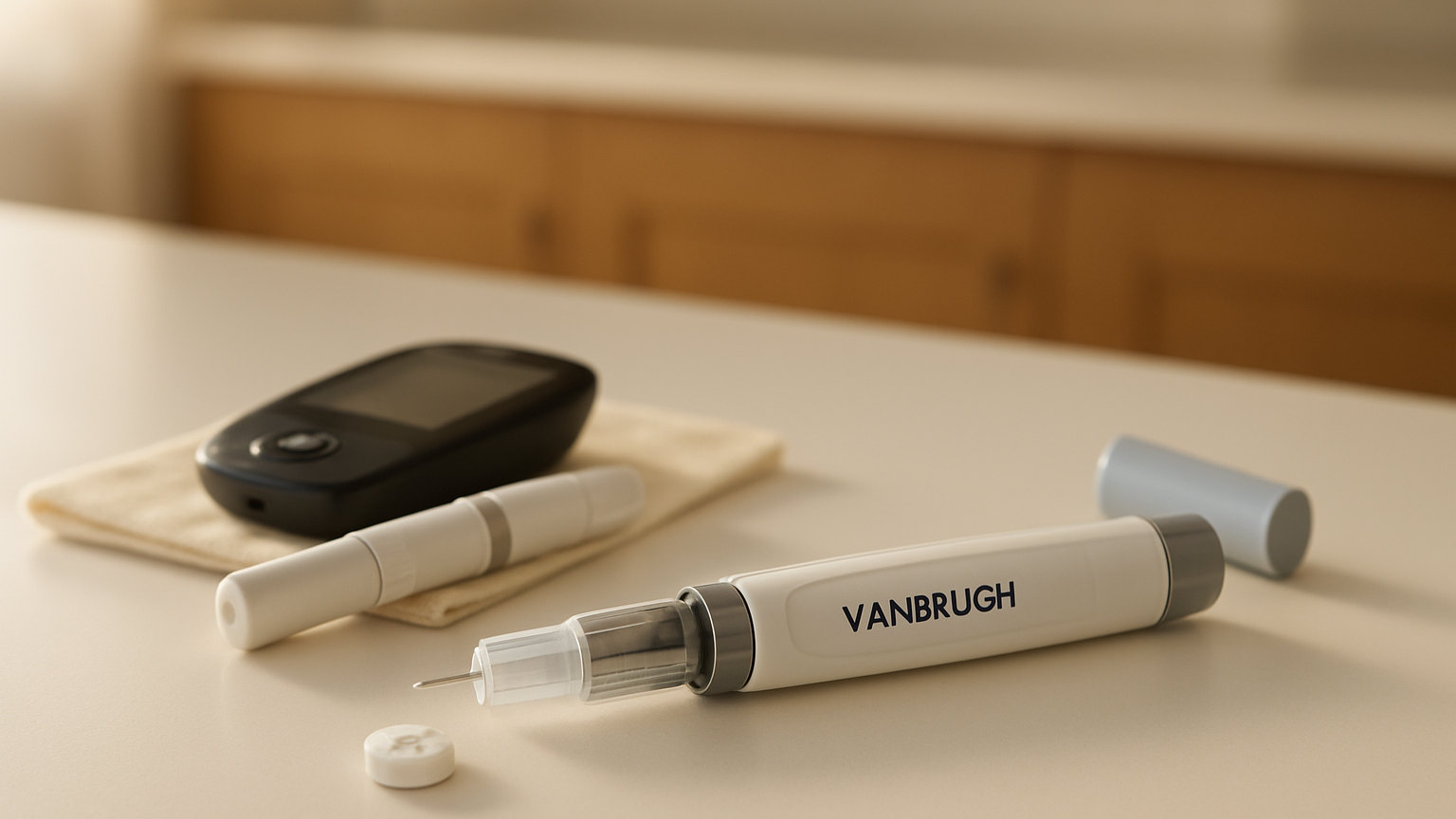
Insulin lispro is a rapid-acting analogue, engineered by swapping two amino acids so the molecules separate quickly after injection rather than clumping. It works within about fifteen minutes, peaks at one to two hours and is largely gone by four to five. It is used as mealtime insulin by pen, and it is the insulin most commonly used in insulin pumps - a setting that changes the safety picture considerably.
Follow the plan your diabetes team gave you. This guide contains no doses.
Pumps have no safety net
Someone on injections has a long-acting background insulin working for many hours. Someone on a pump has only rapid-acting insulin, delivered continuously in small amounts.
If delivery stops - a blocked or kinked cannula, a dislodged set, an empty reservoir, an air bubble, or the pump detaching - insulin ceases within minutes and there is nothing in reserve.
Ketones rise and ketoacidosis can develop within a few hours, far faster than on injections.
If your glucose is unexpectedly high and does not come down after a correction bolus, do not simply bolus again. Give insulin by pen or syringe, change the whole infusion set, and test for ketones.
Always carry a spare pen or syringe and insulin. A pump failure without backup insulin is a genuine emergency.
Seek urgent help for ketones rising, vomiting, abdominal pain, rapid deep breathing or confusion.
Changing the set
Infusion sets are changed every two to three days as directed. Leaving one in longer raises the risk of blockage, infection and erratic absorption.
Rotate sites systematically, and feel your sites - lipohypertrophy under a frequently used area causes unexplained highs that look like pump failure.
Report redness, pain or pus at an infusion site.
Change the set before bed only if you can check afterwards - a failure discovered eight hours later is the classic route to overnight ketoacidosis.
Timing with meals
Injected at the first mouthful, rapid-acting insulin arrives slightly late, since food raises glucose within minutes.
Most people are advised to bolus around fifteen minutes before eating, which improves post-meal glucose considerably.
Exceptions: if glucose is already low, if intake is uncertain, or with a young child.
Faster formulations of lispro exist, absorbed more quickly, which reduces the need for that pre-meal gap and suits pump users in particular.
Do not stack doses
Lispro keeps working for four to five hours. Correcting two hours after a meal, while the mealtime dose is still active, is the commonest way people go low.
Pumps and smart pens calculate insulin still on board automatically. Without one, it is a matter of waiting long enough before correcting.
Persistent highs two hours after meals usually mean the mealtime dose or timing needs adjusting rather than a top-up.
See insulin aspart, which behaves almost identically.
Concentration
Lispro is available at 100 units per millilitre and at 200 units per millilitre - twice as concentrated, in a pen that delivers the correct number of units.
The device handles the difference. The danger is drawing insulin out of a pen with a syringe, which would deliver double.
Never draw insulin from a pen with a syringe. If a pen fails, contact your team or pharmacy.
Biosimilar insulins
Biosimilar versions of insulin lispro are available and widely used. They are highly similar rather than identical, and are approved on evidence of equivalent effect.
What usually changes on a switch is the device - different pens have different dialling mechanisms, click feedback and dose increments.
If your product changes, ask to be shown the new pen rather than assuming it works the same way. Errors at a switch come from the device, not the insulin.
See why some medicines are prescribed by brand.
Hypoglycaemia
Sweating, trembling, hunger, palpitations, anxiety and tingling lips, progressing to confusion and slurred speech.
Treat immediately with fast-acting carbohydrate, then follow with longer-acting carbohydrate. Carry treatment at all times, and make sure glucagon is available at home with someone who knows how to give it.
Report hypoglycaemia unawareness - it is reversible and affects driving eligibility. See medicines and driving.
Exercise increases sensitivity for many hours afterwards, and alcohol causes delayed hypoglycaemia overnight.
Carbohydrate counting
Matching the dose to the carbohydrate in a meal gives far better control and far more dietary freedom than fixed doses.
Structured education courses teach this and are free on the NHS. If you have never been offered one, ask - the difference is substantial.
Fat and protein slow absorption, which is why a high-fat meal raises glucose later and for longer.
Storage
Unopened in the fridge, never frozen. In use, at room temperature for a set number of weeks then discarded - write the date on it.
Used needles and sets go in a sharps bin - see needles and sharps disposal.
Glipizide: A Shorter-Acting Sulfonylurea covers a related point, and the Medicines section has the rest of these guides.


