
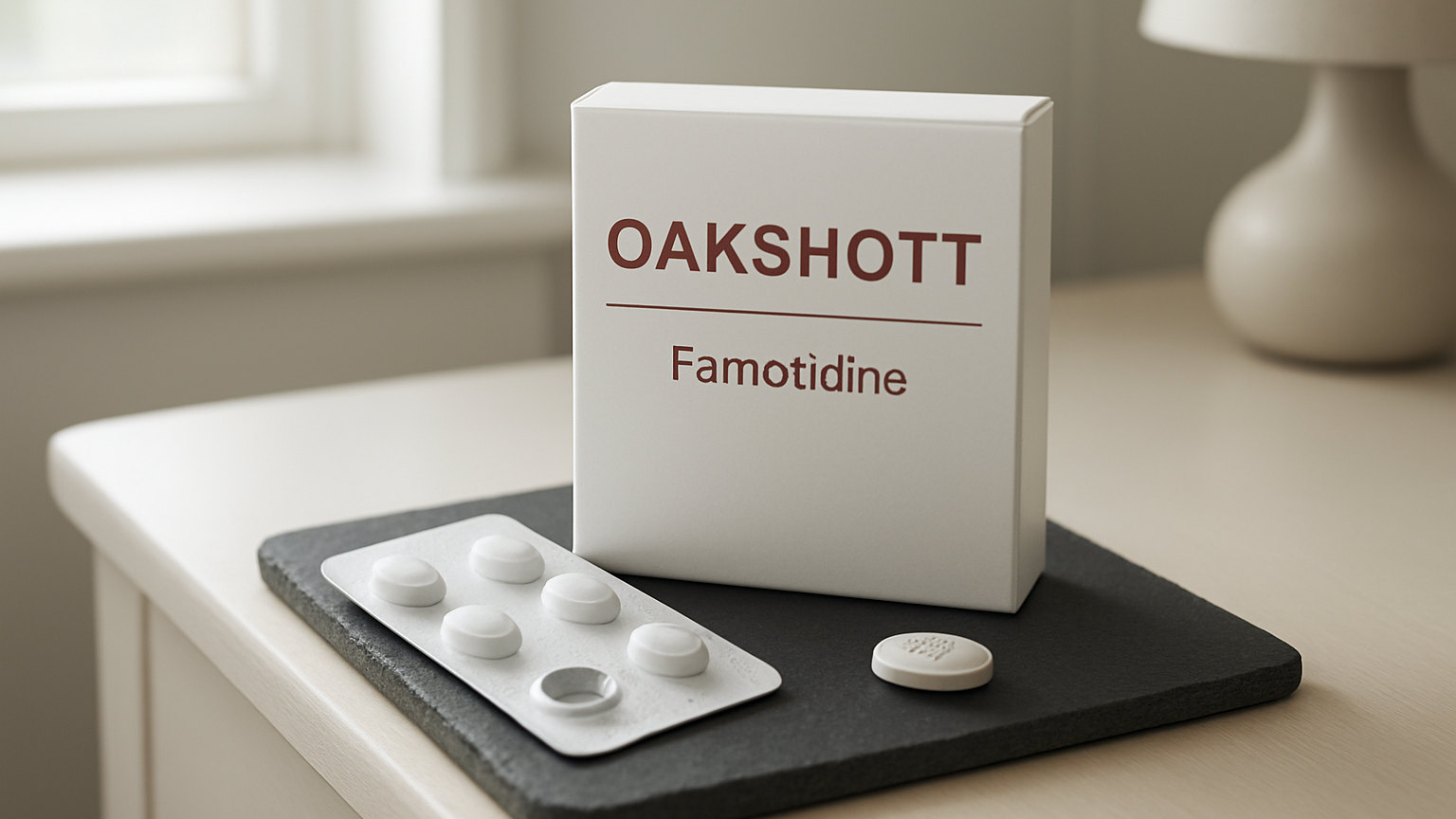
Famotidine is an H2 receptor antagonist. It blocks histamine receptors on the acid-producing cells of the stomach, reducing acid output - a different mechanism from proton pump inhibitors, which switch off the pumps themselves. Famotidine became far more widely used after ranitidine was withdrawn from markets worldwide in 2019 and 2020, and a great many people were moved onto it without much explanation of how the two classes differ.
Follow the instructions on your label. This guide contains no doses.
What happened to ranitidine
Ranitidine was withdrawn after testing found N-nitrosodimethylamine, a probable human carcinogen, in products - and evidence that levels could increase over time and with storage.
It was a manufacturing and stability problem rather than an inherent property of blocking H2 receptors, which is why famotidine remains available and widely used. If you were switched at that point, that is why.
How it compares with a proton pump inhibitor
Speed. Famotidine works within about an hour. A proton pump inhibitor takes a day or more to reach full effect, and several days for the full benefit.
Strength. PPIs suppress acid considerably more and for longer, and they heal oesophagitis and ulcers more reliably.
Duration. Famotidine lasts around half a day, so it is often taken twice; a PPI lasts through the day from a single morning dose.
Tolerance. This is the important one - the effect of H2 blockers diminishes with continuous use over days to weeks as receptors adapt. PPIs do not lose effect this way. That is why famotidine suits intermittent use better than daily long-term use.
Our guides to omeprazole and lansoprazole cover the PPI class.
Where famotidine still fits
- Occasional heartburn, where something that works within the hour is more useful than something that works by tomorrow.
- Night-time symptoms, sometimes added at bedtime alongside a daytime PPI.
- People who cannot take a PPI, through intolerance or interaction.
- Where a PPI would interact - famotidine does not meaningfully affect clopidogrel, which omeprazole does.
- Stepping down from a PPI, as part of coming off it.
That last one is genuinely useful. Rebound acid after stopping a PPI is the main obstacle to getting off it, and an H2 blocker can cover the gap.
Side effects
Famotidine is well tolerated. Headache, dizziness, constipation and diarrhoea are the common complaints, all uncommon.
Confusion can occur in older people and in those with reduced kidney function, where levels rise. The dose is adjusted in kidney impairment - see medicines that affect your kidneys.
Unlike cimetidine, an older drug in the same class, famotidine does not inhibit liver enzymes and so has very few drug interactions. That is a real advantage for anyone on a long list.
What reduced acid means generally
Stomach acid helps release vitamin B12 from food and aids absorption of iron and calcium, and it is part of your defence against swallowed bacteria.
Those consequences are better documented with PPIs, which suppress acid more, but the principle applies. If you have been on acid suppression for years, B12 is worth checking - see cyanocobalamin.
Red flags
See your GP rather than self-treating if you have difficulty swallowing, food sticking, unintentional weight loss, persistent vomiting, vomiting blood or material like coffee grounds, black tarry stools, or new indigestion starting over the age of 55.
Acid suppression masks symptoms, which is the main risk of buying it indefinitely over the counter - see warning signs you should not ignore.
Before tests
H2 blockers, like PPIs, can produce a false negative on testing for H. pylori and should be stopped for a period beforehand. Follow the instruction you are given rather than assuming it applies only to PPIs.
Antacids and alginates
Antacids neutralise acid already present and work in minutes, and alginates form a raft on top of the stomach contents to reduce reflux. Both are useful for immediate relief and neither reduces acid production.
They are worth knowing about as part of a step-down plan. But antacids interfere with the absorption of several medicines, so they need separating - see over-the-counter interactions and medicines, milk and dairy.
Where the two classes are combined
Adding an H2 blocker at bedtime alongside a daytime proton pump inhibitor is sometimes used for stubborn night-time symptoms, on the reasoning that acid production overnight is driven partly through the histamine pathway.
It is not a routine combination and the evidence is modest, partly because of the tolerance problem - the added benefit tends to fade over weeks. If it has been on your list for years, it is worth asking whether it is still doing anything.
What helps without a tablet
Smaller meals, not eating late, raising the head of the bed, losing excess weight, and reducing alcohol and smoking. Unglamorous, effective, and what makes stopping possible.
If this was useful, Metoclopramide: Why It Is Limited to Short Courses is worth reading next, and Medicines collects the rest.


