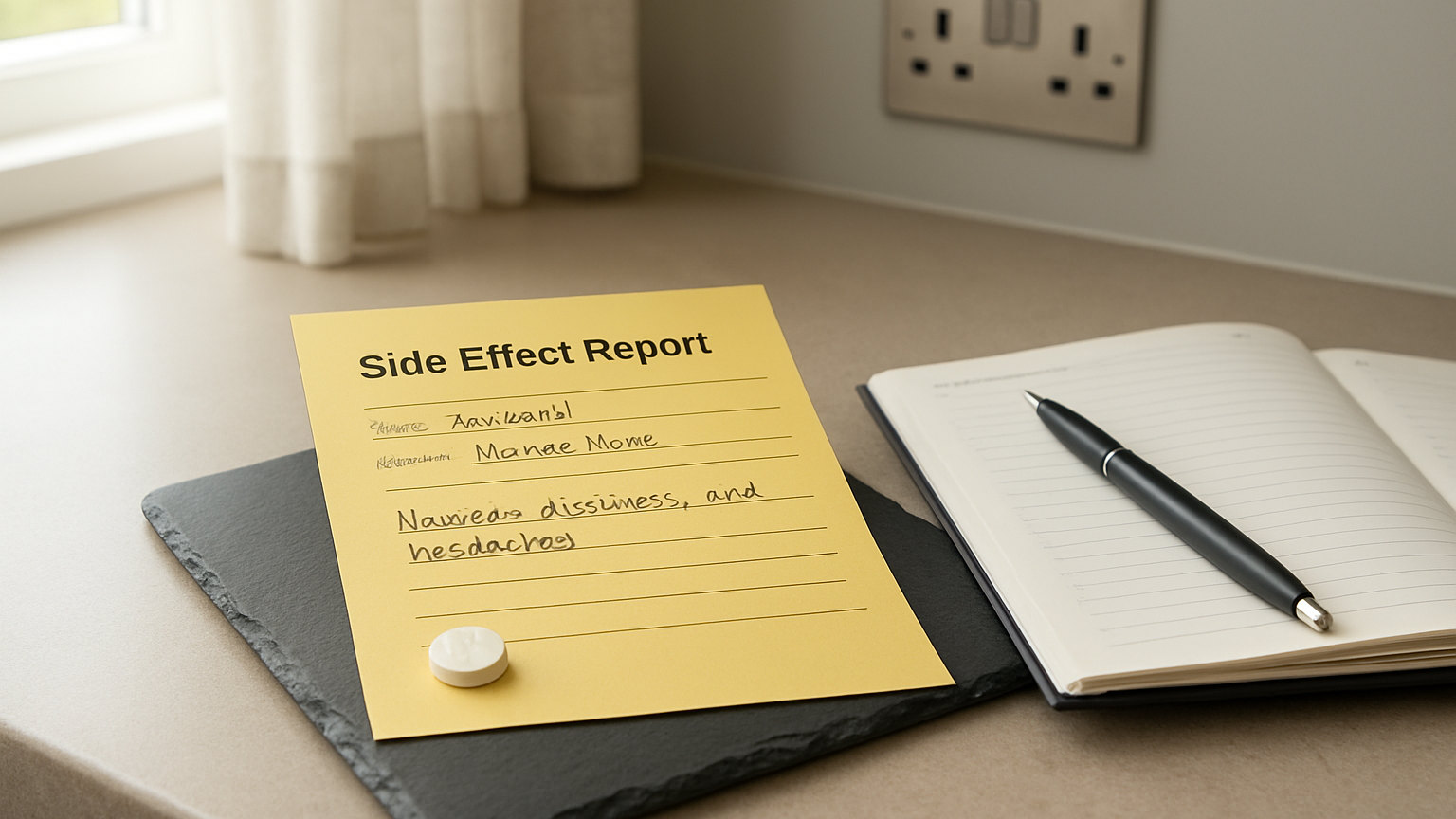
Describing a side effect well is a skill, and it is not about medical vocabulary. What determines whether anyone can act on it is the timing, the pattern and what changed - and those are things only you know. A vague account of a real problem frequently gets filed as nothing; a precise account of the same problem gets acted on.
Timing is the most valuable thing
Nearly every judgement about whether a medicine is responsible turns on the sequence.
Say: when the medicine started or the dose changed, and when the symptom began relative to that.
"This started about ten days after the dose went up" is worth more than any amount of description, because it is the one thing that distinguishes a drug effect from a coincidence.
Note whether it began before the medicine, which points away from it - though the medicine may still be making something worse.
Memory reconstructs timelines in a predictable direction, so write it down as it happens rather than recalling it at an appointment.
See keeping a side effect diary.
Be specific about words that sound similar
Several everyday words cover very different things, and choosing between them narrows the possibilities considerably.
Dizzy - do you mean light-headed as though you might faint, or the room spinning, or unsteady on your feet? Those point to blood pressure, the inner ear and balance respectively.
Tired - sleepy and struggling to stay awake, or physically weak, or mentally foggy?
Sick - nauseated, or actually vomiting?
Rash - flat or raised, itchy or sore, blistering, where it started and how it spread.
Breathless - on exertion, at rest, or lying flat?
Palpitations - fast, irregular, pounding, or skipped beats?
You are not expected to diagnose. Describing what you actually experience is exactly what is needed.
Pattern and severity
How often - constant, daily, a few times a week.
When - shortly after a dose, in the mornings, overnight, on standing.
How long each episode lasts.
What makes it better or worse - food, standing, rest, a skipped dose.
What it stops you doing. This is the measure clinicians act on most readily. "I have stopped walking to the shop" carries more weight than "quite bad", because it is concrete and it can be tracked.
Numbers help: how many times a night, how many days out of seven, how far you can walk.
Bring the whole list
Include everything, not just the medicine you suspect.
Prescribed medicines, hospital and private prescriptions, anything bought over the counter, supplements, herbal products and anything obtained online.
Bring the actual boxes where you can. Strengths and formulations matter, and the record frequently differs from what you are taking.
Mention alcohol, cannabis or CBD honestly - these are asked about for safety and they genuinely change the assessment.
Photographs and readings
A rash will have changed by the time you are seen. Photograph it, with something for scale, in daylight.
Home blood pressure readings, blood glucose logs and weight records are all useful, provided the device is validated and the technique is right.
A short video is occasionally the best evidence for a tremor, a movement problem or breathlessness.
Say what you want from the conversation
Worth stating plainly at the start, because it shapes everything.
"I want to know whether this is the tablet" is a different request from "I want to stop this" or "I can live with it but I want to know it is safe".
Being direct about it avoids a consultation where you are reassured and leave without the thing you came for.
Useful closing questions: is this a recognised effect; will it settle; is there an alternative; what should make me come back?
See questions to ask about a new medicine.
If it is not in the leaflet
Say so, and say it anyway.
Leaflets list what has been found so far, not everything that exists, and unlisted effects are the most valuable to report.
See when a side effect is not in the leaflet.
Writing a Yellow Card report
The same principles, with a few additions.
Give the medicine by generic name, plus the brand and batch number if known - the batch matters for vaccines and biologics.
Give dates for starting, for the symptom and for stopping.
Say what happened when the medicine stopped, and whether it returned on restarting. That sequence is close to definitive.
Include age, other conditions and everything else being taken.
Anyone can report - the person affected, a relative, a carer or a professional.
See how the Yellow Card scheme works and reporting on behalf of someone else.
Where description matters most
When someone cannot describe things themselves - through dementia, a learning disability, confusion or very young age - a carer's account of behaviour is the whole evidence base.
"Stopped getting out of the chair" is more useful than "seemed low".
See side effects in older people.
The Side Effects section covers more on side effects and safety - Reporting a Medication Error is closely related to this one.