Topical treatment fails more often through under-use than through anything wrong with the medicine. People are told creams are absorbed and become anxious, so they apply a thin smear, use it for three days, and conclude it did not work. The amounts that are actually needed are considerably larger than most people expect, and there is a straightforward way to measure them.
Fingertip units
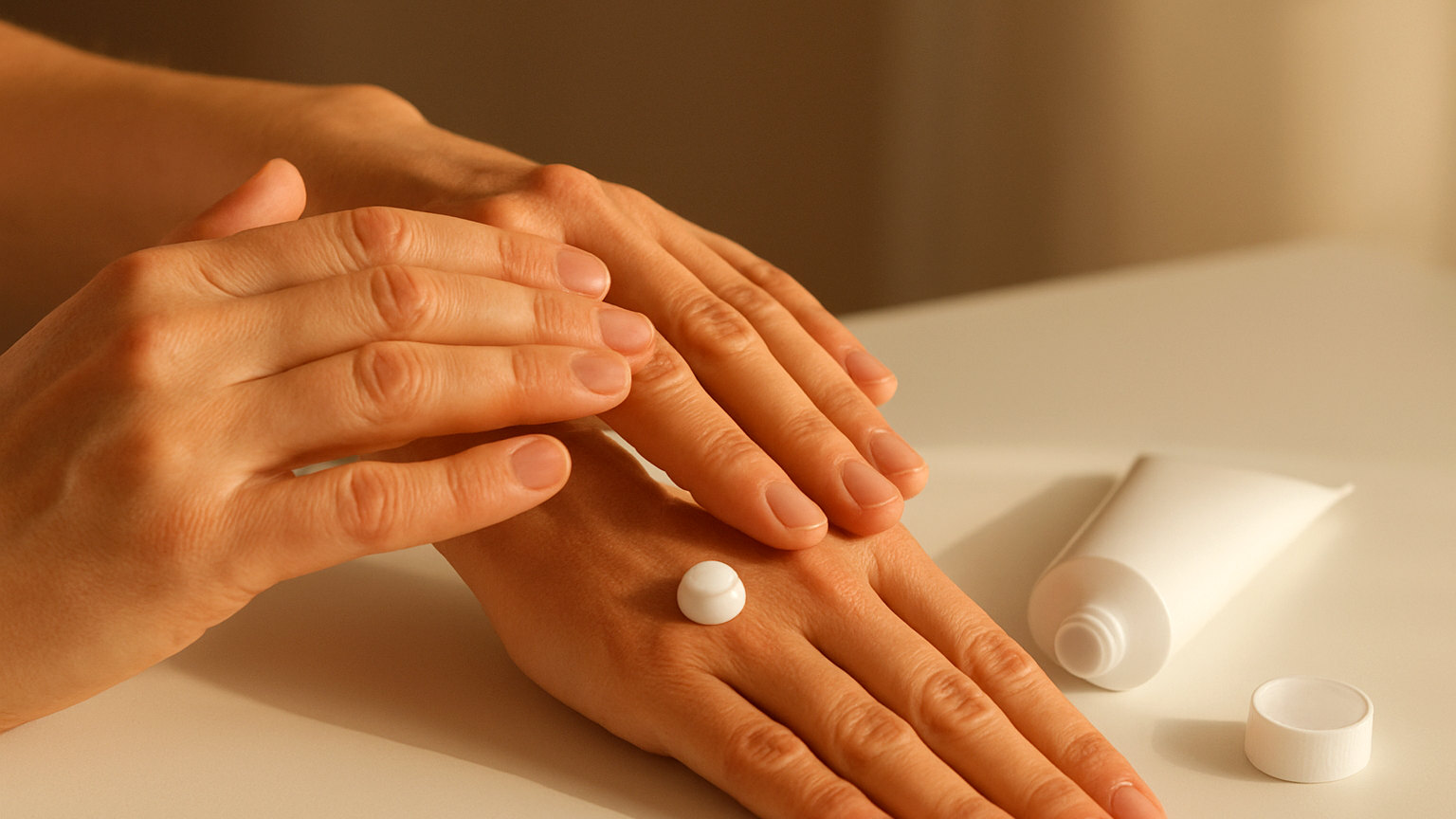
A fingertip unit is the amount of cream or ointment squeezed from a standard tube along an adult index finger, from the tip to the first crease.
It is a practical measure rather than an exact one, and it is what dermatology guidance uses.
Roughly, one fingertip unit covers an area about the size of two flat adult hands including the fingers.
Typical amounts for one application in an adult run to around one unit for the face and neck, a couple for one hand and arm, several for a leg, and considerably more for the trunk front and back.
Ask for the number of units for your specific areas - it makes the difference between treating and gesturing at the problem.
Children need proportionally less, and there are age-based charts.
How to apply
Apply in the direction of hair growth, in a smooth downward stroke, rather than rubbing in circles. Rubbing against the hair pushes product into follicles and causes folliculitis - small red spots that get mistaken for the condition worsening.
Do not rub vigorously. Smooth it on and let it absorb.
Apply to slightly damp skin after washing where an emollient is concerned, which helps trap moisture.
Wash your hands afterwards unless you are treating the hands - transferring a potent steroid or a hormone gel to the face, eyes or another person is a real and avoidable problem.
Cream, ointment or lotion
The base matters as much as the active ingredient.
Ointments are greasy, contain little or no water, and are the most effective at holding moisture in. They suit dry, thickened, scaly skin, and they generally need no preservatives - so they cause less stinging on broken skin. They are unpopular because they are messy, and people stop using them.
Creams are lighter, absorb faster and are more acceptable cosmetically, but contain water and therefore preservatives, which can sting or sensitise.
Lotions and gels suit hairy areas and the scalp.
If you have abandoned something because it was unpleasant to use, say so - an equally effective alternative in a different base usually exists, and a treatment you will actually use beats a better one you will not.
See emollients.
The order, and the gap
Where both an emollient and an active treatment are prescribed, apply them separately rather than mixing them on the skin, which dilutes the active one.
Leave a gap - around twenty to thirty minutes is commonly advised - and it matters less which goes first than that they are not applied simultaneously.
A practical approach is emollient in the morning and after washing, with the active treatment at a different time of day.
Some products interact directly: salicylic acid inactivates calcipotriol, and benzoyl peroxide can stain or degrade other treatments.
See calcipotriol and medicines you need to space apart.
Steroid creams: the balance
Fear of steroid creams causes more harm than the creams do.
Under-treatment prolongs inflammation, and inflamed skin absorbs more, not less. Using an adequate amount of an appropriate strength for a defined period, then stopping, is the intended pattern.
Potency is matched to the site - mild on the face and flexures, stronger on thick skin and the palms and soles.
Courses are usually a week or two for a flare, sometimes with intermittent use afterwards on problem areas.
Long-term unsupervised use of potent steroids does cause thinning, stretch marks and visible vessels - which is why the defined period matters.
See steroid creams and potency and betamethasone.
Things that transfer
Anything on your skin can reach someone else.
Hormone gels and sprays transfer readily and have caused effects in children and pets. Cover the area, wash your hands, and let it dry fully.
Fluorouracil cream is extremely toxic to dogs and cats.
Be careful with bedding, towels and shared surfaces during treatment.
See medicines and pets.
Practical points
Use a pump or a spoon rather than fingers when taking emollient from a tub, to avoid contaminating the whole container.
Emollients are a fire risk. Paraffin-based products soak into fabric, and clothing or bedding that has absorbed them ignites easily and burns fiercely. Keep away from naked flames, cigarettes and heaters, and wash fabrics at a high temperature - though washing does not remove the risk entirely.
Do not apply under an occlusive dressing unless told to, since that dramatically increases absorption.
Note the quantity you are given. If a tube lasts months, you are almost certainly not using enough.
When to go back
See your GP if the condition has not improved after using an adequate amount for the stated period, if it is spreading, if the skin is weeping, crusted or hot, or if you are needing a potent steroid continuously.
Ask whether the diagnosis is right - fungal infections are frequently treated as eczema, and steroids make them worse.
Opening Medicine Packaging With Poor Grip covers a related point, and the Usage section has the rest of these guides.