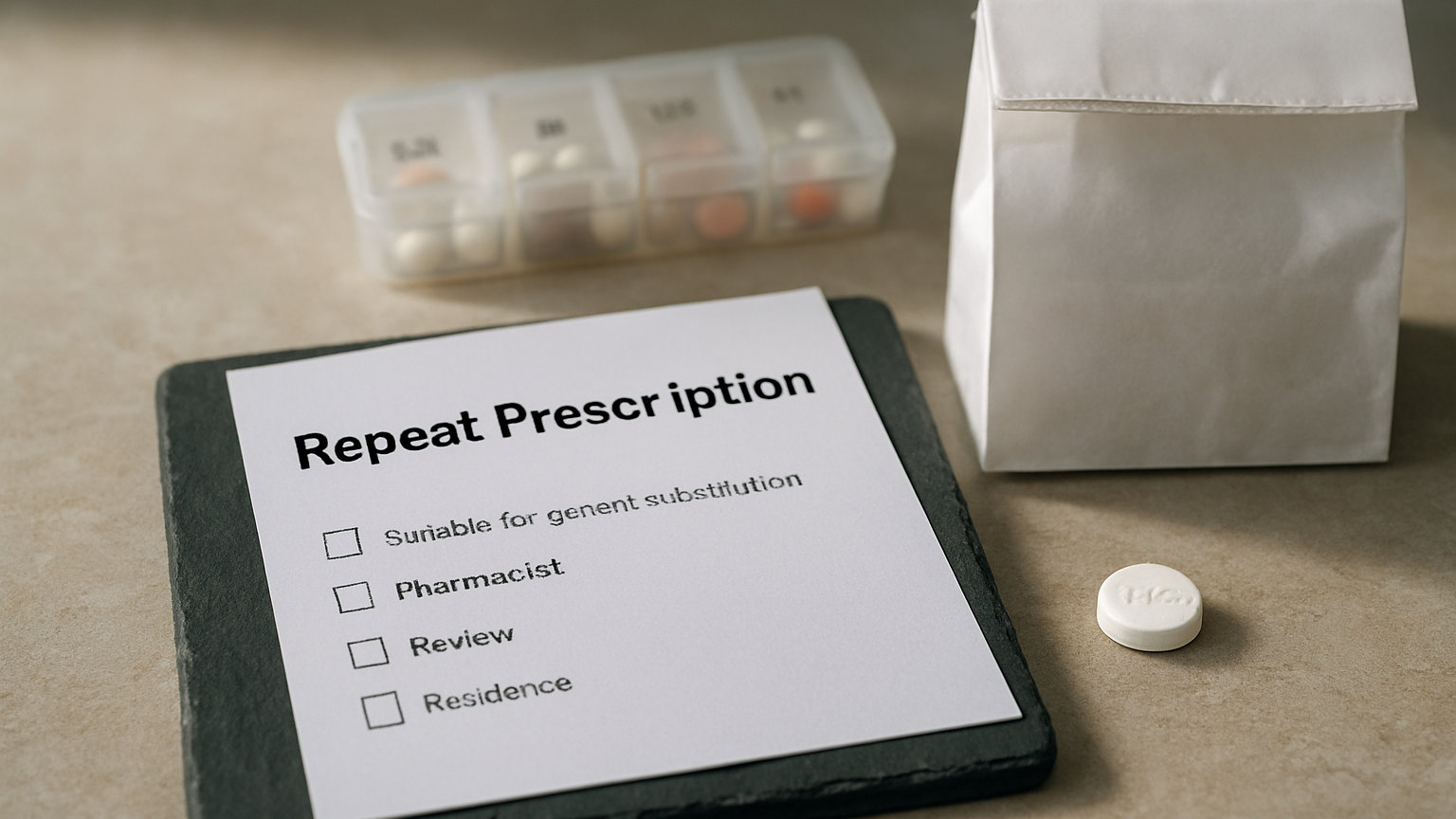
People on several medicines frequently find them running out on different days - one on the fourth, another on the eleventh, a third some time next week. That is not how anyone designed it. It happens because items were started at different times and dispensed in quantities that do not divide evenly, and the drift compounds. It is fixable, and fixing it removes most of the reasons people end up without something.
Why it drifts
Three causes, all mundane.
Different start dates. Each medicine begins its cycle whenever it was first prescribed.
Quantities that do not match. A month's supply is not the same number of days for a once-daily tablet in a pack of 28 as for a three-times-daily one in a pack of 100.
Partial supplies. An item owed because of stock and collected a week later shifts that item's cycle permanently.
Once three or four items have drifted apart, you are ordering something almost every week, and the chance of missing one rises accordingly.
What synchronising involves
The practice adjusts quantities once - issuing a short supply of some items and a longer one of others - so that everything lands on the same date from then on.
That single adjustment is the whole intervention.
Ask the practice or the pharmacy to align your repeats. Both can initiate it, and pharmacies frequently spot the problem before patients do.
It is a routine request, and most practices do it regularly.
Why it is worth doing
Fewer chances to run out. One order and one collection instead of four, so fewer opportunities to forget.
Easier to spot problems. If everything arrives together, a missing item is obvious.
Better for organisers. Filling a weekly tray is straightforward when all the boxes were opened on the same day.
Fewer journeys, which matters if getting out is difficult.
Possibly cheaper in England. Prescription charges are per item, not per form, so this does not reduce the charge directly - but a prepayment certificate removes the calculation entirely. See is a prepayment certificate worth it.
See blister packs and dosette boxes.
Repeat dispensing does it for you
For stable long-term medicines, repeat dispensing issues a batch of prescriptions covering several months, held at the pharmacy and released at intervals.
Everything is aligned by definition, the monthly ordering task disappears, and the pharmacy can plan stock ahead - which helps if any of your medicines are hard to obtain.
It is under-used. If your medicines have been stable for a year, it is worth asking about.
See repeat dispensing and planning ahead for hard-to-get medicines.
What will not align
Some items sit outside the cycle and that is fine:
Controlled drugs, which are limited in quantity and have prescriptions valid for only 28 days.
Items used intermittently - a reliever inhaler, a rescue pack, an as-required painkiller - which run out unpredictably by nature.
Hospital-supplied and homecare medicines, which come through a different route entirely.
Fridge items, sometimes supplied in different quantities.
See how long a prescription is valid.
Keep an eye on the drift
Alignment does not hold by itself - a partial supply or a dose change will shift one item again.
Two habits keep it in order:
Check what you have received against what you ordered before leaving the pharmacy, and note anything owed. Owed items are the commonest cause of re-drift and are frequently forgotten by everyone.
Do a stock check periodically - a rough count of what is left in the cupboard. It reveals both items running short and items accumulating because you are not taking them.
See if you think your medicine is wrong.
Order only what you need
Ticking every box on the reorder form regardless of what you need is how surplus accumulates, and it defeats the point.
Tell the practice if you have plenty of something, or have stopped taking it.
Do not stockpile - it makes shortages worse and generates waste, since dispensed medicine cannot be reused.
See ordering repeats and stockpiling makes shortages worse.
If you live somewhere without a pharmacy nearby
Alignment matters more the harder collection is.
Where you rely on lifts, public transport or a delivery service, reducing four collections a month to one is a substantial practical gain - and it reduces the chance that a missed trip becomes a missed week of treatment. Delivery services and repeat dispensing work considerably better once everything is on the same cycle. See NHS prescriptions delivered.
Use the opportunity
A synchronisation exercise means someone is looking at your whole list at once, which is a natural moment to ask whether everything on it is still needed.
Items no longer taken, short courses that became permanent, and duplications all tend to surface at exactly this point.
See medication reviews and deprescribing.
More on prescriptions and pharmacy services in the Prescriptions section, including What Your Repeat List Actually Shows.