
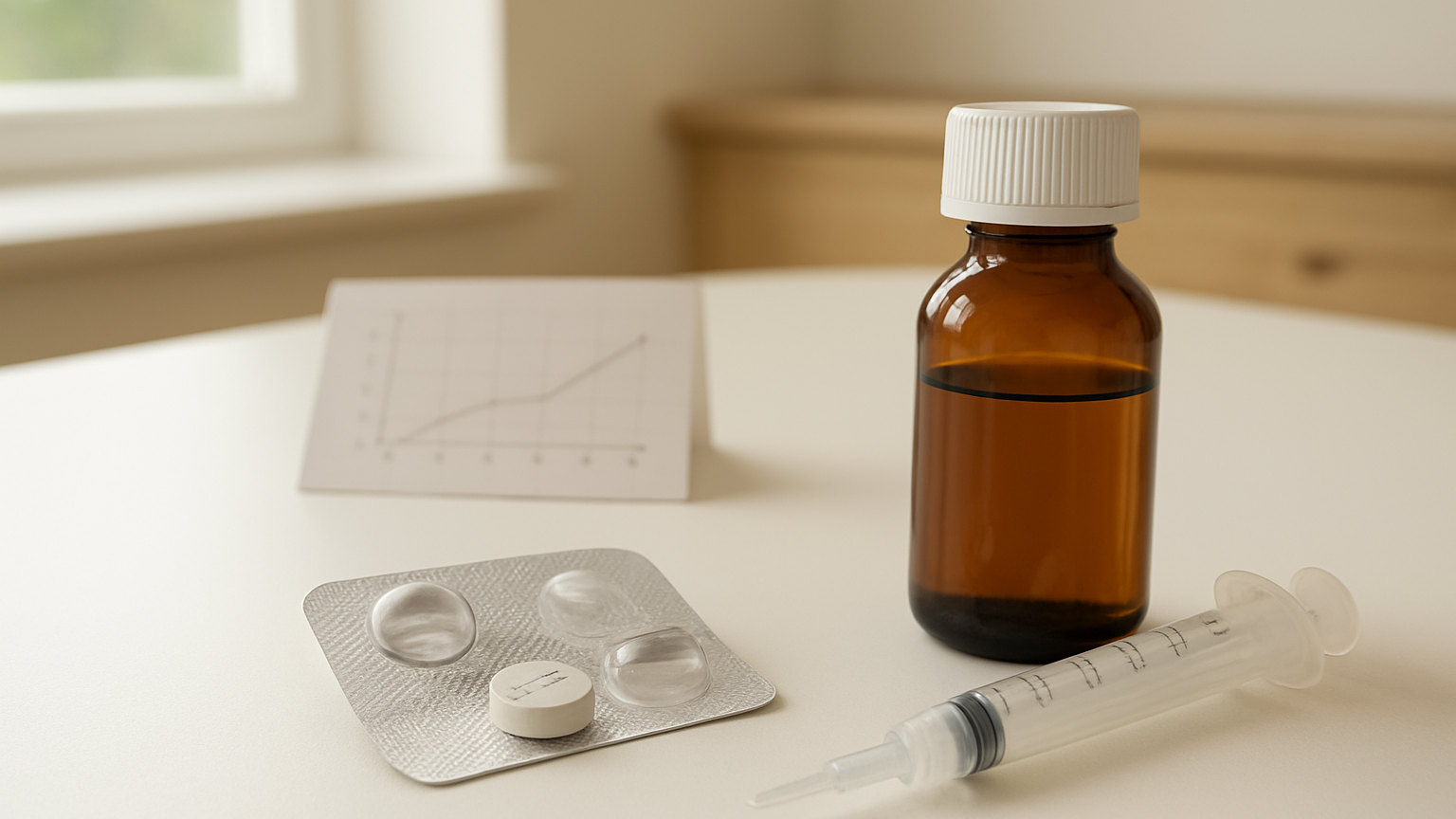
Tapering advice has historically been written as equal steps to zero over a few weeks, and for several medicine groups that is too fast at exactly the wrong point. The last reductions - from a small dose to nothing - are frequently the hardest, and understanding why explains how to plan a taper that actually succeeds rather than one that gets abandoned partway.
Why the final steps are hardest
The relationship between dose and effect at the receptor is not a straight line. At higher doses, receptor occupancy is near its maximum, so a large reduction changes the biological effect relatively little.
At low doses, the curve is steep - so a small reduction produces a disproportionately large change.
The practical consequence is that halving a high dose may be easy while the final small step to zero is the one that produces marked withdrawal.
That is why proportional reductions - taking a percentage of the current dose each time, so the steps get smaller in absolute terms as you go down - work better than equal cuts.
This thinking now underpins guidance on stopping antidepressants and benzodiazepines.
How slow in practice
There is no single answer, and anyone offering one is oversimplifying.
Reasonable principles:
Reduce by a proportion of the current dose rather than a fixed amount.
Wait between steps until symptoms from the last reduction have settled - typically weeks rather than days.
Go slower the longer you have taken it. Years of treatment warrant months of reduction.
Hold rather than push if a step is difficult. Staying at the current dose for longer is the standard answer, not forcing through.
Do not reverse a whole taper because one step was hard - going back one step is usually enough.
Your prescriber sets the actual schedule. These are the principles to expect it to follow.
Getting small enough doses
The practical obstacle: tablet strengths do not go low enough for the final steps.
Options include liquid formulations, which allow very small reductions; tapering strips; combinations of lower-strength tablets; and alternate-day dosing for long-acting medicines only.
Alternate-day dosing is not suitable for short-acting drugs, where it produces a daily withdrawal cycle rather than a smooth reduction.
Splitting tablets is inaccurate at small sizes, and modified-release and enteric-coated tablets must never be split.
See cutting and crushing tablets and what the letters after a medicine name mean.
Where slow tapers particularly matter
Benzodiazepines and Z-drugs - reduction over months, with switching to a longer-acting drug such as diazepam to smooth the levels between doses. Abrupt withdrawal after regular use can cause seizures.
Antidepressants - paroxetine and venlafaxine are hardest because they are short-acting; fluoxetine is easiest because its long half-life tapers itself.
Opioids, where tolerance is also lost quickly - which matters if the taper is interrupted and doses resume.
Gabapentin and pregabalin.
Steroids, where the issue is different - the adrenal glands need time to resume their own production, and stopping too fast causes adrenal crisis.
See coming off antidepressants safely and paroxetine.
Withdrawal versus relapse
The distinction that decides whether a taper succeeds.
Withdrawal appears within days of a reduction, frequently includes physical symptoms that were never part of the original problem - dizziness, electric-shock sensations, nausea, flu-like aches - and settles over days to weeks.
Relapse is slower, appears weeks later, and looks like the original condition returning.
Mistaking withdrawal for relapse is the commonest reason people conclude they need the medicine indefinitely.
If symptoms appear promptly after a reduction and improve when you hold the dose, that points to withdrawal - and a slower taper.
See when a side effect is actually the illness.
Practical support
Keep a simple daily record - a score out of ten and the dose. It distinguishes patterns that memory cannot.
Do not start a taper during a major life upheaval, a house move or a bereavement.
Change one thing at a time, so you can attribute what happens.
Agree in advance what would prompt holding, going back a step, or stopping the taper.
See keeping a side effect diary.
When not to taper at all
Sometimes continuing is the right answer, and a taper is not a moral achievement.
If a medicine is working, the condition is serious, and the risks of relapse are high, staying on it is a legitimate decision.
And in a serious adverse reaction - a severe rash, agranulocytosis, anaphylaxis - the medicine is stopped immediately rather than tapered.
See why you cannot just stop some medicines.
Restarting a Medicine After a Break covers a related point, and the Side Effects section has the rest of these guides.


