Disposing of medicines at home is simple: take them back to a pharmacy. Where someone is being cared for - in a care home, or at home with visiting carers - the same act becomes a recorded transaction, with rules about who may do it, what gets written down, and what happens to controlled drugs. Families are frequently unaware any of this exists until they ask what became of a relative's medicines.
Why it is more formal
Three reasons.
Medicines in a care setting belong to the resident, not the home, and disposing of someone else's property needs a record.
Care homes are regulated, and medicines management is inspected - including what happens to waste.
Controlled drugs carry legal requirements about destruction that do not apply in a private household.
So what looks like bureaucracy is mostly a paper trail protecting the resident.
What should be recorded
A care home's medicines policy should cover disposal, and the record for each item returned should show the resident's name, the medicine and quantity, the date, the reason for disposal, and who handled it.
Reasons for disposal are usually one of: the course finished, treatment stopped or changed, the medicine expired, the resident refused it, or the resident died or moved.
Waste accumulates on the monthly supply cycle, since a 28-day batch arrives whether or not the previous one was finished.
Families are entitled to ask to see the record.
See medicines when you move into a care home.
Where it goes
Residential homes without nursing generally return medicines to the supplying pharmacy, in the same way an individual would.
Nursing homes are usually classed as producing clinical waste and use a licensed waste contractor rather than a pharmacy return.
Which applies depends on the setting, so the home's policy is the authority rather than general advice.
Either way, nothing goes into household waste, nothing is flushed, and nothing is emptied out of its container first.
See what happens to medicines you return.
Controlled drugs
The part with genuine legal weight.
Controlled drugs are recorded in a register, and disposal is recorded too - normally with a second person witnessing and signing.
Where a home destroys them on site, a denaturing kit is used, which renders the drug irretrievable before it enters the waste stream. Denaturing is required precisely so that a returned opioid cannot be recovered.
Running balances are checked at handover, which is why a discrepancy prompts questions.
If you are a relative and are told a controlled drug has been destroyed, it is entirely reasonable to ask to see the entry.
See disposing of fentanyl patches safely.
Home care and visiting carers
A different situation, and one with more gaps.
Medicines in someone's own home remain the person's property, and a visiting carer generally cannot dispose of them without consent from the person or whoever holds authority to decide.
Many home care agencies restrict what staff may do with medicines waste, and some will not transport it at all - partly because carrying controlled drugs raises its own issues.
The practical result is that returning medicines falls to the family, and unused supply accumulates in the house.
If you are a relative, ask directly who returns unwanted medicines and how often. Where the answer is nobody, that is a job worth doing yourself every few months.
See managing someone else's medicines.
After a death
Medicines should be returned to a pharmacy rather than kept or binned.
Wait a short period before disposing of anything in case a coroner needs to see it - and in a care setting, the home should be following that principle too.
Controlled drugs are held securely and recorded until they can be destroyed appropriately.
Nothing may be passed to another resident or another family member, however sensible that seems. Dispensed medicine is issued to a named person and cannot be reused.
Reducing what gets wasted
The larger problem is not disposal but the volume needing disposal.
Ordering everything on the monthly cycle regardless of stock, continuing items nobody has reviewed, and failing to tell the pharmacy what has stopped all generate waste - and once dispensed, medicine cannot be reused.
A medication review at admission, and annually afterwards, is the most effective intervention there is.
See deprescribing and medication reviews.
Sharps and patches
Sharps go into a proper container, collected under the setting's clinical waste arrangements - never into any bin.
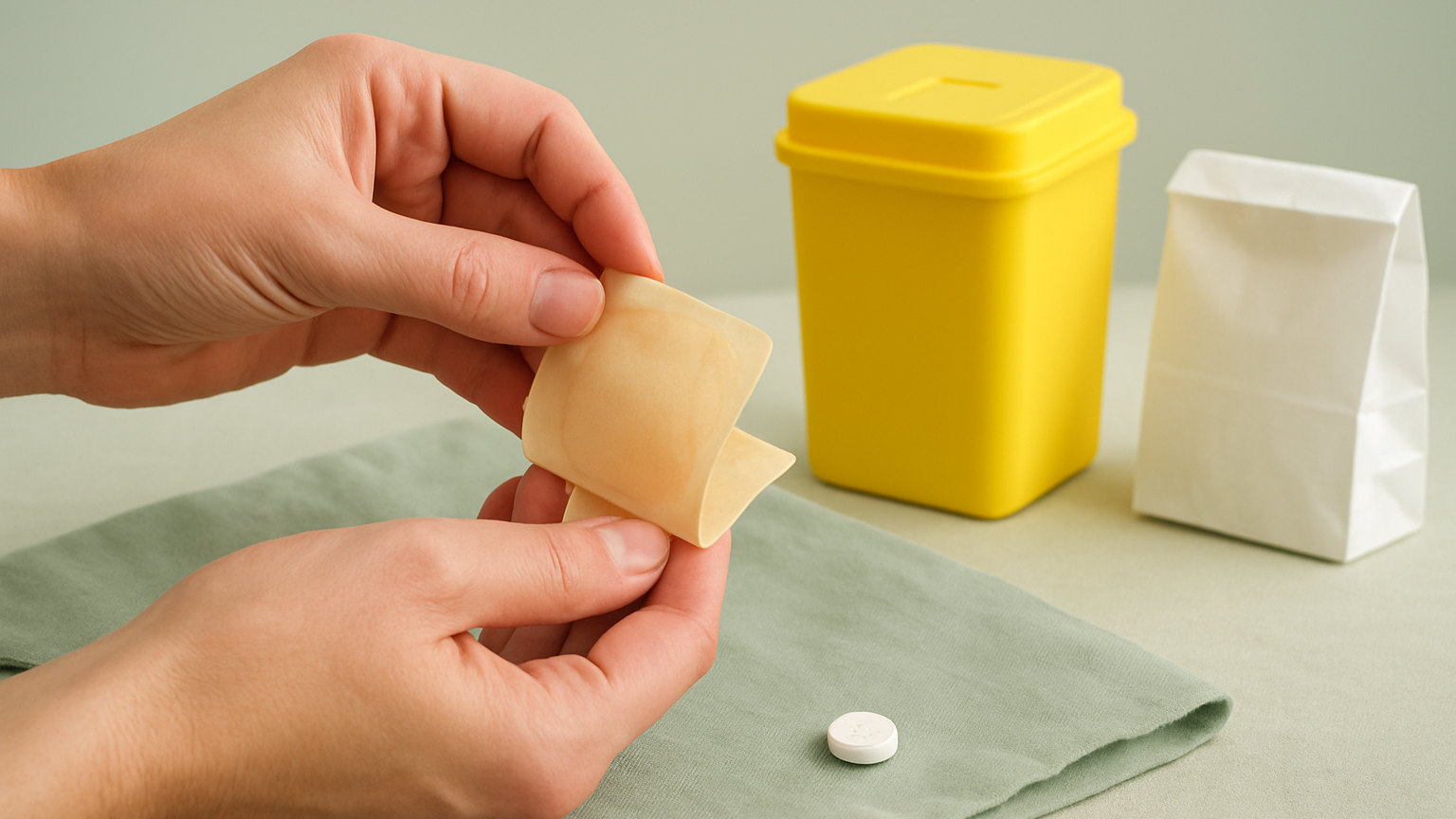
Used patches are folded sticky sides together and disposed of as medicine waste, since a used opioid patch still contains enough drug to harm a child or a pet.
See needles and sharps disposal.
Getting Rid of Medicines You Bought Yourself covers a related point, and the Usage section has the rest of these guides.