Liquid medicines are used by anyone who cannot swallow tablets, by children, and for drugs that only come that way. They are also where dosing errors concentrate. Two things cause almost all of them: measuring with something that was never designed for the job, and assuming the strength is the same as last time. Both are easy to eliminate.
Use the device supplied
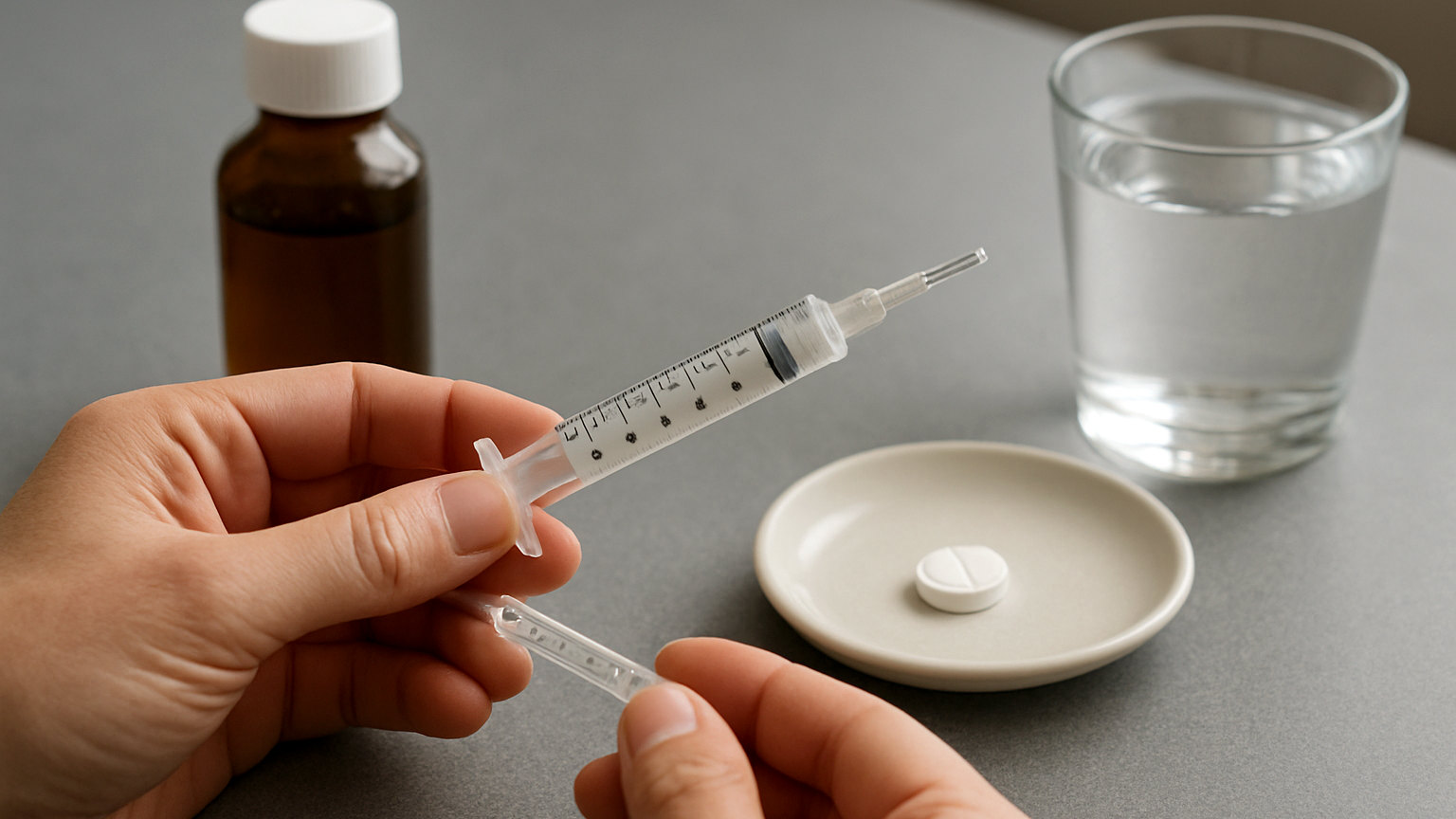
Liquid medicines come with an oral syringe or a measuring cup calibrated for that product.
Never use a kitchen teaspoon or tablespoon. Household spoons vary enormously in volume, and studies consistently find people delivering anything from well under to well over the intended amount.
Oral syringes are more accurate than cups, particularly for small volumes, and the difference is largest exactly where it matters most - in children and with potent medicines.
If the device is lost or broken, ask the pharmacy for another. They will supply one.
Oral syringes are usually purple and will not connect to an intravenous line, which is a deliberate safety feature - never use an intravenous syringe for an oral dose.
Check the strength every time
The same drug comes in more than one liquid strength, and the volume you need differs completely between them.
Children's paracetamol and ibuprofen each come in an infant strength and a stronger version for older children. The bottles look similar. Giving the stronger product at the volume used for the weaker one is a real overdose.
Adult liquids have the same issue - enalapril oral solution comes in more than one concentration.
Read the strength on the label, not just the name, every time you open a new bottle - including when a different manufacturer's product is supplied, and when a friend or relative has provided it.
Check the volume you have been told to take against the strength, and query anything that has changed.
See enalapril and how to read a medicine label.
How to measure well
Shake the bottle if the label says to. Suspensions separate, and an unshaken bottle delivers too little at the start and too much at the end.
With a syringe: insert into the bottle adaptor or into the liquid, draw up slowly past the mark, then push back to the mark to expel air bubbles. Read at eye level.
With a cup: stand it on a flat surface and read at eye level rather than holding it up - reading at an angle is a well-documented source of error.
For viscous liquids, allow time for the liquid to settle before reading, and expect some to remain in the syringe.
If more than one syringe size is supplied, use the smallest that holds the dose.
Giving it
Direct the syringe into the side of the cheek, slowly, rather than at the back of the throat - which triggers gagging and spitting.
Sit or stand upright.
Follow with a drink unless told otherwise.
Rinse the syringe in warm water and let it air dry; do not put it in a dishwasher unless the instructions permit.
See giving medicines to children.
Storage and in-use dates
Several liquids expire on their own clock once opened, and the packet date no longer applies.
Reconstituted antibiotic liquids typically last a week or two and usually need the fridge.
Write the opening date on the bottle - it takes two seconds and removes the guesswork.
Discard anything that has separated and will not remix, changed colour or smell, or grown anything.
See how to tell if a medicine has gone off.
Sugar and other ingredients
Liquid medicines taken long-term, particularly at night when saliva flow is lowest, are a recognised cause of tooth decay.
Ask for sugar-free preparations, which exist for most common liquids.
Several contain sorbitol, which in quantity causes diarrhoea - relevant when someone takes several liquids.
Some contain alcohol, which matters with metronidazole, in recovery, for children and for religious reasons. Alcohol-free versions are usually available.
See medicines and your teeth and hidden alcohol in medicines.
Unlicensed specials
Where no licensed liquid exists, a pharmacy can have one made to order.
These are expensive, take days to obtain, and the strength can vary between suppliers - so a change of supplier needs checking rather than assuming the same volume applies.
Where a licensed alternative exists in a suitable form, it is generally preferred.
See off-label and unlicensed prescribing and trouble swallowing tablets.
If measuring is difficult
Poor grip, tremor or limited vision all make this harder.
Ask about syringes with easier plungers, large-print labels, and whether a different formulation would suit better.
See opening medicine packaging with poor grip.
Taking Medicines in Hospital covers a related point, and the Usage section has the rest of these guides.