Difficulty swallowing tablets is extremely common and rarely mentioned. People cope by crushing, splitting, hiding tablets in food, or quietly not taking them - and the last of those is the commonest. There are usually better options, and crushing should be the last resort rather than the first, because for some medicines it is genuinely dangerous.
Technique first
Two methods have been tested and work better than simply trying harder.
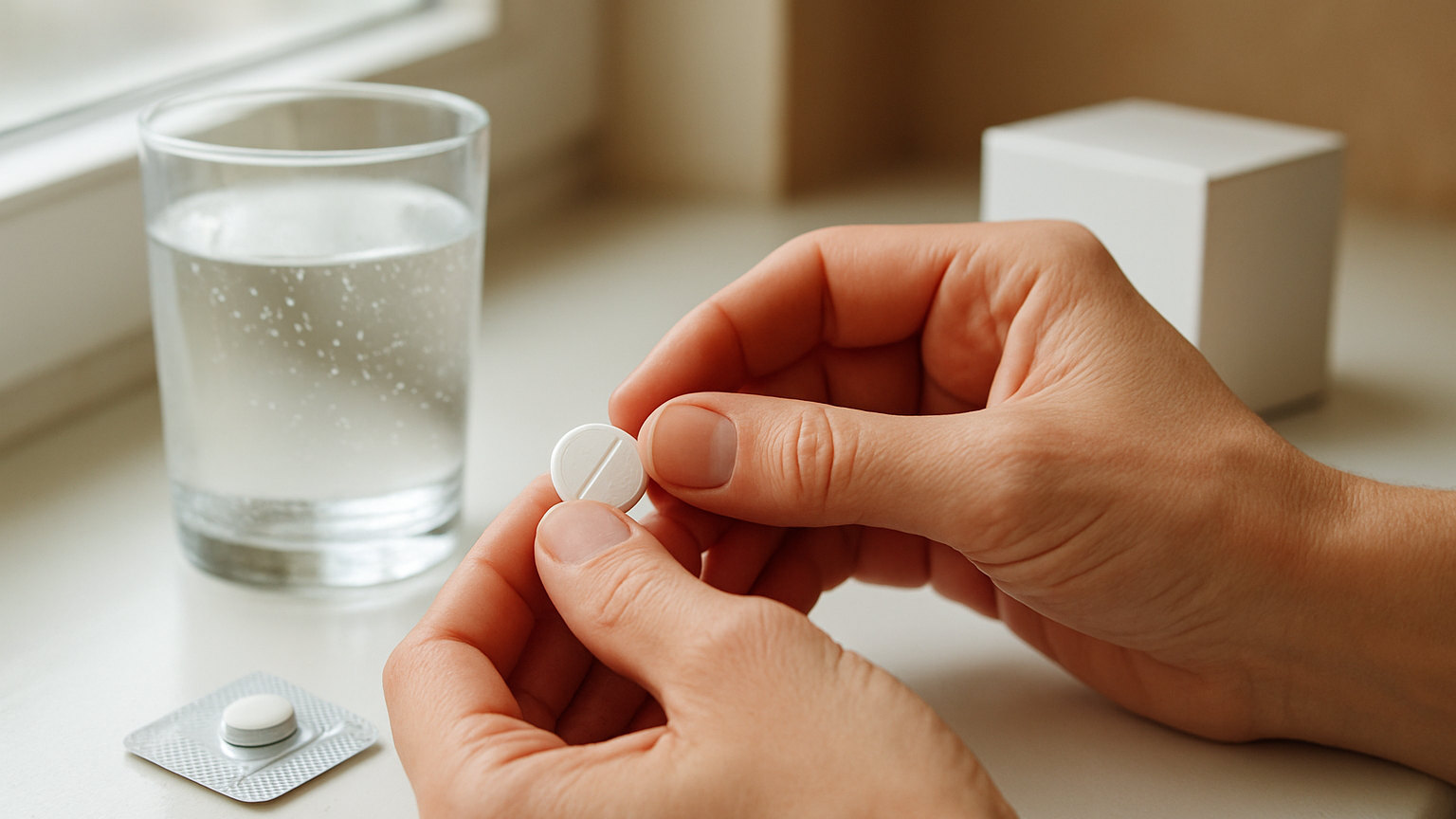
The lean-forward method, for tablets. Put the tablet on your tongue, take a mouthful of water, then tip your chin down towards your chest as you swallow. Tipping the head back, which is what most people do instinctively, closes the throat and makes it harder.
The bottle method, for capsules. Capsules float. Put the capsule on your tongue, seal your lips tightly around the neck of a plastic water bottle, and suck the water in while swallowing - the sucking action carries the capsule back.
Beyond those: take a sip of water first so the mouth is not dry, stay sitting or standing upright, and stay upright for a few minutes afterwards.
Tablets taken lying down, or with too little water, can lodge in the oesophagus and cause ulceration - a real problem with doxycycline, clindamycin and alendronate in particular.
See doxycycline and alendronate.
What not to crush
Crushing changes how some medicines behave, and for a few it is dangerous.
Modified-release preparations - often labelled MR, SR, XL, LA, CR, retard or prolonged-release. Crushing one releases a whole day's worth at once. With opioids and some heart medicines that can be fatal.
Enteric-coated or gastro-resistant tablets - the coating exists to protect the drug from stomach acid, or the stomach from the drug.
Cytotoxic and hormonal medicines - crushing creates dust that other people should not be exposed to.
Capsules with special contents, though some can be opened and sprinkled - check rather than assume.
See cutting and crushing tablets.
Ask about the formulation
This is the part most often skipped. A great many medicines come in forms designed for exactly this problem:
- Liquids and oral solutions - licensed versions exist for many common medicines, and enalapril is a good example among blood pressure drugs. See enalapril.
- Dispersible or soluble tablets - dissolved in water before taking
- Orodispersible tablets and films - dissolve on the tongue without water
- Patches - see how to use and rotate patches
- Injections, where nothing else will do
- Smaller tablets - sometimes two of a lower strength are easier than one large one
Sometimes a different drug in the same class has a better formulation, which is a legitimate reason to switch.
Tell your GP or pharmacist that you are struggling. They cannot offer an alternative they do not know you need, and this is one of the easiest problems in medicine to solve once it is raised.
Unlicensed specials
Where no licensed liquid exists, a pharmacy can sometimes have one made - an unlicensed special.
These are expensive, take time to obtain, and the strength can vary between suppliers, so a switch of supplier needs checking.
They are a reasonable answer when nothing else works, and not a first choice.
Hiding tablets in food
Mixing a tablet into yoghurt or jam is common, particularly for children and for people with dementia.
Two cautions. Some medicines interact with what they are mixed into - dairy blocks several antibiotics, and grapefruit juice affects many drugs. See medicines, milk and dairy.
And giving medicine covertly to an adult who has not agreed to it is a decision with legal and ethical weight, not a practical shortcut. It needs discussing with the prescribing team and, where relevant, a best-interests process.
See managing someone else's medicines.
Feeding tubes
Medicines given through a feeding tube need specific handling - liquids where possible, flushing before and after, and never crushing anything modified-release.
Some medicines block tubes, and some interact with feed - phenytoin and levothyroxine both need the feed pausing around the dose.
This should always be planned with a pharmacist rather than improvised.
When swallowing itself is the problem
Struggling with tablets is different from struggling with food and drink.
See your GP promptly if you are having difficulty swallowing food, feel food sticking, cough or choke when eating or drinking, are losing weight, or notice your voice has changed.
Difficulty swallowing that is new, progressive or painful needs investigating - it is not something to work around.
Speech and language therapists assess swallowing and can advise on safe textures and techniques, and a referral is worth asking about.
If a tablet gets stuck
Stay calm and sip water; most pass within minutes. Eating a small piece of soft bread can help move it.
Seek urgent help if you cannot swallow your own saliva, you have chest pain, or you are struggling to breathe.
Pain on swallowing that persists for hours after a tablet needs reporting, since it may indicate irritation or an ulcer.
See also Giving Medicines to Children, and the Usage section for more on taking medicines day to day.