Giving medicine to a child is one of the situations where errors are commonest and most avoidable. Very few are about choosing the wrong drug. They are about measuring - a kitchen spoon instead of a syringe, a different liquid strength than last time, or two products given together that turn out to contain the same ingredient. A few habits prevent nearly all of it.
Use the device that came with it
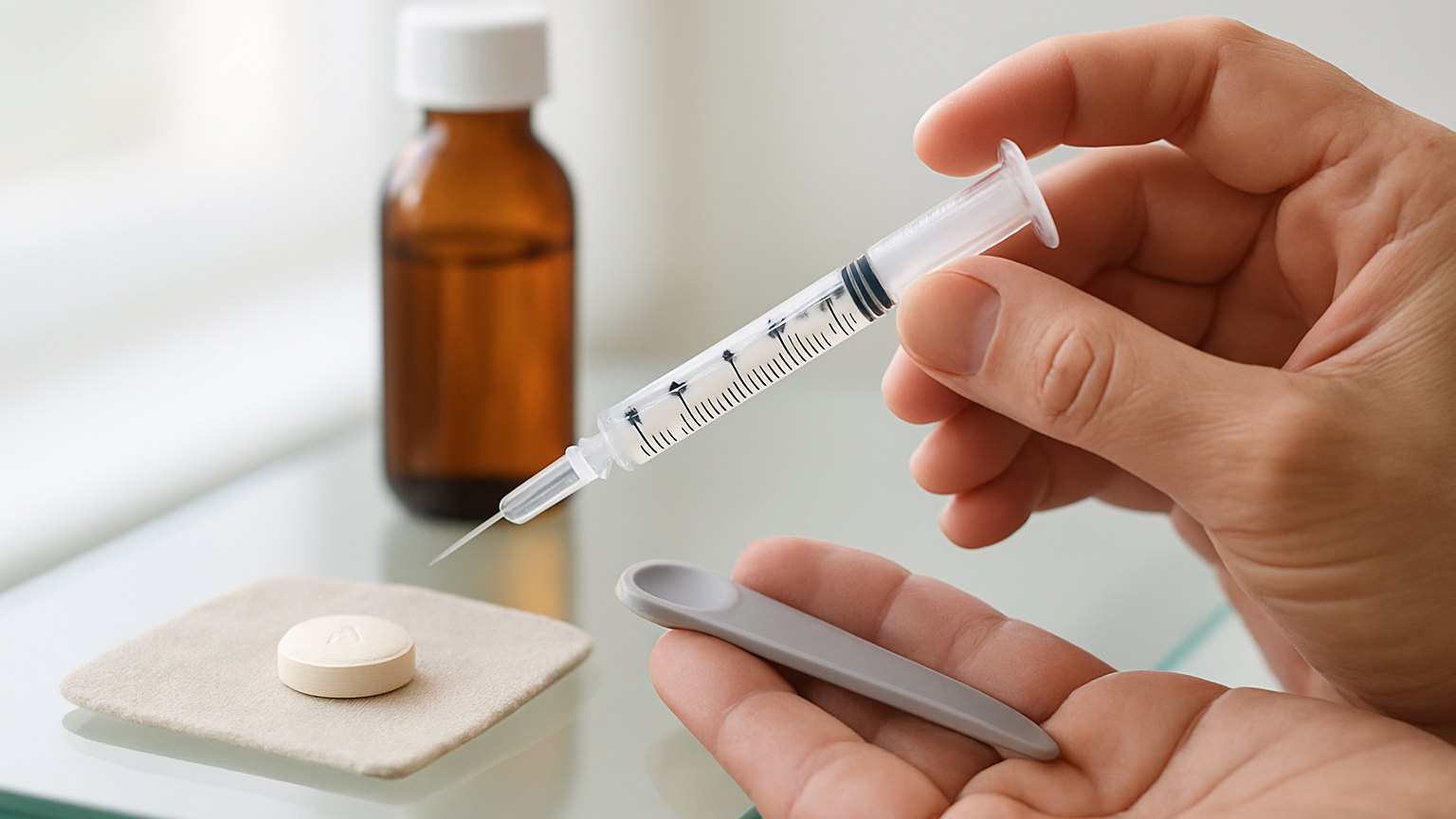
Liquid medicines come with an oral syringe or a measuring cup calibrated for that product.
Never use a kitchen teaspoon. Household spoons vary enormously in volume, and studies consistently find people using them deliver anything from well under to well over the intended amount.
Oral syringes are more accurate than cups, particularly for small amounts, and they are easier with a reluctant child - you can direct the medicine into the side of the cheek rather than the back of the throat, which reduces gagging and spitting.
If the device is lost, ask the pharmacy for another. They will give you one.
Check the strength every time
This is the single most important habit.
Children's liquid medicines are sold in more than one strength - paracetamol and ibuprofen suspensions each come in an infant strength and a stronger version for older children.
The bottles look similar, the volume you give differs completely, and giving the stronger product at the volume you used for the weaker one is a real overdose.
Read the strength on the label, not just the brand name, every time you open a new bottle - including when a friend or grandparent has supplied it.
See how to read a medicine label.
Dose by weight, not by guesswork
Children's doses are worked out by weight and age, and the bands on the packet assume an average-sized child.
For a child who is notably large or small for their age, ask the pharmacist rather than going by the age band alone.
Never estimate from an adult dose. Children are not small adults, and several medicines behave quite differently in them.
Do not double up on the same ingredient
Paracetamol and ibuprofen hide inside cold and flu remedies, teething gels and combination products under brand names that do not mention them.
Giving a paracetamol suspension and a paracetamol-containing cold remedy together is a common route to accidental overdose.
Read the ingredients panel, not the brand name - see paracetamol.
Guidance advises against giving paracetamol and ibuprofen alternately as a routine for fever - it increases dosing errors and confusion, and fever itself is not harmful. Give one, and add the other only if advised.
Some things are not for children
Aspirin should not be given to anyone under 16, except for specific conditions such as Kawasaki disease, because of the association with Reye's syndrome. Check cold remedies, where aspirin appears under several names.
Codeine is not used in children under 12, and not in under-18s after tonsil or adenoid surgery for sleep apnoea.
Cough and cold remedies containing decongestants or sedating antihistamines are not advised under six.
Promethazine and other sedating antihistamines have specific age restrictions - see promethazine.
Fluoroquinolone antibiotics are generally avoided in children outside specific circumstances.
Getting it into them
Practical measures that help more than persistence:
Give it into the side of the cheek, slowly, rather than straight back - which triggers gagging.
Let an older child have some control - choosing which drink follows, or holding the syringe.
A cold drink or ice lolly beforehand numbs the tongue slightly and dulls taste.
Follow immediately with a favourite drink.
Ask the pharmacist about flavour options and alternative formulations - some medicines come as dispersible tablets, granules or melts that suit better than a liquid.
Do not call medicine "sweeties" - it works once and creates a genuine poisoning risk.
Mixing with food
Sometimes acceptable, sometimes not. Some medicines interact with dairy or juice, and some must not be crushed or opened.
Ask before mixing, and if you do, use a small amount of food so the whole dose is taken.
See medicines, milk and dairy and cutting and crushing tablets.
If they are sick or spit it out
Whether to repeat depends on how soon afterwards and which medicine - see being sick after taking a dose.
Do not automatically give another. For some medicines that risks a double dose.
Storage
Children's medicines taste pleasant, which is precisely the problem.
Store everything out of sight and reach, in a cupboard rather than on a worktop or bedside table, and put it away immediately after use rather than leaving it out for the next dose.
Handbags are a common source, including visitors' bags left at floor level.
See keeping medicines away from children.
If a child swallows any medicine that was not meant for them, call 999 or go straight to A and E, even if they seem well - and take the packaging.
Antibiotics and courses
Finish courses as directed, and note that some liquid antibiotics must be kept in the fridge and discarded after a set number of days.
Shake before each dose where the label says to - otherwise the active ingredient settles.
Report side effects, which are reportable for children just as for adults - see side effects in children.
Related reading: Patches: How to Use and Rotate Them, with more on taking medicines day to day in Usage.