Some medicines need refrigerating, and the instruction is usually followed - it is printed clearly and people take it seriously. What goes wrong is at the edges: medicines pushed to the back where they freeze, medicines left out and thrown away unnecessarily, and journeys where nobody planned the cold chain. Insulin, many injectable treatments, some eye drops, some liquid antibiotics and several vaccines all live in this category.
Always follow the label on your own medicine. The ranges below are typical rather than universal.
What "refrigerated" actually means
The standard range is 2 to 8 degrees Celsius. That is a domestic fridge, but not everywhere in one.
The back of a shelf, particularly near the cooling plate, regularly drops below zero. The salad drawer and the middle of a shelf are the reliable spots. The door is too warm and fluctuates every time it is opened.
A cheap fridge thermometer is worth having if you store medicine long-term. It costs very little and it tells you something you cannot otherwise know.
Freezing is worse than warmth
This is the part most worth knowing. For protein-based medicines - insulin, most injectable biologics, GLP-1 medicines - freezing destroys them permanently, and there is often nothing to see afterwards.
A frozen insulin pen that has thawed looks entirely normal and does not work properly. That is a far more common cause of unexplained loss of control than people realise.
If you suspect something has frozen, do not use it. Ask your pharmacist. Our guide to starting insulin covers the practical side of storage.
What typically needs it
- Insulin - unopened supplies in the fridge; the pen in use is usually kept at room temperature for a set number of days.
- Biologic injections for arthritis, psoriasis and inflammatory bowel disease - see biosimilars.
- GLP-1 injections - see GLP-1 injections.
- Some liquid antibiotics once made up by the pharmacy, usually with a short life of a week or two.
- Some eye drops, and some ear and nose preparations.
- Vaccines, though these are normally administered rather than stored at home.
The pen or syringe in use is frequently the exception - many are designed to be kept at room temperature once started, because cold injections sting. Check your own leaflet.
If it has been left out
Do not automatically bin it, and do not automatically use it. Ring your pharmacist, and be ready to say what the medicine is, roughly how long it was out, and how warm the room was.
Many products tolerate a defined period outside the fridge, and the manufacturer will have data on it. Some do not. A pharmacist can usually find out in a couple of minutes, and it may save you replacing an expensive item unnecessarily - or stop you injecting something that will not work.
If it has to be replaced, our guide to what to do if your medicine is out of stock covers getting a supply quickly.
Travelling with them
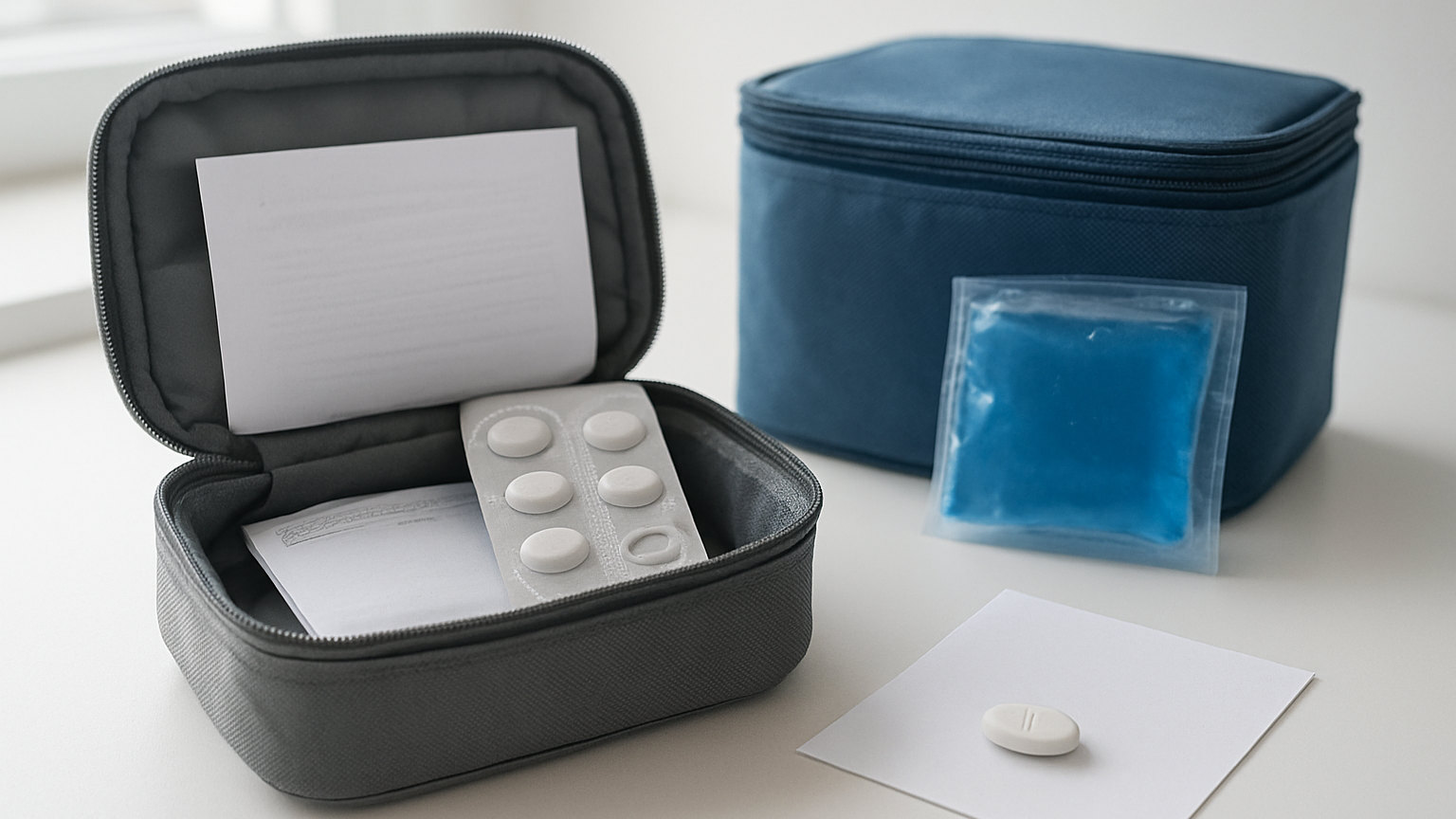
Plan this before the day. A cool bag with a gel pack that is not touching the medicine directly - wrap the medicine or use a purpose-made wallet, because direct contact with a frozen pack can freeze it.
Keep it in hand luggage. The hold is not temperature-controlled and can freeze. Take the pharmacy label and a copy of your prescription, and ask for a letter if you are carrying injectables through security.
Ask your accommodation about a fridge in advance rather than on arrival. Our guides to flying with prescription medicines and medicines in hot weather cover documentation and heat.
Power cuts
A closed fridge holds temperature for several hours. Keep the door shut rather than checking, and use a cool bag if the outage looks long.
Afterwards, check your thermometer if you have one. If you cannot tell how warm it got, ask rather than guess.
Signs something is wrong
Cloudiness in a solution that should be clear, particles, crystals, colour change, or a clear insulin that has become grainy. Any of those means do not use it.
But most degradation is invisible, so appearance is a reason to reject something rather than a way to approve it. Our guide to whether medicines really expire covers the same principle.
The label to write on
Write the date you take a pen or bottle out of the fridge directly on it. Almost nothing else will remind you when the in-use period runs out, and that date is frequently shorter than the printed expiry.
The Usage section covers more on taking medicines day to day - Keeping Medicines Away From Children is closely related to this one.