A cruise combines several things that make medicines awkward at once: no pharmacy, a medical centre that charges private rates, repeated time zone changes, days at sea with no way to obtain anything, and countries whose rules differ at every stop. Almost all of it is manageable with planning, and very little of it is manageable once you have sailed.
Take more than you need
Take at least twice the trip's requirement, and split it between two bags.
There is no pharmacy on board. The medical centre carries a limited stock for emergencies, charges private rates, and will not have your particular medicine in your particular strength.
Days at sea mean no option at all, and port stops may fall on a Sunday or in a country where your medicine is unavailable.
Request extra well ahead - this is a planned trip, not an emergency, and last-minute requests are the ones refused.
See extra medicine before a holiday.
Hand luggage and paperwork
Keep medicines with you rather than in checked luggage, which may not reach the cabin for hours.
Carry medicines in original labelled packaging, a copy of your repeat prescription, and a letter from the prescriber naming your conditions and medicines by generic name.
Cruises visit several countries, and ordinary UK medicines - codeine, tramadol, ADHD medicines, pseudoephedrine - are controlled or prohibited in some of them. Check every port and every transit country, not just the departure point.
Ships are subject to the rules of the countries they call at, and cabin searches do happen.
See medicines that are illegal in other countries and taking controlled drugs abroad.
Fridge medicines
Cabin fridges - where they exist - are frequently minibars that run either too warm or too cold, and some are switched off when the cabin is unoccupied.
Freezing destroys insulin and most biologics permanently, and the vial looks entirely normal afterwards.
Ask the cruise line before booking whether a medical fridge is available and how to arrange it - most will store medicines in the medical centre.
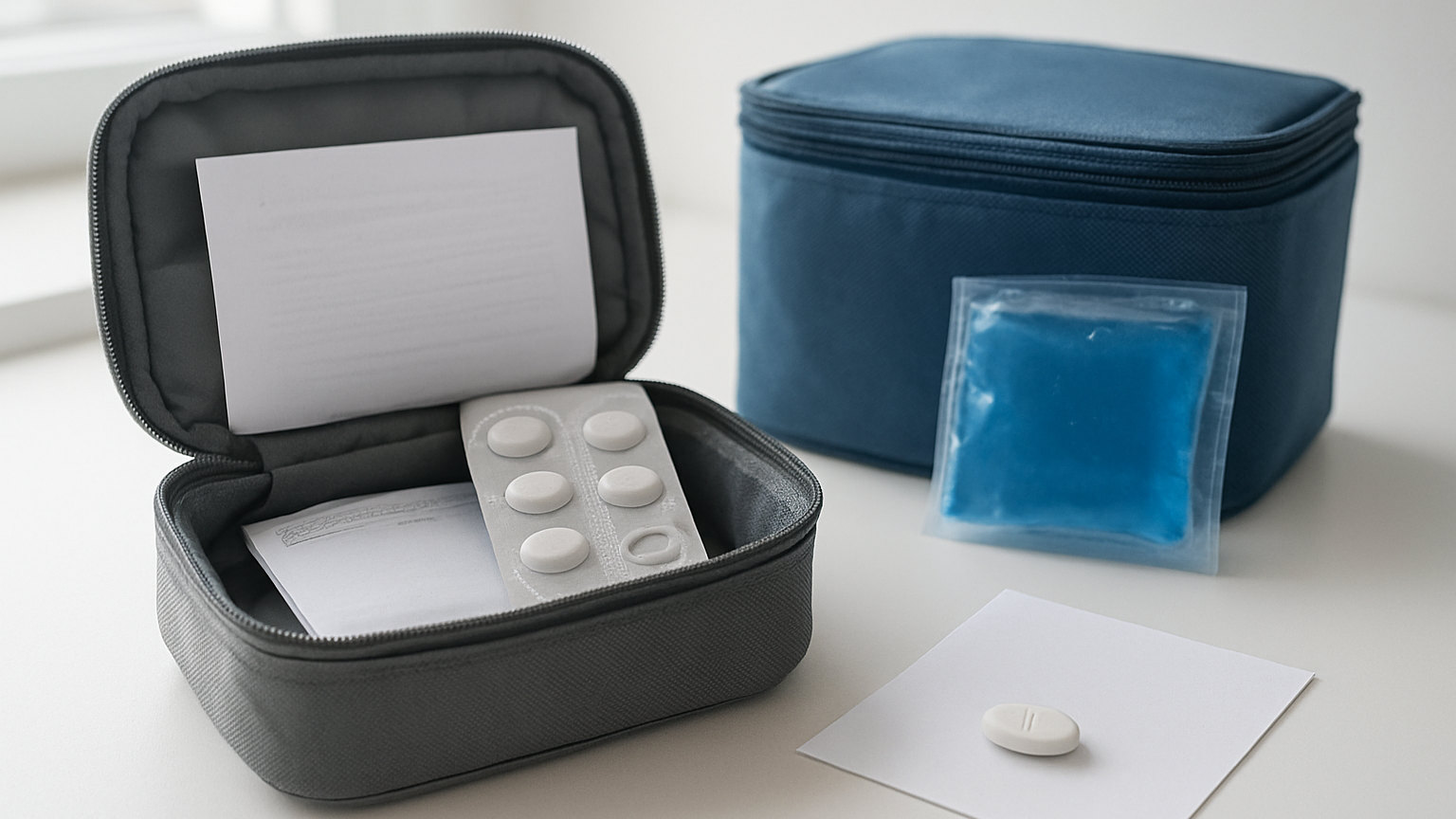
Take a cool bag and gel packs for port days and transfers, and never let medicine touch a frozen pack directly.
Remember insulin in use is kept at room temperature anyway.
See travelling with medicines that need a fridge.
Time zones
Cruises cross time zones gradually and repeatedly, with the ship's clock moving an hour at a time - which is actually easier than a long-haul flight.
For most medicines, simply following the ship's clock is fine.
For insulin, anti-epileptics and anything where timing is tight, get a written plan before you travel.
See medicines across time zones.
Seasickness remedies
The interaction people do not anticipate.
Hyoscine patches and sedating antihistamines such as cinnarizine and promethazine are all anticholinergic and sedating.
Added to anything else anticholinergic - oxybutynin, amitriptyline, some antipsychotics - the combined burden causes confusion, dry mouth, constipation and urinary retention, particularly in older people.
Added to alcohol, opioids or sedatives, drowsiness compounds.
Ask the pharmacist which seasickness remedy suits your list before you go rather than buying one at the terminal.
Stomach illness on board
Norovirus spreads readily in a closed environment, and vomiting and diarrhoea have consequences beyond discomfort.
Sick day rules apply: several medicines are paused during illness with vomiting or diarrhoea - ACE inhibitors, ARBs, diuretics, metformin, SGLT2 inhibitors and anti-inflammatories. Insulin is never stopped, and steroid replacement goes up.
Vomiting also means a dose may not have been absorbed, and it reduces the effectiveness of oral contraception.
Take oral rehydration sachets, and know your own sick day rules before you travel.
See sick day rules.
Insurance
Declare every condition and medicine. An undeclared condition is the commonest reason a claim is refused.
Check the policy includes cruise cover specifically - many standard policies exclude it, and medical repatriation from a ship at sea is among the most expensive claims there is.
A GHIC is not insurance and does not cover repatriation, and its usefulness on a cruise is limited anyway.
Check what the medical centre charges and whether your policy reimburses it.
See travel insurance and your medicines.
Other practical points
Take a sharps container if you inject, and bring it home sealed.
Keep emergency medicines on you rather than in the cabin - a reliever inhaler, GTN spray or auto-injector is no use several decks away.
Tell your travelling companion what you take and what to do in an emergency.
Heat and sun - several medicines cause sun sensitivity, and a deck is an unforgiving place for that.
See medicines that make you sun-sensitive.
The Usage section covers more on taking medicines day to day - Flying With Prescription Medicines: UK Rules is closely related to this one.