
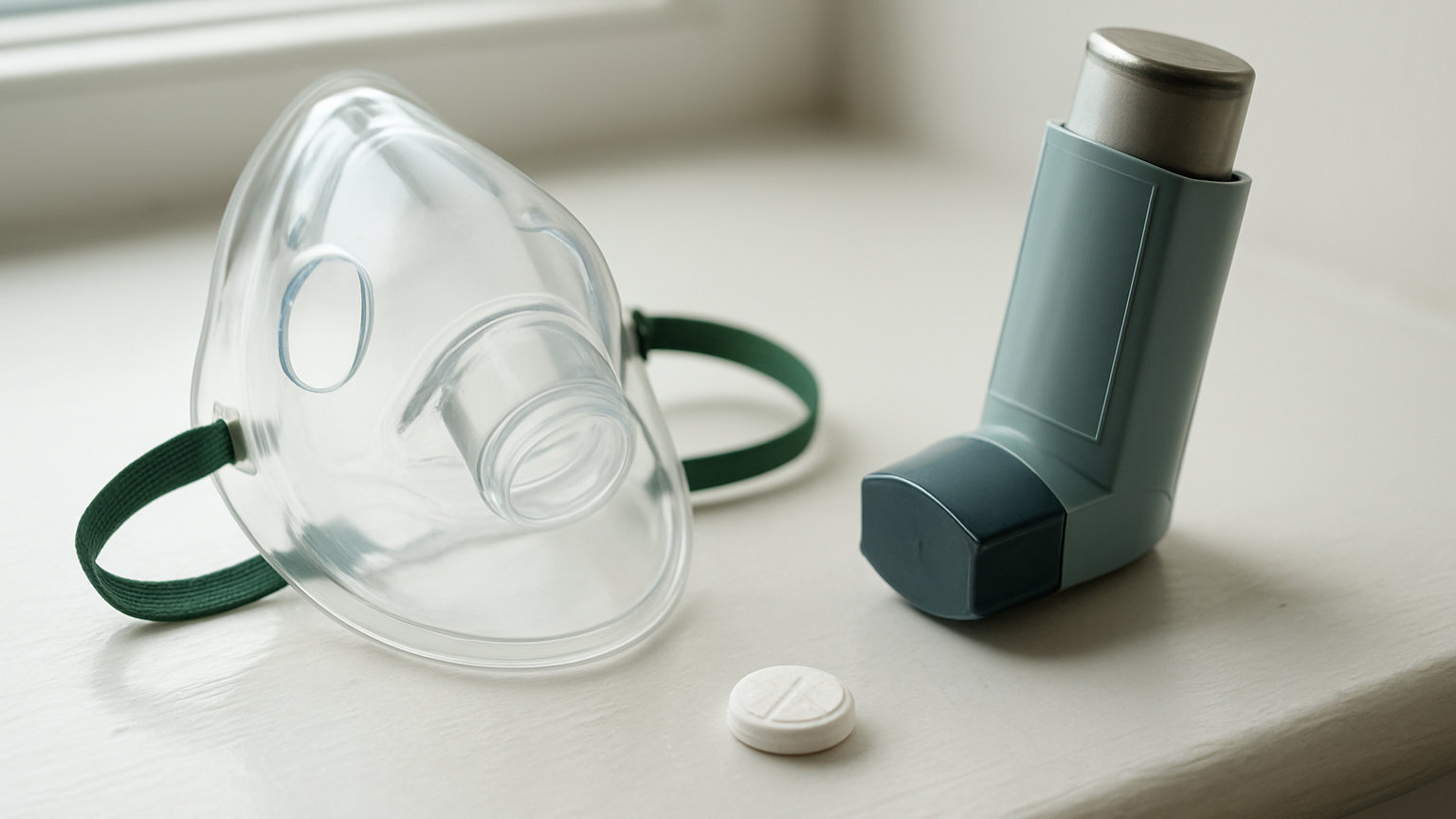
Ipratropium is a short-acting muscarinic antagonist. It blocks the signals that keep airway smooth muscle partly contracted, widening the airways over about four to six hours. It is the short-acting relative of tiotropium, used as a reliever mainly in COPD, and given by nebuliser during exacerbations. One hazard is specific to how it is often delivered: through a mask, close to the eyes.
Follow the instructions on your label and your action plan. This guide contains no doses.
Where it fits
In COPD, ipratropium is a reliever, used when symptomatic. It is often more effective in COPD than salbutamol, since the cholinergic tone it blocks is a bigger contributor to airway narrowing there.
In acute asthma and COPD exacerbations, nebulised ipratropium is added to nebulised salbutamol - the combination works better than either alone.
In stable asthma it has little routine place; salbutamol is the reliever, and the preventer does the real work.
See salbutamol and preventers and relievers.
Do not use it with tiotropium
Ipratropium and tiotropium act on the same receptors. Using both adds side effects without adding benefit.
Anyone started on a long-acting muscarinic antagonist should generally have their ipratropium stopped, and their reliever switched to salbutamol.
Being left on both is a common and avoidable problem after an inhaler change. If you have a LAMA and an ipratropium inhaler, ask a pharmacist to check.
See tiotropium.
The eye problem with nebulisers
Nebulised ipratropium delivered through a face mask escapes around the edges and reaches the eyes, where it dilates the pupil.
In someone with narrow drainage angles that can precipitate acute angle-closure glaucoma - a painful red eye with blurred vision, haloes around lights, headache and vomiting, which threatens sight and needs same-day treatment.
The preventive measures are straightforward:
- Use a mouthpiece rather than a mask where possible
- If a mask is necessary, ensure a good fit, and consider eye protection
- Be particularly careful in anyone with known or suspected glaucoma
Seek urgent help for a painful red eye with blurred vision during or after nebulised treatment.
The same applies to the soft mist and pressurised inhaler forms - avoid spraying towards the eyes.
Other antimuscarinic effects
Dry mouth is the commonest, and it matters more than it sounds because saliva protects teeth. Sipping water, sugar-free gum and telling your dentist all help - see dry mouth from medicines and high-fluoride toothpaste.
Urinary retention can be precipitated in men with an enlarged prostate. Seek urgent help if you cannot pass urine at all and your bladder feels full and painful - see tamsulosin.
Constipation, headache, cough and a bitter taste also occur.
Very little is absorbed systemically, so these are less prominent than with oral antimuscarinics - but they add to the cumulative anticholinergic burden in someone already on several. See medicines and your memory.
Paradoxical bronchospasm
Rarely, an inhaled bronchodilator causes immediate worsening of breathing rather than improvement.
Stop it and seek urgent help if breathing worsens immediately after a dose. This is uncommon but recognised with any inhaled treatment.
Nebulisers at home
Nebulisers deliver a large dose over several minutes and can make someone feel better without addressing why they are deteriorating.
The main risk of a home nebuliser is that it masks worsening disease - people keep nebulising rather than seeking help, and present later and sicker.
If you have one, know at what point you stop nebulising and call for help instead. A spacer with a pressurised inhaler is as effective as a nebuliser for most acute treatment.
See nebulisers.
When to call for help
Call 999 if your reliever is not helping or not lasting, you are too breathless to speak in full sentences, your lips or fingers look blue or grey, or your breathing is worsening quickly.
Do not delay because you want to try one more nebuliser - see when asthma gets worse.
For COPD, know when to start a rescue pack of antibiotics and steroids if you have one, and tell your team when you do - see prednisolone.
Combination inhalers
Ipratropium is available combined with salbutamol in a single inhaler and in nebuliser solution, which is convenient during exacerbations.
The convenience has the usual drawback: if a side effect appears, it is harder to tell which component caused it, and it is easy to end up with overlapping products. If you have a combination inhaler plus separate salbutamol or a long-acting muscarinic antagonist, ask a pharmacist to check none duplicates another - see being on too many medicines.
The nasal spray
Ipratropium nasal spray treats a persistently runny nose - it reduces secretion rather than congestion, so it suits rhinorrhoea specifically, including the streaming nose some people get when eating.
It does nothing for blockage or sneezing, which need a steroid nasal spray or an antihistamine - see steroid nasal sprays.
If this was useful, Cetirizine: Antihistamines That Do Not Sedate is worth reading next, and Conditions collects the rest.


