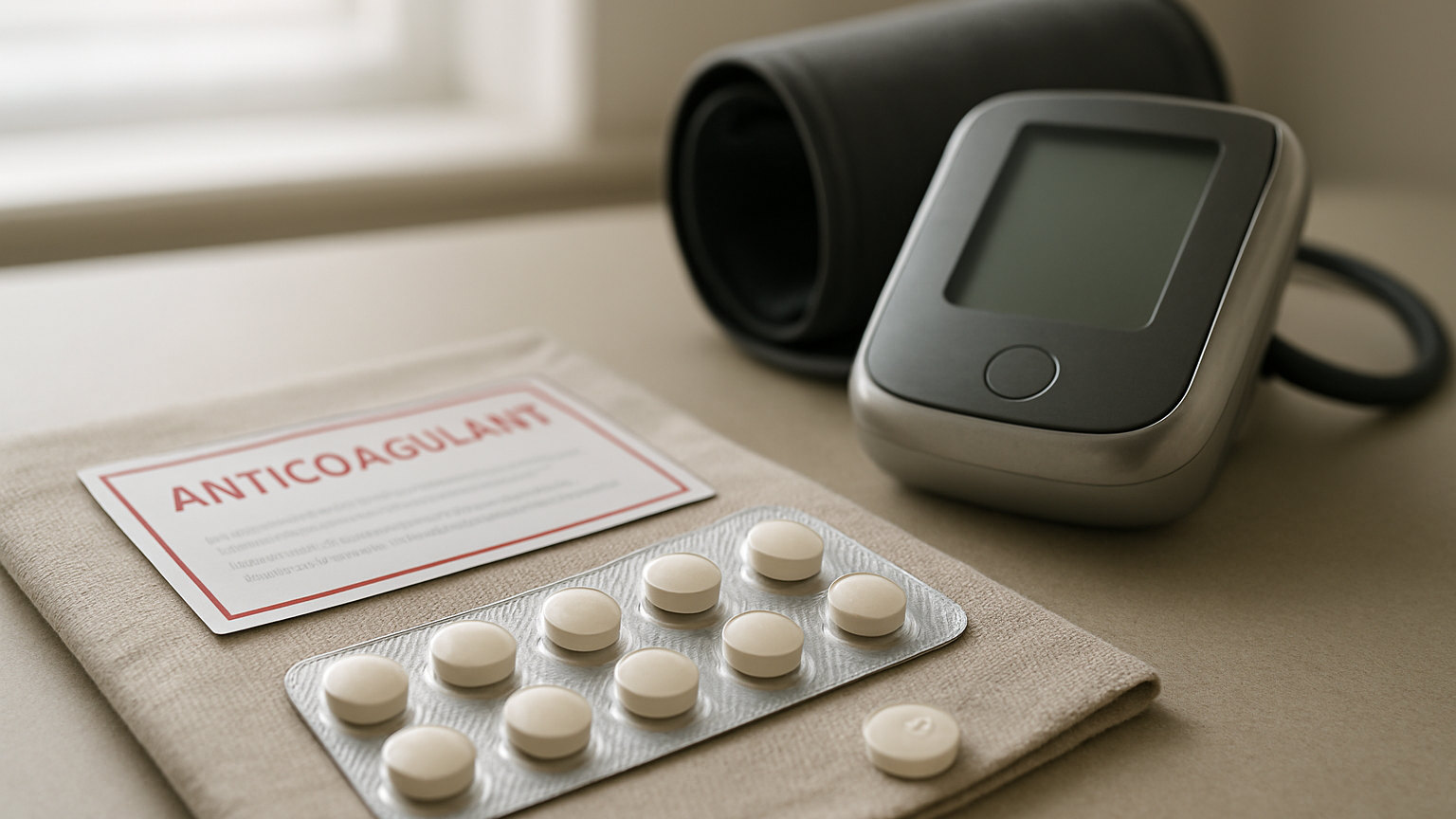
Apixaban is a direct oral anticoagulant - a blood thinner that blocks a specific clotting factor. It is used to prevent stroke in atrial fibrillation, and to treat and prevent deep vein thrombosis and pulmonary embolism. Compared with warfarin it needs no routine blood monitoring and has no dietary restrictions, which is why it has largely replaced it. The trade-off is real: with no INR test, nobody can tell whether you have been taking it, and missed doses matter more than most people realise.
Follow the instructions on your label. This guide contains no doses.
What it is used for
- Stroke prevention in atrial fibrillation, which is the largest use - see atrial fibrillation for why aspirin is no longer considered adequate for this.
- Treatment of DVT and pulmonary embolism, and prevention of recurrence.
- Prevention of clots after hip or knee replacement.
It is taken twice daily, which is a genuine practical difference from some alternatives taken once.
Compared with warfarin
No INR tests, no dose adjustments based on results, no interaction with vitamin K in food, and fewer drug interactions. Trials found comparable or better stroke prevention with less bleeding into the brain.
Warfarin still has its place - mechanical heart valves and some other situations - and it has a well-established reversal agent and a test that shows whether it is working. Our guide to warfarin or a newer blood thinner compares them properly.
Missed doses matter
Apixaban has a short duration of action. Warfarin's effect persists for days, so a single missed dose barely registers; apixaban's protection falls away within a day.
Missing doses regularly leaves you unprotected for meaningful periods, and there is no blood test that will reveal it. This is the most important practical difference between the two drugs.
If you miss one, check your leaflet - the usual advice is to take it as soon as you remember on the same day and then continue as normal, but never to double up. Our guide to remembering to take your medicine covers anchoring a twice-daily dose to something you already do.
Bleeding
Some bruising, nosebleeds and bleeding gums are expected. What needs attention is different.
Call 999 or go to A and E for a significant blow to the head - even if you feel fine, and even if there is no visible injury, because bleeding inside the skull can be delayed. Also for bleeding that will not stop, vomiting blood or material like coffee grounds, black tarry stools, blood in urine, or sudden severe headache, weakness or confusion.
A specific reversal agent exists for apixaban in emergencies, which is worth knowing and worth mentioning to anyone treating you.
Carry your anticoagulant alert card and show it to any doctor, dentist or pharmacist.
What to avoid
Anti-inflammatory painkillers including ibuprofen and naproxen raise bleeding risk substantially and are generally avoided. Aspirin too, unless specifically prescribed alongside. Paracetamol is the usual alternative - see paracetamol and ibuprofen.
Some medicines significantly change apixaban levels - certain antifungals, some HIV medicines, rifampicin and some epilepsy drugs. St John's wort reduces its effectiveness and is sold freely over the counter - see supplements that interfere with your medicines.
Always mention your anticoagulant before any new prescription, including from a dentist or an online service.
Before procedures
Apixaban is usually stopped a short period before surgery, dental extractions and some procedures, then restarted afterwards. The interval depends on the procedure's bleeding risk and your kidney function.
Never stop it on your own initiative - stopping without cover raises stroke risk - and never simply skip doses because a procedure is coming up. Ask whoever is arranging it for written instructions.
Monitoring
There is no INR, but kidney function is checked periodically, typically at least annually and more often if it is reduced, because apixaban is partly cleared by the kidneys and the dose depends on it.
Your dose also takes account of age and weight. If any of those change significantly, it may need reviewing - see monitoring long-term medicines.
Why it is twice daily
Apixaban's short duration of action is the reason for twice-daily dosing, and it is worth understanding rather than resenting. A once-daily anticoagulant leaves a longer trough before the next dose; twice daily keeps the level steadier.
It does mean two opportunities a day to forget. Anchoring both doses to fixed points - breakfast and an evening routine - works better than relying on memory, and a pill organiser makes a missed dose visible. Our guide to blister packs and dosette boxes covers when a filled pack is worth asking about.
Do not run out
Because protection lapses within a day, a gap in supply is a gap in protection. Order repeats with a week or more to spare, and earlier before bank holidays - see ordering repeats.
See also Bisoprolol: What This Beta Blocker Does, and the Conditions section for more on what medicines are prescribed for.