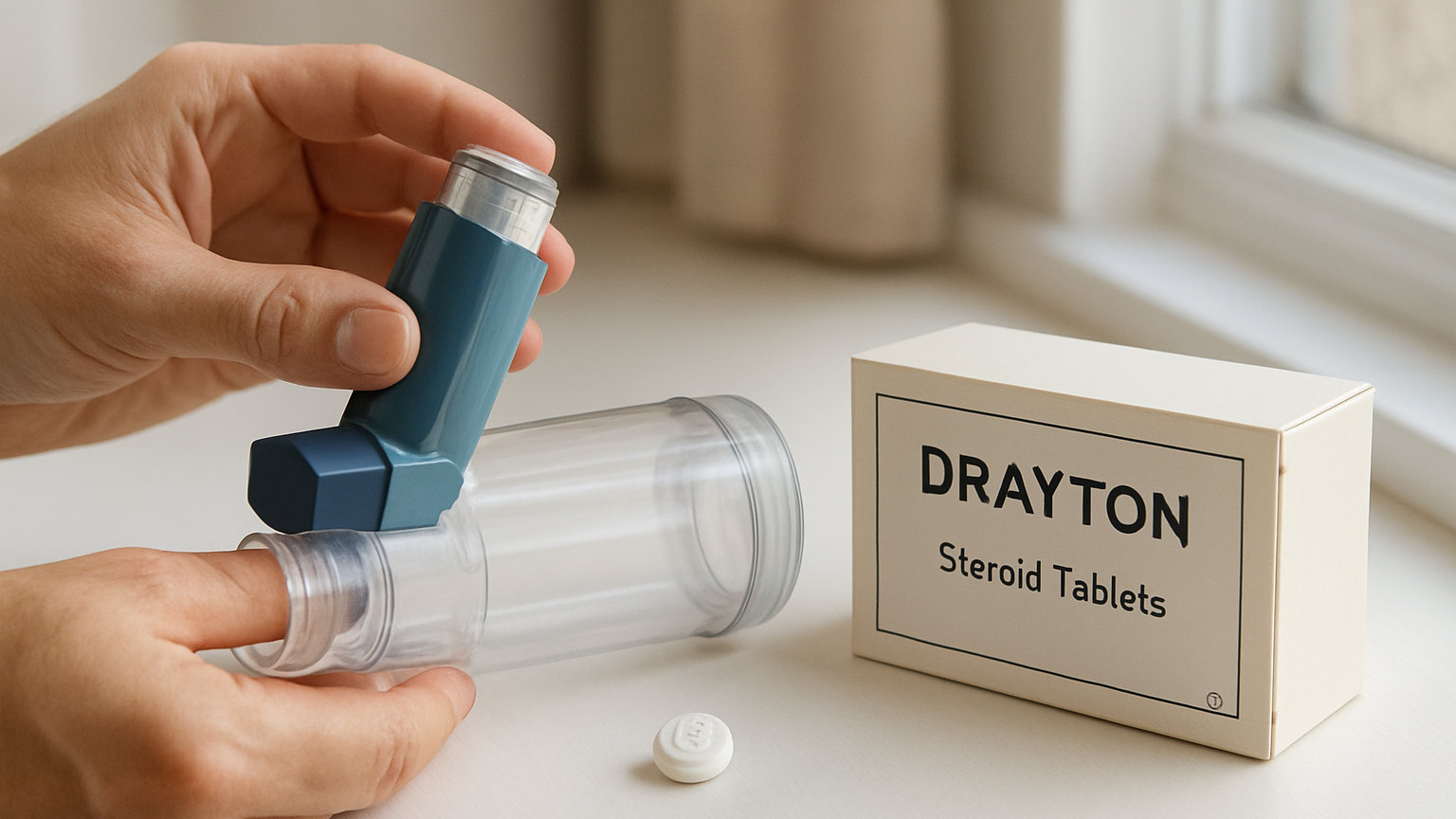
A spacer is a plastic chamber that sits between an aerosol inhaler and your mouth. It sounds like an accessory and is closer to a fundamental part of the treatment: it substantially increases how much drug reaches the lungs, reduces how much lands in the mouth and throat, and removes the need to coordinate pressing and breathing. For many people it does more good than any change of medicine.
What it actually does
An aerosol inhaler fires a fast-moving cloud. Without a spacer much of that hits the back of the throat and is swallowed rather than inhaled.
The chamber slows the cloud and lets the largest droplets drop out, so what you breathe in is finer and travels further into the lungs.
It also removes the timing problem - you no longer have to press and breathe in at the same instant, which a great many people cannot do reliably.
The practical results: better symptom control, and far less steroid deposited in the mouth, which means less oral thrush and hoarseness.
Spacers work with aerosol (pressurised) inhalers only. Dry powder devices do not use them and must not be fitted to one.
See how to use your inhaler properly and steroid inhaler side effects.
How to use one
Remove the cap, shake the inhaler, and fit it into the end of the spacer.
Breathe out gently, away from the spacer, then seal your lips around the mouthpiece.
One puff at a time. Never fire two puffs into the chamber together - the second largely sticks to the first.
Then either:
Tidal breathing - breathe in and out normally through the spacer several times after each puff. Easiest, and the method used for children and anyone struggling.
Single breath - one slow deep breath in, then hold it for about ten seconds.
Wait about half a minute before a second puff, shaking the inhaler again.
Rinse your mouth and spit out after a steroid inhaler, even with a spacer.
If you hear a whistle from the spacer, you are breathing in too fast.
Washing it - the part everyone gets wrong
Plastic spacers build up a static charge that attracts the drug to the walls, so a badly cared-for spacer delivers considerably less.
Wash monthly in warm water with a little washing-up liquid.
Do not rinse the detergent off. The residue is what reduces static.
Do not dry with a cloth or towel. Rubbing recharges the static. Leave it to air dry standing up.
Wipe only the mouthpiece before using it again.
A brand new spacer should be washed this way before first use, for the same reason.
Some newer spacers are antistatic and have different instructions - check the leaflet.
When to replace it
Roughly every year, and sooner if it is cracked, cloudy, or the valve is damaged or sticking.
Check the valve moves freely, since a stuck valve means nothing is delivered.
Spacers are prescribable, so ask rather than buying one.
Children
A spacer is the standard way to give an inhaler to a child, and for young children it is used with a face mask sealed over the nose and mouth.
Move to a mouthpiece once the child can manage one, since it delivers more drug.
Tidal breathing is the method - several normal breaths after each puff.
A distressed, crying child gets very little drug, so it is worth taking time to settle them. Blowing the dose at a screaming face achieves almost nothing.
Make sure the school has the arrangement written down, and remember schools can hold spare salbutamol inhalers.
See medicines at work and school.
In an attack
A reliever given through a spacer is as effective as a nebuliser for most attacks, which is why spacers are used in hospital.
Repeated puffs, one at a time with several breaths after each, is the standard emergency approach - follow the written plan you were given.
Call 999 if the reliever is not helping, if you cannot complete a sentence, or if symptoms are worsening.
Keep a spacer wherever you might need one - home, work, school, the car.
See salbutamol and nebulisers.
Worth asking for
Spacers are under-prescribed, particularly to adults, who are frequently assumed not to need one.
Ask for one if you have any doubt about your technique, if you get thrush or a hoarse voice, or if your symptoms are not well controlled.
Ask to be shown rather than told, and to demonstrate it back - inhaler technique is checked far less often than it should be.
Related reading: Combination Inhalers and MART, with more on how the main families of medicine work in Medicines.