
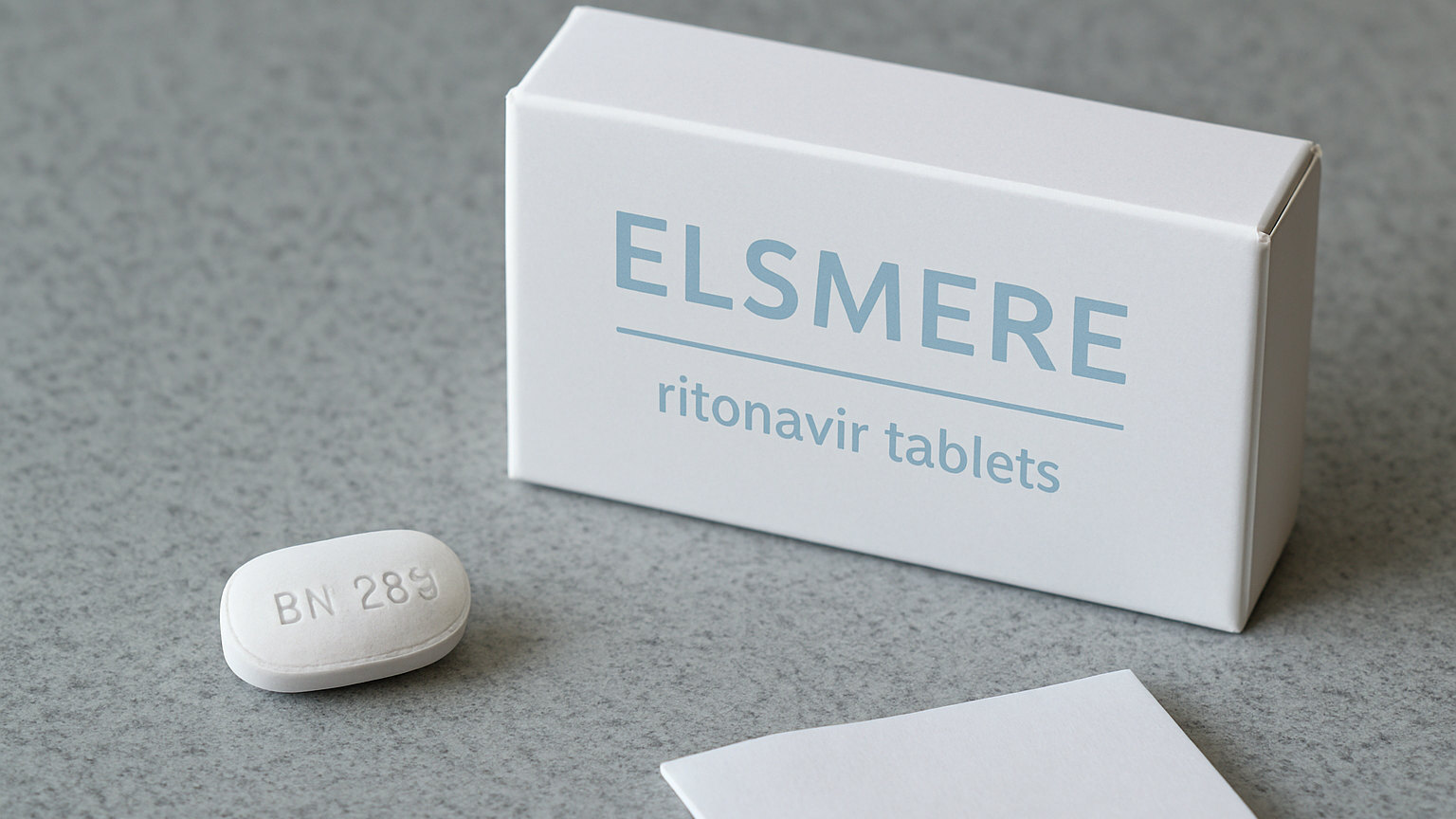
Ritonavir was developed as an HIV protease inhibitor. It is now used almost entirely for a different reason: at low doses it powerfully inhibits CYP3A4, the liver enzyme that clears a large proportion of all medicines. Given alongside another drug, it slows that drug's breakdown so levels stay higher for longer - a pharmacokinetic booster. The problem is obvious once stated. The enzyme does not know which drug you meant to boost.
Follow the plan your prescriber gave you. This guide contains no doses.
Where it is used
- HIV treatment, boosting protease inhibitors such as darunavir or atazanavir
- Nirmatrelvir with ritonavir, the oral COVID-19 antiviral, where ritonavir exists solely to keep the active drug at useful levels
- Hepatitis C regimens, in some combinations
Cobicistat is a related booster that does the same job without HIV activity of its own, and carries much the same interaction profile.
Why the interactions are so extensive
CYP3A4 handles a very large share of prescribed medicines. Blocking it raises the levels of all of them, sometimes several-fold.
That converts ordinary doses into excessive ones, and the consequences depend entirely on which drug is affected. Some combinations are simply adjusted; some are avoided outright.
Our guide to medicines and your liver explains the enzyme system, and grapefruit and medicines covers a milder, dietary version of the same mechanism.
The ones that cause real harm
Inhaled and nasal steroids. This one surprises people. Fluticasone - in a common preventer inhaler and in nasal sprays - is normally cleared so efficiently by the liver that very little reaches the circulation. Block the enzyme and levels rise dramatically, producing Cushing's syndrome and adrenal suppression from what looks like an ordinary inhaler. See steroid inhaler safety.
Statins. Simvastatin and atorvastatin levels rise steeply, raising the risk of severe muscle breakdown. Simvastatin is contraindicated; others are capped or swapped. See statins and muscle pain.
Sedatives. Midazolam and triazolam levels rise enough to cause prolonged sedation and respiratory depression.
Ergot medicines for migraine, which can cause severe blood vessel narrowing.
Some heart rhythm drugs, where a level rise is dangerous - see medicines that affect your heart rhythm.
Anticoagulants - see apixaban.
Some erectile dysfunction medicines, where levels can rise severalfold - see sildenafil.
And the ones that stop it working
The reverse also applies. Enzyme inducers reduce ritonavir and whatever it is boosting, risking treatment failure and resistance.
St John's wort is contraindicated with HIV treatment for exactly this reason, and it is sold freely over the counter. Rifampicin, carbamazepine and some other anticonvulsants do the same.
See supplements that interfere with your medicines and carbamazepine.
What this means practically
Every new medicine needs checking against ritonavir - every time, including anything bought over the counter, herbal or recreational.
That includes prescriptions from dentists, urgent care, online services and hospital teams who may not have your full list. HIV drug interaction checkers are freely available online, and your specialist pharmacist will check for you - that call is worth making before you take the first dose, not after.
Carry a list of your medicines and say plainly that you take a booster. See over-the-counter interactions.
The short course problem
With the COVID antiviral the course lasts only a few days, and there is a temptation to assume interactions do not matter over so short a period. They do.
The standard approach is that certain medicines are paused, dose-reduced or substituted for the duration and for a few days afterwards, since the enzyme takes time to recover. That is a decision for the prescriber, made against your actual list - and it is why eligibility assessment involves a medication review rather than just a positive test.
Why the dose looks so small
The amount of ritonavir used as a booster is a fraction of what was originally given for its own antiviral effect. At that low dose it contributes essentially nothing to treating HIV - it exists purely to slow the clearance of the drug beside it.
That is worth understanding because people sometimes assume a small dose means a small effect. On the enzyme the inhibition is near-complete, and the interaction profile is exactly the same whether the ritonavir is there as treatment or as a booster.
Side effects
Nausea, vomiting, diarrhoea, abdominal pain and altered taste - a persistent metallic taste is characteristic. Most are worse at the start.
Raised liver enzymes, raised lipids and, with longer-term use, changes in fat distribution and glucose handling.
Seek advice for jaundice, dark urine, persistent abdominal pain, or a rash with fever.
Take it with food, which improves absorption and tolerability.
Related reading: Pantoprazole: The PPI Chosen for Interactions, with more on how the main families of medicine work in Medicines.


