A great many people inject themselves at home - insulin, biologics for arthritis or eczema, fertility treatment, anticoagulant injections, hormone treatment. The technique itself is quickly learned and rarely the problem. Three other things account for most of what goes wrong: injecting solution straight from the fridge, using the same patch of skin repeatedly, and reusing needles. All three are easy to fix.
Let it warm up first
Cold solution stings considerably more, and this is the single commonest cause of unnecessary pain.
Take the pen or syringe out of the fridge and let it reach room temperature for around thirty to forty-five minutes before injecting.
Do not warm it in hot water, in a microwave or on a radiator - heat damages proteins, and biologics and insulin are proteins.
Just leave it on the side while you get everything else ready.
See medicines that need the fridge.
Rotate properly
Repeated injection into the same spot causes lipohypertrophy - a lump of thickened fatty tissue under the skin.
It is painless, which is the problem. Because it does not hurt, people keep using it - and absorption from it is erratic and reduced, producing unexplained swings in whatever the medicine is doing.
With insulin this is a frequent and unrecognised cause of unstable glucose.
Rotate systematically rather than randomly - move a couple of centimetres each time, working across an area in a pattern, and change area periodically.
Feel your sites from time to time, and ask for them to be examined at review. If you find a lump, stop using it - and expect to need a lower dose once you move to healthy tissue, because absorption improves.
See insulin degludec.
A new needle every time
Needles blunt after a single use, and the microscopic damage is visible under magnification.
Reusing them hurts more, damages tissue, contributes to lipohypertrophy and risks infection.
With pen needles, attach a fresh one for each injection and remove it afterwards - leaving it on allows air into the cartridge and medicine to leak out, which affects the next dose.
Where to inject
For subcutaneous injections - which is most home injecting - the usual sites are the abdomen, the outer thigh, the upper outer arm and the upper buttock.
Avoid within a few centimetres of the navel, and avoid scars, moles, bruises, broken skin, and anywhere affected by psoriasis or eczema.
Absorption differs by site - the abdomen is fastest - so for insulin it is worth keeping to the same general area for the same dose rather than switching between abdomen and thigh.
Pinch a fold of skin if you are slim or using a longer needle; most modern short needles do not need it.
Technique in brief
Wash your hands. Check the medicine, the strength and the expiry, and look at the solution - discard anything cloudy that should be clear, or containing particles.
Clean skin is enough; an alcohol swab is not usually needed, and if you use one, let it dry first or it stings.
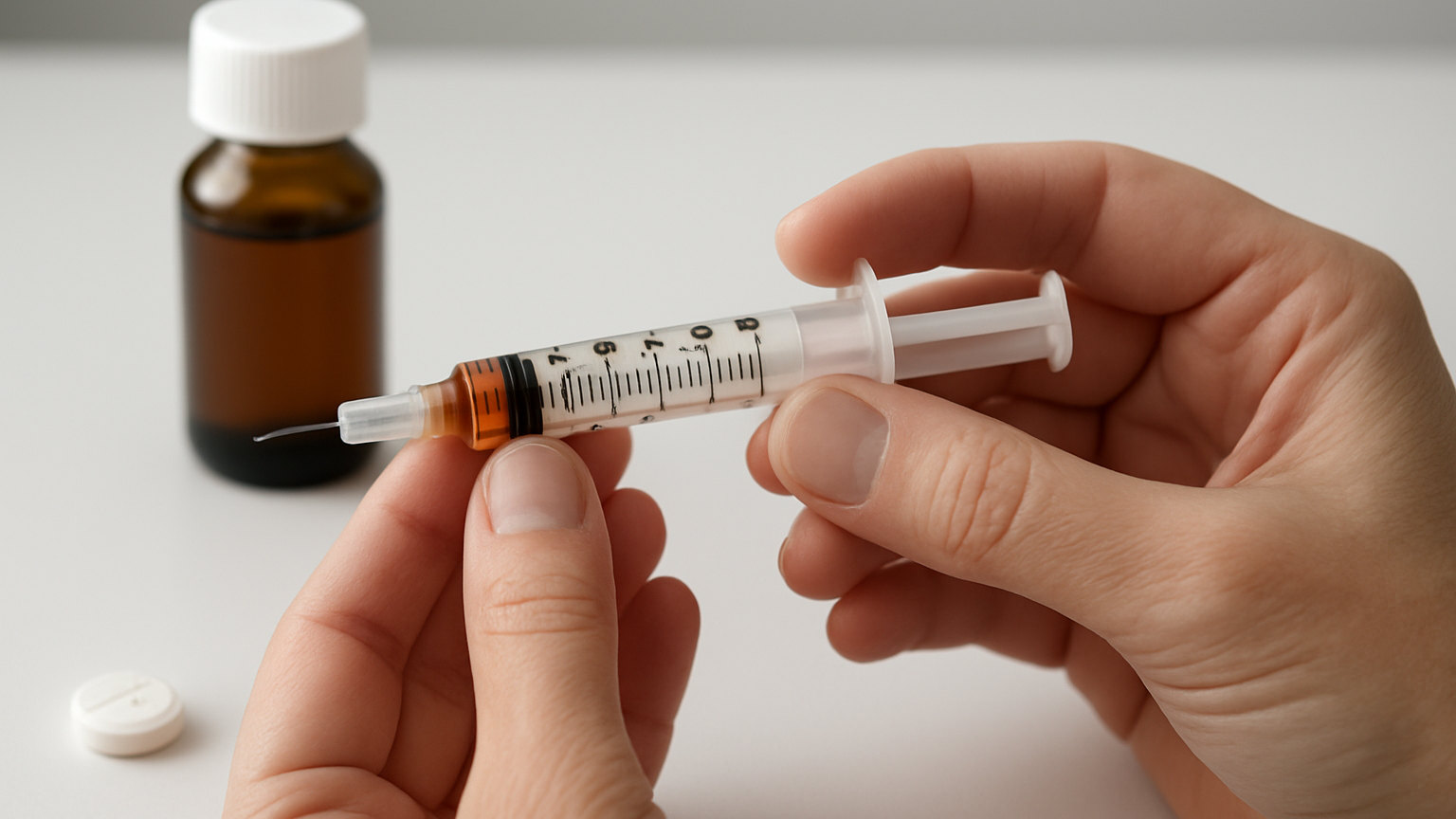
Insert at the angle you were taught, inject slowly - fast injection hurts - and hold for the stated count before withdrawing, which stops the dose leaking back out.
With pens, wait for the click or window change and keep the pen against the skin until it completes.
Do not rub afterwards. Press gently if it bleeds.
What is normal and what is not
Normal: redness, itching, mild swelling and a small bruise at the site, settling over a few days. These usually become less frequent with time.
Report: a site that becomes increasingly painful, hot or swollen after the first day or two, or that discharges pus - that suggests infection.
Seek urgent help for swelling of the face or throat, difficulty breathing, widespread rash or faintness - see anaphylaxis.
Sharps
Used needles, pen needles, lancets and pre-filled devices go in a sharps bin - never household waste or recycling.
Bins are supplied by your GP, clinic or pharmacy, and collection arrangements vary by council.
Do not overfill, and never try to recap a needle.
See needles and sharps disposal.
If you dislike needles
Worth saying rather than struggling.
Options include auto-injector devices where the needle is hidden and inserted automatically, shorter and finer needles, a different product with a friendlier device, numbing cream, or ice on the skin beforehand.
Some medicines are available in more than one device - see dulaglutide, whose pen conceals the needle entirely.
Nurses will re-teach technique at any point, and a refresher after months of doing it alone is worth asking for - technique drifts.
If your device changes
Switching between biosimilars or between manufacturers usually changes the device rather than the medicine.
Different pens have different dialling mechanisms, dose increments and needle covers, and some contain citrate buffer while others do not, which affects stinging.
Ask to be shown the new device rather than assuming it works the same way - see switching between manufacturers.
The Usage section covers more on taking medicines day to day - Using Suppositories and Pessaries is closely related to this one.