Standing in the kitchen with no memory of whether you swallowed the tablet is an experience almost everyone on regular medicines has had. It happens because taking medicine becomes automatic, and automatic actions leave no memory trace. The immediate question is whether to take one anyway. The more useful question is how to stop the situation recurring, because it will.
The general answer
For most medicines, if you genuinely cannot remember, skip it and take the next dose as normal.
That is because a missed dose of a typical long-term medicine is usually a smaller problem than a double dose, and because you have probably taken it - the whole reason you cannot remember is that you did it without thinking.
Never take an extra "to be safe" as a general habit.
See missed doses.
Where a double dose matters most
Skipping is the safer default specifically because doubling is the riskier error with these:
Anticoagulants - an extra dose meaningfully increases bleeding risk.
Insulin and sulfonylureas - a double dose causes hypoglycaemia, and with a long-acting sulfonylurea that can be prolonged. Seek advice, eat carbohydrate, and monitor. See glimepiride.
Opioids and sedatives - respiratory depression, particularly in combination.
Medicines with a narrow margin - lithium, digoxin, theophylline, methotrexate.
Blood pressure medicines - an extra dose can cause a marked drop and a fall.
Where missing matters more
A smaller group where the balance tips the other way, and it is worth checking rather than simply skipping:
Anti-epileptics, where a missed dose risks a seizure.
Parkinson's medicines, where timing is tight and deterioration is rapid.
Steroid replacement, where missing doses causes adrenal crisis - see hydrocortisone.
Contraception, which has its own specific rules - see missed contraceptive pill.
Transplant immunosuppressants.
For these, ring the pharmacy or 111 rather than deciding alone.
Make the question impossible
This is the part that actually solves it.
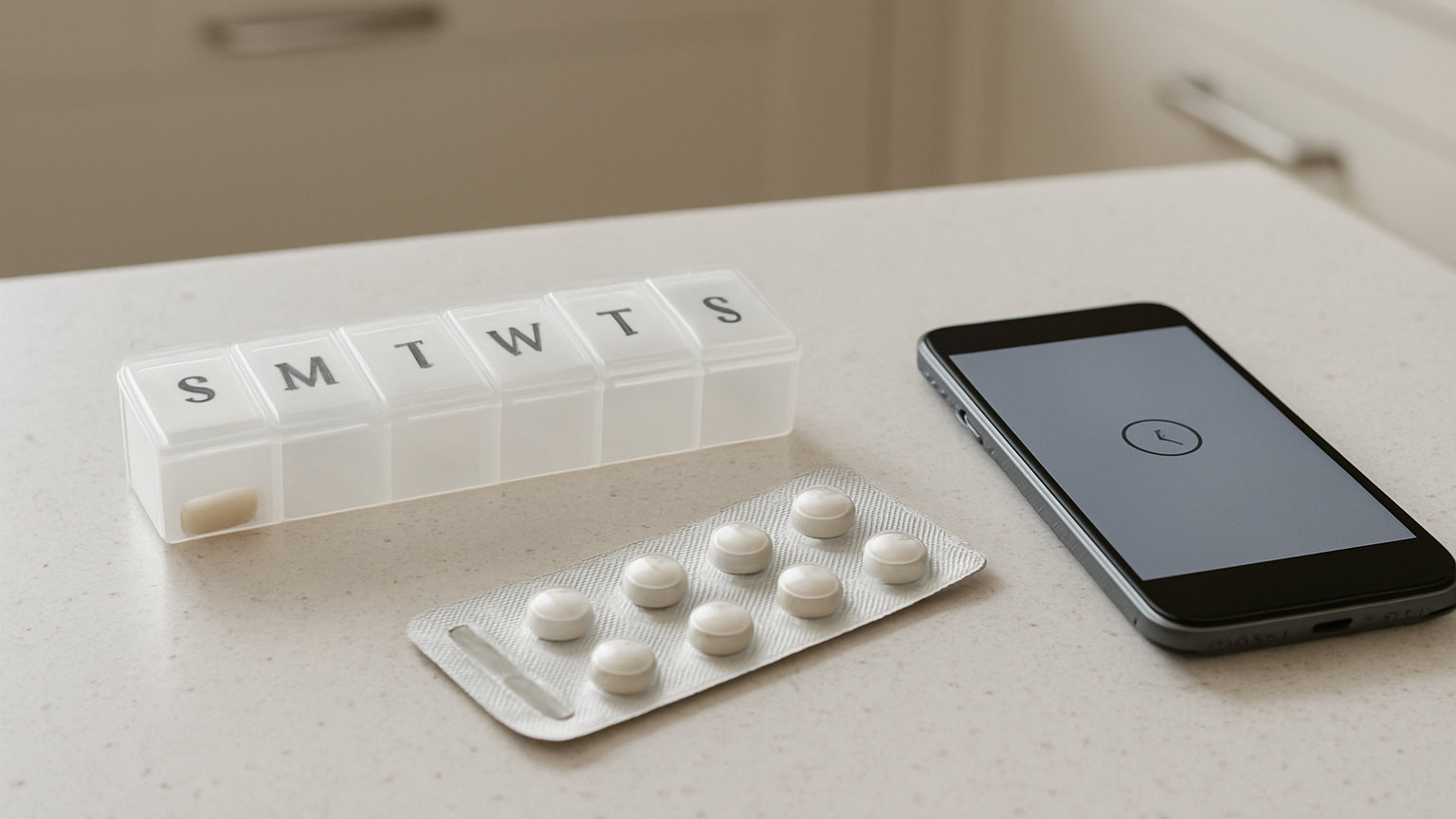
A weekly organiser answers the question by looking - the compartment is either empty or it is not. That is its real value, more than convenience. Check which of your medicines must stay in their original packaging first, since some are moisture-sensitive.
Blister packs prepared by the pharmacy do the same and remove the filling task, which is useful where someone else helps.
Turn the bottle round after each dose, or move it from one shelf to another. Any physical marker works.
Mark a chart on the fridge, which also helps anyone else involved in care.
Reminder apps that require you to confirm the dose keep a log you can check - useful if you are comfortable with them.
Tie it to a fixed daily event - brushing teeth, the kettle, feeding the cat - rather than a clock time. Anchored actions are easier to recall than isolated ones.
See blister packs and dosette boxes and remembering to take your medicine.
Count what is left
A quick check that frequently settles it: count the tablets remaining against the date you collected them.
Over a week or two this also tells you something more useful - whether you are missing doses regularly without realising, which is common and rarely discovered any other way.
If the count says you are taking fewer than you thought, that is worth raising at a review rather than resolving to try harder.
When it happens often
Occasional uncertainty is normal. Frequent uncertainty is a signal.
It may mean the regimen is too complicated - four-times-daily dosing is genuinely hard to sustain, and there is frequently a longer-acting alternative.
It may mean too many medicines, which is worth reviewing in its own right.
And in an older person, a new difficulty keeping track can be an early sign of memory change worth mentioning - though it is far more often just the ordinary automaticity everyone experiences.
See being on too many medicines and medicines and your memory.
When you realise hours later
Sometimes the uncertainty resolves itself - you find the tablet on the floor, or remember clearly at lunchtime.
If it turns out you did miss it, the usual rule applies: take it when you remember unless it is nearly time for the next dose, and never double up to compensate. For a long-acting medicine a single missed dose changes very little. See taking a dose late.
If you look after someone else
Do not rely on asking them whether they have taken it - the answer is unreliable in both directions, and repeated questioning is wearing for everyone.
Use a system that shows the answer without asking: a blister pack, a chart, or a box that is visibly empty.
See managing someone else's medicines.
Medicines and Shift Work covers a related point, and the Usage section has the rest of these guides.