Most people take at least one dose late most weeks, and the honest answer to whether it matters is that it depends almost entirely on one property: how long the medicine stays in your body. A drug that lasts days barely notices a few hours. A drug that is gone within twelve hours leaves a real gap. Knowing which of yours is which tells you when to relax and when to act.
Half-life is the thing
Half-life is the time taken for the amount in your body to fall by half.
A long half-life means levels change slowly, so timing is forgiving. A short one means levels rise and fall sharply, so timing matters.
That is why some medicines are once daily and others are three or four times a day - the dosing schedule is telling you something about the margin you have.
As a rough rule: the more often you take it, the less late you can afford to be.
Forgiving medicines
Several common medicines last well beyond their dosing interval:
Amlodipine - its effect persists well past twenty-four hours, so a late or occasional missed dose barely registers.
Insulin degludec - over forty-two hours, which is why flexible timing is explicitly permitted.
Fluoxetine - days, which is why it causes so few discontinuation symptoms.
Telmisartan, chlorthalidone and bisphosphonates, all of which last far longer than a day.
Statins - the benefit accrues over years, so a missed evening is irrelevant.
See amlodipine and insulin degludec.
Unforgiving medicines
Where a gap genuinely leaves you exposed:
Direct oral anticoagulants - apixaban and rivaroxaban are short-acting, and protection falls away within a day. A missed dose is a gap in stroke protection, which is the trade-off for not needing INR monitoring. See rivaroxaban.
Ticagrelor, taken twice daily because it binds reversibly.
Parkinson's medicines, where timing is measured in minutes for some people and a late dose means noticeable deterioration.
Anti-epileptics with shorter half-lives.
Short-acting opioids and Parkinson's treatment in palliative care.
Progestogen-only contraceptive pills, some of which have a window of only a few hours.
See desogestrel and missed contraceptive pill.
Where lateness has a specific consequence
A few medicines have rules that are not about half-life at all.
Clozapine - missing doses for more than 48 hours means the entire titration restarts from a low dose, because tolerance is lost. Restarting at the previous dose has caused deaths. See clozapine.
Lamotrigine - a break of more than about five days means restarting the slow titration, because the rash risk returns. See lamotrigine.
Alpha blockers - after a few days off, the first-dose blood pressure drop can return, so restarting needs care. See terazosin.
Methotrexate is weekly, and the danger is the opposite - taking it daily by mistake is a recognised fatal error. See methotrexate.
When timing is about something other than levels
Some instructions are not about half-life:
Nitrates are deliberately dosed unevenly to create a nitrate-free period, because continuous exposure causes tolerance. Spacing the doses evenly to be tidy stops the medicine working. See isosorbide.
Diuretics are taken in the morning so you are not up all night.
Sulfonylureas are timed to meals, so a late dose without food risks a hypo.
Simvastatin and pravastatin work better in the evening, when the liver makes most cholesterol.
Bisphosphonates are taken on waking with water and upright, which is about absorption and oesophageal safety rather than timing.
The general rule when you are late
Take it when you remember, unless it is nearly time for the next dose, in which case skip the missed one and carry on.
Never double up to catch up, except where the leaflet specifically permits it.
If you routinely find yourself hours late, that is a cue to change the routine rather than to keep improvising.
See missed doses and accidental double dose.
Steady state takes time
When you start a medicine, or change the dose, it takes several half-lives to reach a stable level - usually four or five.
For a long-acting drug that means a week or more before the full effect appears, which is why dose changes are spaced out and why judging a medicine after three days is unfair to it. It also means the effect of stopping fades over a similar period rather than immediately.
Making timing easier
Anchor doses to fixed daily events - brushing teeth, a meal, going to bed - rather than to clock times you will not honour.
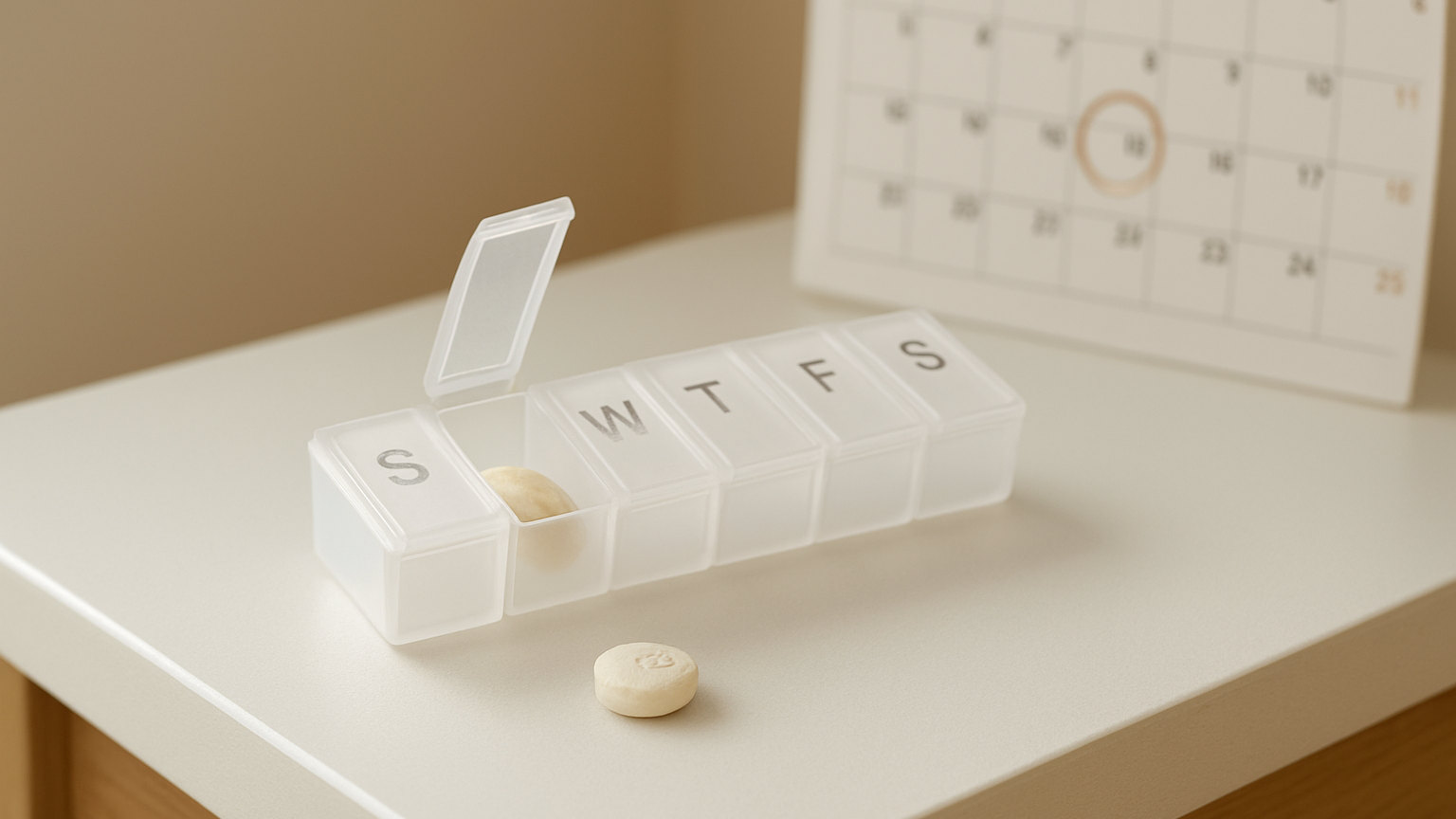
Alarms work better than intentions. Weekly organisers help with "did I take it", though check which medicines must stay in their original packaging.
If a four-times-daily schedule is unmanageable, say so - there is frequently a longer-acting alternative.
See remembering to take your medicine and blister packs and dosette boxes.
The Usage section covers more on taking medicines day to day - Did I Take It? What to Do is closely related to this one.