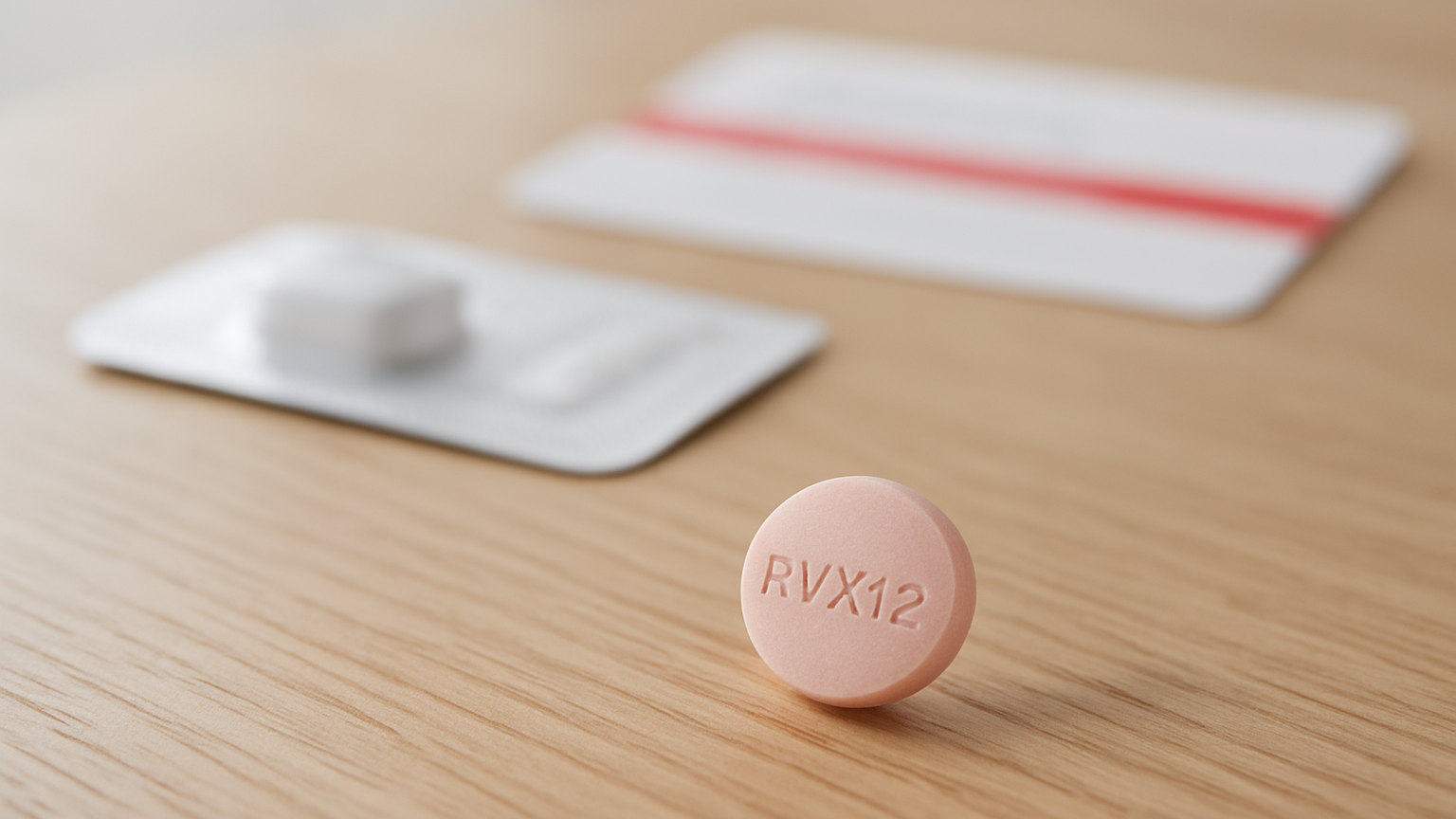
Rivaroxaban is a direct oral anticoagulant, blocking factor Xa in the clotting cascade. It is used to prevent stroke in atrial fibrillation, to treat and prevent deep vein thrombosis and pulmonary embolism, and after hip and knee replacement. It needs no routine blood monitoring and has no dietary restrictions in the way warfarin does - with one important exception, which is that at treatment doses it must be taken with food.
Follow the instructions on your label. This guide contains no doses.
The food requirement
At higher doses, rivaroxaban's absorption falls substantially when taken on an empty stomach - enough to leave you inadequately anticoagulated.
Taken with a meal, absorption is close to complete.
Take it with your main meal, at the same time each day. This is an absorption requirement, not a tolerability suggestion, and it is the most common way rivaroxaban underperforms.
At the lowest doses used for prevention after joint replacement, food matters less - but taking it with a meal consistently is the simplest rule.
Apixaban has no such requirement, which is one practical difference between them - see apixaban.
Once daily, except at the start
For atrial fibrillation, rivaroxaban is taken once daily - a genuine advantage over apixaban's twice-daily schedule for anyone who struggles with adherence.
For treating a DVT or pulmonary embolism, it starts as a twice-daily dose for the first three weeks, then reduces to once daily.
That switch happens on a specific date and is easy to get wrong. Make sure you know when it changes and what the new dose is.
Missed doses
Rivaroxaban has a short duration of action, so protection falls away within a day - unlike warfarin, where a single missed dose barely registers.
On the once-daily regimen, take a missed dose as soon as you remember on the same day, then continue as normal. Do not double up the next day.
On the twice-daily regimen the advice differs - check your leaflet, as taking two together is permitted in some circumstances to reach the daily total.
Because there is no INR, nobody can tell whether you have been taking it. That is the trade-off for the convenience - see warfarin.
Bleeding
Bruising, nosebleeds and bleeding gums are expected.
Call 999 or go to A and E for a significant blow to the head - even if you feel fine, since bleeding inside the skull can be delayed - bleeding that will not stop, vomiting blood or material like coffee grounds, black tarry stools, blood in urine, or sudden severe headache, weakness or confusion.
A specific reversal agent exists for factor Xa inhibitors, which is worth knowing and worth mentioning to anyone treating you.
Carry your anticoagulant alert card.
What to avoid
Anti-inflammatory painkillers including ibuprofen and naproxen raise bleeding risk substantially and are generally avoided. Aspirin too, unless specifically prescribed alongside. Paracetamol is the usual alternative - see naproxen.
Some medicines significantly change rivaroxaban levels. Strong inhibitors of both CYP3A4 and P-glycoprotein - certain antifungals, some HIV medicines and boosters - raise them and are generally avoided. See cobicistat.
St John's wort reduces its effectiveness and is sold freely over the counter. Rifampicin, carbamazepine and phenytoin do the same - see supplements that interfere with your medicines and carbamazepine.
Clarithromycin raises levels too - see clarithromycin.
Always mention your anticoagulant before any new prescription, including from a dentist or an online service.
Before procedures
Rivaroxaban is stopped a defined period before surgery and some procedures, then restarted afterwards - the interval depends on bleeding risk and kidney function.
Never stop it on your own initiative, and never skip doses because a procedure is coming up. Ask for written instructions.
Most dental treatment can be done without stopping it, sometimes by omitting or delaying the morning dose on the day.
Monitoring
There is no INR, but kidney function is checked periodically - at least annually, more often if reduced - because rivaroxaban is partly cleared by the kidneys and the dose depends on it.
Liver function and full blood count are also checked. See monitoring long-term medicines.
Do not run out
Because protection lapses within a day, a gap in supply is a gap in protection. Order repeats with a week or more to spare and earlier before bank holidays - see ordering repeats.
Pregnancy
Rivaroxaban is not used in pregnancy - injected heparin is used instead. If you could become pregnant, this should be discussed in advance.
See also Amiodarone: Effective and Demanding, and the Conditions section for more on what medicines are prescribed for.