
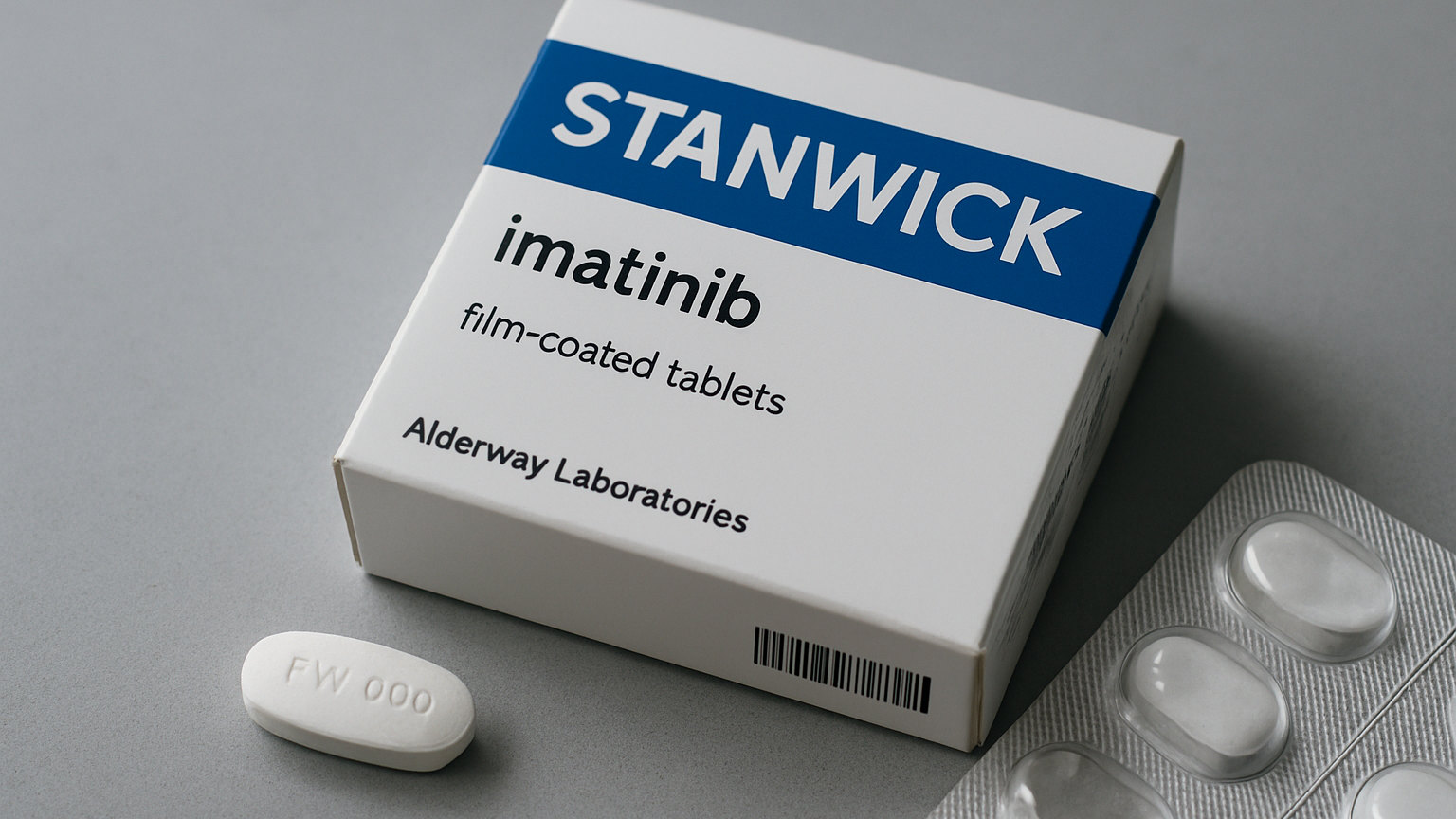
Imatinib was the first of the targeted cancer drugs to reach practice, and it changed what people expected of cancer treatment. It blocks a specific abnormal protein, BCR-ABL, produced by a chromosomal rearrangement found in chronic myeloid leukaemia. Before it, CML was usually fatal within a few years. With it, most people have a life expectancy close to normal - provided they keep taking it, which turns out to be harder than it sounds.
Follow the plan your haematology or oncology team gave you. This guide contains no doses.
How targeting works
In CML, a swap of material between two chromosomes creates a fusion gene producing a permanently switched-on enzyme that drives white cells to multiply.
Imatinib fits into that enzyme's binding site and switches it off. Because the abnormal protein exists only in the cancer cells, the drug spares normal tissue in a way conventional chemotherapy does not - which is why the side effects are so different in character.
It also blocks related enzymes, which is why it works in gastrointestinal stromal tumours and a few other conditions.
Adherence matters more than almost anywhere
This is the point worth emphasising. Studies in CML have found that people taking less than around ninety per cent of their prescribed doses are substantially less likely to achieve a deep molecular response - and molecular response is what predicts long-term outcome.
Missing the occasional dose is not a catastrophe. A pattern of missed doses is.
The difficulty is that CML on treatment causes no symptoms, so there is nothing to remind you and nothing to feel if you stop. Anchoring it to a fixed daily routine works better than intention - see remembering to take your medicine.
If side effects are the reason you are skipping doses, say so rather than rationing. Dose adjustment and supportive treatment are both possible, and there are alternative drugs in the same class.
Take it with food and a large glass of water
Imatinib irritates the stomach, and taking it with a meal and plenty of water substantially reduces nausea - which is the commonest early complaint.
Do not take it on an empty stomach. If swallowing is difficult, tablets can be dispersed in water or apple juice - check with your team rather than crushing them.
Side effects
Fluid retention is characteristic - puffiness around the eyes, particularly in the morning, and swelling of the ankles. It is usually mild but can be significant; report marked swelling, breathlessness or rapid weight gain.
Muscle cramps are very common and often troublesome. Adequate hydration helps, and magnesium or calcium are sometimes checked - see magnesium.
Nausea, diarrhoea, rash, fatigue, bone and joint aches, and headache all occur.
Blood counts fall, particularly early - report fever, sore throat, unexplained bruising or bleeding. Full blood count and liver function are monitored regularly, alongside molecular testing to track the response.
See monitoring long-term medicines and infection risk.
Interactions
Imatinib is cleared by CYP3A4, so a great deal affects its levels.
Avoid grapefruit and grapefruit juice - see grapefruit and medicines.
Levels are raised by some antifungals, clarithromycin and boosters such as ritonavir - see ritonavir. They are lowered by rifampicin, carbamazepine and St John's wort, which must be avoided because reduced levels risk treatment failure and resistance.
Imatinib also raises levels of some other drugs, including warfarin and simvastatin - see supplements that interfere with your medicines.
Check every new medicine with your team, including anything bought over the counter.
Stopping treatment
For many years imatinib was lifelong. It is now recognised that a proportion of people with a sustained deep molecular response can stop under close monitoring, and roughly half remain in remission - a concept called treatment-free remission.
This is done only within strict criteria and with frequent molecular monitoring, because relapse requires prompt restarting. It is not something to attempt independently, and stopping without that framework is dangerous.
If you have been on treatment for years with an excellent response, it is a reasonable thing to ask about.
The newer drugs in the same class
Imatinib was the first BCR-ABL inhibitor. Several second and third-generation drugs followed - dasatinib, nilotinib, bosutinib and ponatinib - which are more potent and work against some mutations imatinib cannot.
They are used where imatinib has not produced an adequate response, where resistance has developed, or sometimes first-line in higher-risk disease. Each has its own side effect profile, so a switch is about matching the drug to the person as well as to the disease.
Pregnancy
Imatinib can harm a developing baby and effective contraception is advised during treatment. Pregnancy planning needs specialist discussion well in advance, and fertility preservation is worth raising before treatment where relevant.
Linaclotide: For IBS With Constipation covers a related point, and the Conditions section has the rest of these guides.


