
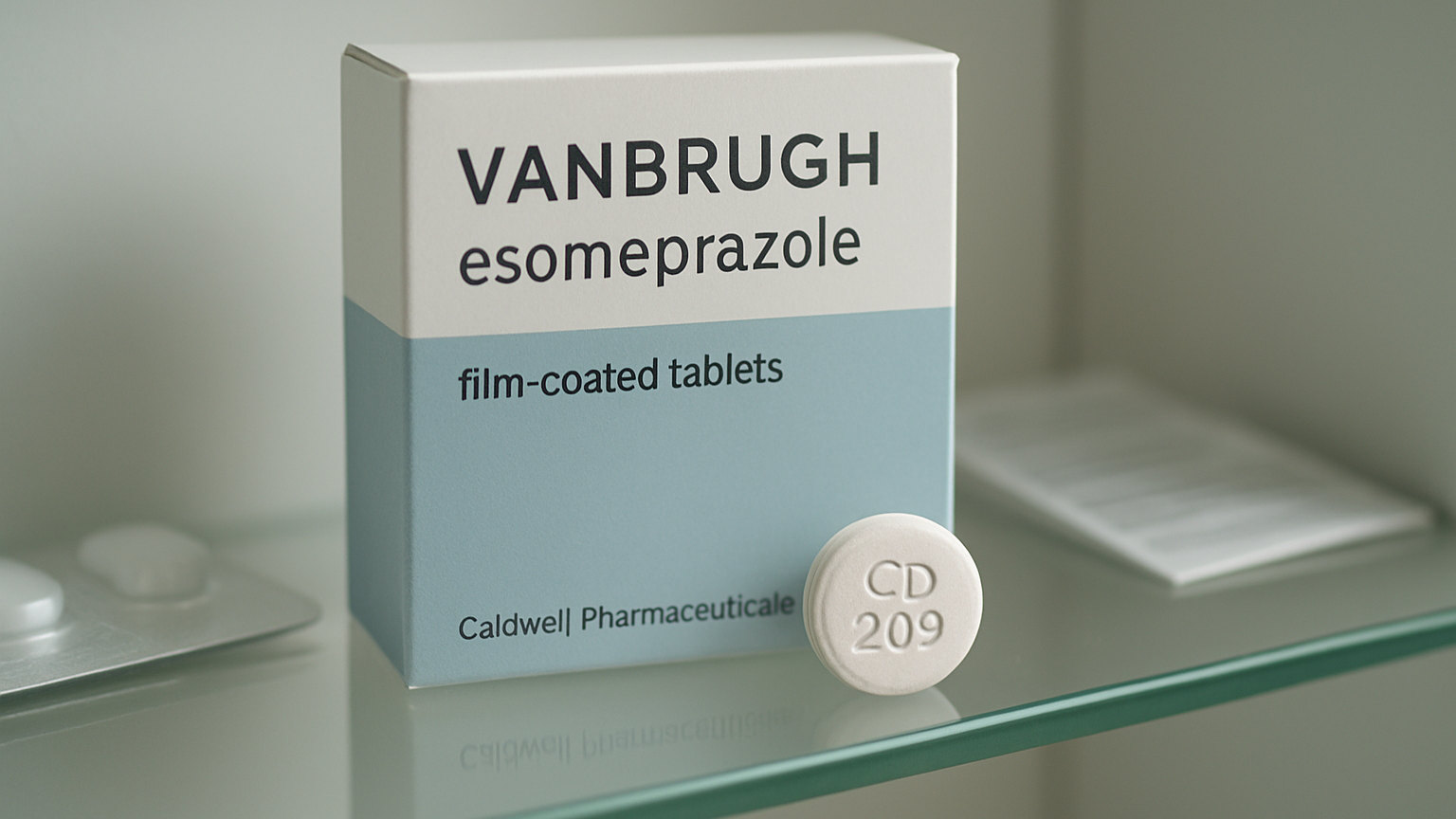
Esomeprazole is a proton pump inhibitor, switching off the pumps in the stomach lining that produce acid. Its relationship to omeprazole is straightforward: omeprazole is a mixture of two mirror-image forms of the same molecule, and esomeprazole is the more active one isolated. That makes it modestly more potent at equivalent doses. What it does not do is solve omeprazole's main drawback, which is the reason people are usually switched between PPIs in the first place.
Follow the instructions on your label. This guide contains no doses.
The clopidogrel point
Clopidogrel has to be converted by the liver enzyme CYP2C19 into its active form before it can prevent platelets sticking together.
Omeprazole inhibits that enzyme appreciably, reducing how well clopidogrel works - which matters when clopidogrel is being taken to prevent a stroke or a further heart attack.
Esomeprazole inhibits the same enzyme just as strongly. Switching from omeprazole to esomeprazole does nothing to address the problem, and it is a switch that gets made on the assumption that the newer drug must be different.
If you take clopidogrel and need acid suppression, pantoprazole is the usual choice, or an H2 blocker. See pantoprazole and famotidine.
Is it actually better?
Head-to-head trials have generally found esomeprazole slightly more effective than omeprazole at healing erosive oesophagitis and at controlling symptoms - a real difference, but a modest one that matters most in people with severe disease.
For ordinary reflux, the difference between any of the PPIs is small enough that cost, formulary and interaction profile usually decide. Our guide to omeprazole covers the class.
The same logic applies as with citalopram and escitalopram: isolating the active isomer produces a genuine but incremental improvement, not a different drug.
What it is used for
- Reflux and erosive oesophagitis, where its advantage is clearest
- Stomach and duodenal ulcers, healing and prevention
- Stomach protection alongside anti-inflammatory painkillers - see naproxen and ibuprofen
- H. pylori eradication, with antibiotics
- Zollinger-Ellison syndrome
An intravenous form is used in hospital after upper gastrointestinal bleeding.
How to take it
Before food, usually thirty to sixty minutes before breakfast. The pumps are activated by eating, so the drug needs to be circulating when that happens - taken after a meal it works measurably less well, and this is a common reason someone concludes a PPI has stopped working.
Capsules and tablets are designed to survive the stomach and should be swallowed whole. Some preparations can be dispersed in water for people who cannot swallow them - check yours rather than assuming. See cutting and crushing tablets.
How long
Four to eight weeks then a review, for uncomplicated reflux. Long-term use is appropriate for severe oesophagitis, Barrett's oesophagus, a history of bleeding ulcer and ongoing anti-inflammatory treatment.
What is not appropriate is a decade of unexamined repeat prescriptions, and proton pump inhibitors are the most common item on any deprescribing list - see deprescribing.
Stopping causes rebound acid
Stopping abruptly after months produces a temporary surge in acid above the original level, causing heartburn that feels like proof the medicine was needed.
It settles over a few weeks. Stepping down - a lower dose, then alternate days, then as required - makes it manageable, and an antacid or alginate covers the gap.
Long-term effects
Shared with the class: low magnesium, reduced absorption of vitamin B12, iron and calcium, a modest increase in fracture risk, and a raised risk of gut infections including C. difficile.
See cyanocobalamin, magnesium and calcium supplements, since calcium carbonate needs acid to be absorbed and works poorly alongside a PPI.
Seek advice for persistent diarrhoea, or cramps and palpitations on long-term treatment.
If it stops working
Reflux that was controlled and no longer is deserves a look rather than a higher dose. The commonest explanations are a change in how the tablet is being taken, a new medicine aggravating reflux, weight gain, or a different diagnosis entirely.
Anti-inflammatories, some blood pressure tablets, bisphosphonates and doxycycline all aggravate reflux - see alendronate, where the upright-and-water rule exists for exactly this reason.
Red flags
See your GP rather than continuing to suppress acid if you have difficulty swallowing, food sticking, unintentional weight loss, persistent vomiting, blood in vomit or black tarry stools, or new indigestion over the age of 55.
See warning signs you should not ignore. PPIs are stopped for a period before H. pylori testing and endoscopy, because they produce false negatives - follow the interval you are given.
The Medicines section covers more on how the main families of medicine work - Drospirenone: What Makes This Pill Different is closely related to this one.


