Events that separate people from their medicines are more common than they sound - a flood, a fire alarm at three in the morning, a sudden hospital admission, a power cut, or simply being taken ill away from home. All of them give you a few minutes to make decisions you would rather have made in advance. A small prepared bag removes the decisions entirely.
What goes in it
A current medicines list, printed. Names, strengths, doses, what each is for, allergies, your GP practice and usual pharmacy. Put a date on it. This is the single most valuable item and the one most often absent.
A few days of your regular medicines, in original labelled packaging.
All emergency medicines - reliever inhaler, GTN spray, adrenaline auto-injector, glucagon, rescue pack, naloxone if you have it.
Any alert cards - steroid, anticoagulant, biologic.
A copy of your repeat prescription slip, or a photograph of it.
A spare device where relevant - a second inhaler, a spare auto-injector.
Basic supplies - a sharps container if you inject, spare needles, blood glucose testing kit.
See keeping a medicines list and alert cards and medical ID.
Keep it realistic
This is a grab bag, not a stockpile.
A few days' supply plus your emergency items is enough - the point is to bridge a gap until you can get to a pharmacy, not to survive independently.
Ordering large surpluses to build a store makes shortages worse and generates waste, since dispensed medicine cannot be reused.
See stockpiling makes shortages worse.
Rotate it
The commonest failure is a bag packed once and forgotten, containing expired items.
Check it whenever you do your annual cupboard sort-out - the two jobs go together naturally.
Pay particular attention to the items that expire quietly: adrenaline auto-injectors, glucagon, GTN tablets (which should be discarded around eight weeks after opening), and rescue packs.
Use the oldest supply first and replace it, so nothing sits for years.
Update the printed list whenever anything changes.
See clearing out your medicine cupboard.
Where to keep it
Somewhere you can reach quickly and without a key - by the front door, in a hall cupboard, or wherever you would grab a coat.
Not the loft, not the garage, and not somewhere that gets hot.
Tell the people you live with where it is, and tell anyone who might need to fetch it for you.
If children or animals are in the house, that has to be balanced against keeping medicines out of reach - a closed box on a high shelf near the door is usually the compromise.
See storing medicines in a shared home.
Fridge medicines
Insulin and biologics obviously cannot live in the bag.
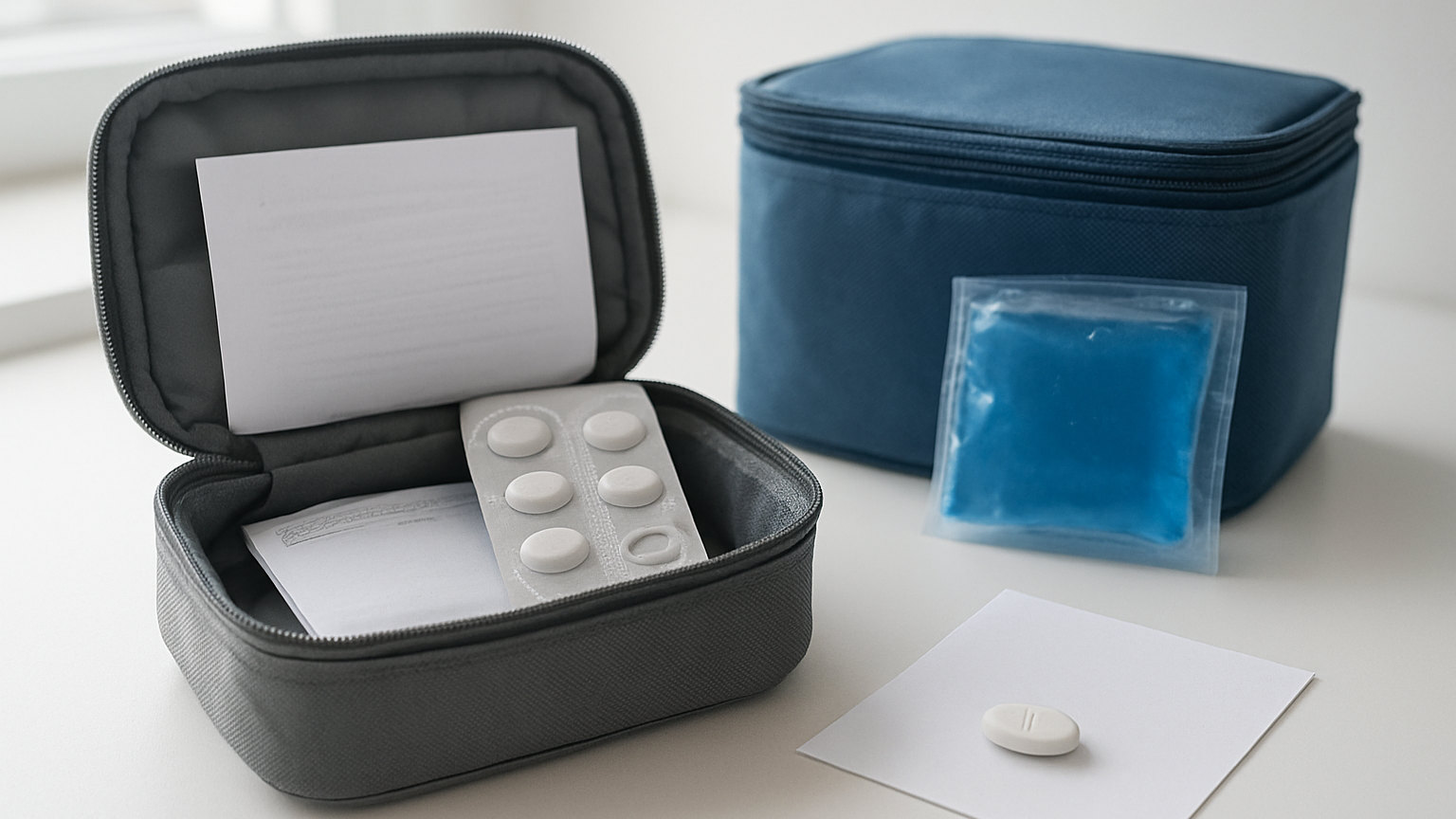
Keep a cool bag and gel packs, or an evaporative cooling wallet, stored with it so you can transfer them in a hurry.
Remember that insulin in use is kept at room temperature anyway, so the pen in your bag is fine - it is the unopened spares that need the cold.
Never let medicine touch a frozen gel pack directly. Freezing destroys insulin and most biologics permanently, even if they look normal afterwards.
See power cuts and fridge failures and travelling with medicines that need a fridge.
Controlled drugs
These need thinking about separately.
They should be stored securely rather than by the door, particularly in a shared household - which conflicts with grab-bag logic.
A practical compromise is keeping them in their usual secure place with a note in the bag saying where they are.
Note also that an emergency supply from a pharmacy is not available for most controlled drugs, so replacing them quickly is harder.
See emergency supply from a pharmacy.
Register for support
Two things worth doing in advance.
The Priority Services Register, run by energy suppliers and network operators, covers people who depend on electricity for medical reasons - refrigerated medicines, oxygen concentrators, feed pumps. Registering is free and gives advance notice of planned outages and priority during unplanned ones.
Water companies run an equivalent scheme.
Also set up your phone's emergency medical information, which displays on the lock screen without a passcode.
Keep a copy somewhere else
A bag that burns or floods with the house is no help at all.
Keep a photograph of your medicines list on your phone, and consider leaving a copy with a relative or in a work drawer. The list is the part that is hardest to reconstruct and easiest to duplicate. See alert cards and medical ID.
If you are helping someone else
Do the same for them, and keep a copy of their list yourself.
Include who to contact, their practice details, and anything already decided about their care.
See managing someone else's medicines.
Medicines at Work and School covers a related point, and the Usage section has the rest of these guides.