Medicines are tested for stability under defined conditions, and the expiry date assumes those conditions were met. Four things degrade them faster: heat, moisture, light and air. Two of those are present in every bathroom, which is why the most popular place to keep medicines is among the worst. Understanding how degradation actually works explains most of the storage rules people find fussy.
Moisture is the main enemy
Water is what most tablet degradation depends on - it allows the chemical reactions that break the active ingredient down, and it makes tablets soften, swell, crumble and stick together.
Humidity does this without any visible water being present.
That is why manufacturers use sealed blister strips, why tablet bottles frequently contain a desiccant sachet, and why some products carry instructions to keep the container tightly closed.
Leave the desiccant in the bottle. It is not packaging waste, and removing it shortens the life of what is left.
Effervescent, dispersible and orodispersible tablets are particularly moisture-sensitive, since they are designed to dissolve quickly.
Why the bathroom is wrong
A bathroom is warm and repeatedly humid - the worst combination, applied several times a day.
A kitchen near a kettle, hob or steamy window is no better.
A cool, dry cupboard in a bedroom or hallway is better, out of sight and reach of children and animals.
The bathroom cabinet's popularity is habit rather than logic.
See where to keep your medicines.
Light
Ultraviolet and visible light break down several active ingredients.
That is why some products come in amber bottles, opaque blisters or cartons you are told not to discard.
The outer carton is part of the protection, not merely packaging - which is one reason to keep medicines in it rather than loose in a drawer.
Windowsills are the obvious thing to avoid, and a sunny car is worse still.
Air
Oxygen degrades some compounds, and volatility affects others.
GTN tablets are the clearest example - the active ingredient evaporates once the bottle is opened, which is why they should be discarded around eight weeks after opening regardless of the printed expiry, and kept in the original glass bottle with the cap tight.
A GTN tablet that produces no tingle under the tongue may well be inert, and you find that out during an attack of angina. The spray does not have this problem.
Aspirin breaking down produces a distinct vinegar smell, which is a reliable sign to discard it.
See glyceryl trinitrate.
Do not decant
Moving tablets into an unlabelled pot removes the moisture barrier, the light protection, the desiccant, the expiry date, the batch number and the strength.
It also makes identification impossible if there is ever a problem.
Some medicines specifically must stay in their original container - GTN and telmisartan among them - which is worth checking before filling a weekly organiser.
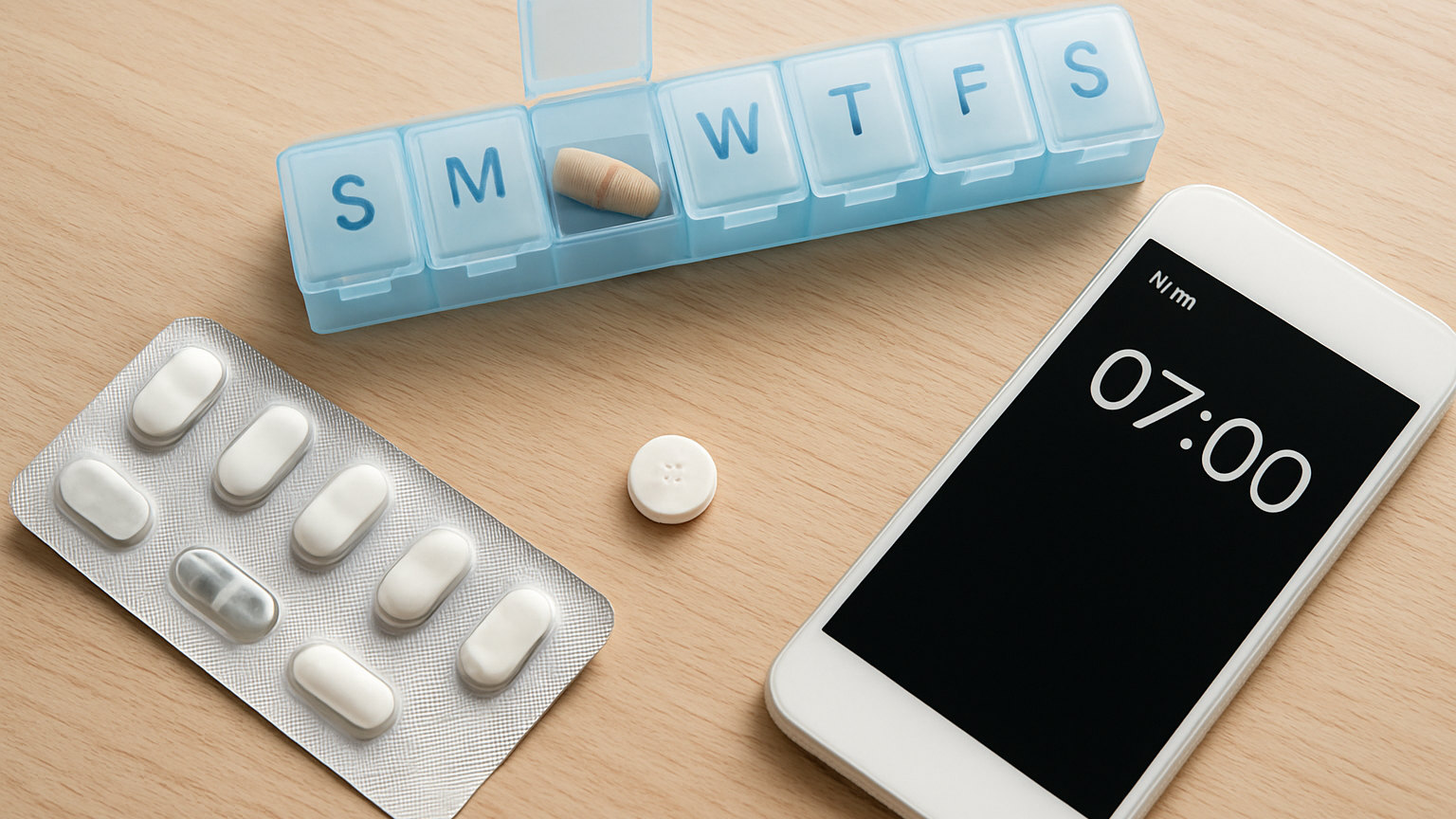
Weekly organisers are genuinely useful for remembering doses, and they trade some protection for that benefit. Ask the pharmacist which of your medicines can go in one.
See blister packs and dosette boxes.
Signs something has degraded
Tablets and capsules - crumbling, chipping, sticking together, discolouration, an unusual smell, softened or leaking capsules.
Liquids - separation that will not remix, cloudiness in something that was clear, crystals, a changed colour or smell.
Creams - separation into oil and water, grittiness.
Effervescent tablets that no longer fizz properly.
And remember that several important failures are invisible - GTN losing potency, insulin damaged by heat or freezing, an inhaler emptied without any change in how it feels.
See how to tell if a medicine has gone off.
In-use dates
Several things expire on their own clock once opened, and the packet date stops applying.
Eye and ear drops, reconstituted antibiotic liquids, insulin in use, biologic pens and GTN tablets all have shorter in-use lives.
Write the opening date on the box.
Temperature
Most medicines are stable at normal room temperature, and the problems come from extremes.
A car in summer exceeds anything a medicine is tested at within minutes. Checked luggage on a flight gets cold enough to freeze insulin.
Refrigerated medicines tolerate short warming far better than freezing, which destroys insulin and most biologics permanently.
See medicines in hot weather and power cuts and fridge failures.
What to do with degraded medicine
Return it to any pharmacy - free, no appointment, no questions.
Never flush medicines, and do not put them in household waste.
See what happens to medicines you return.
The Usage section covers more on taking medicines day to day - How Long Medicines Really Last is closely related to this one.