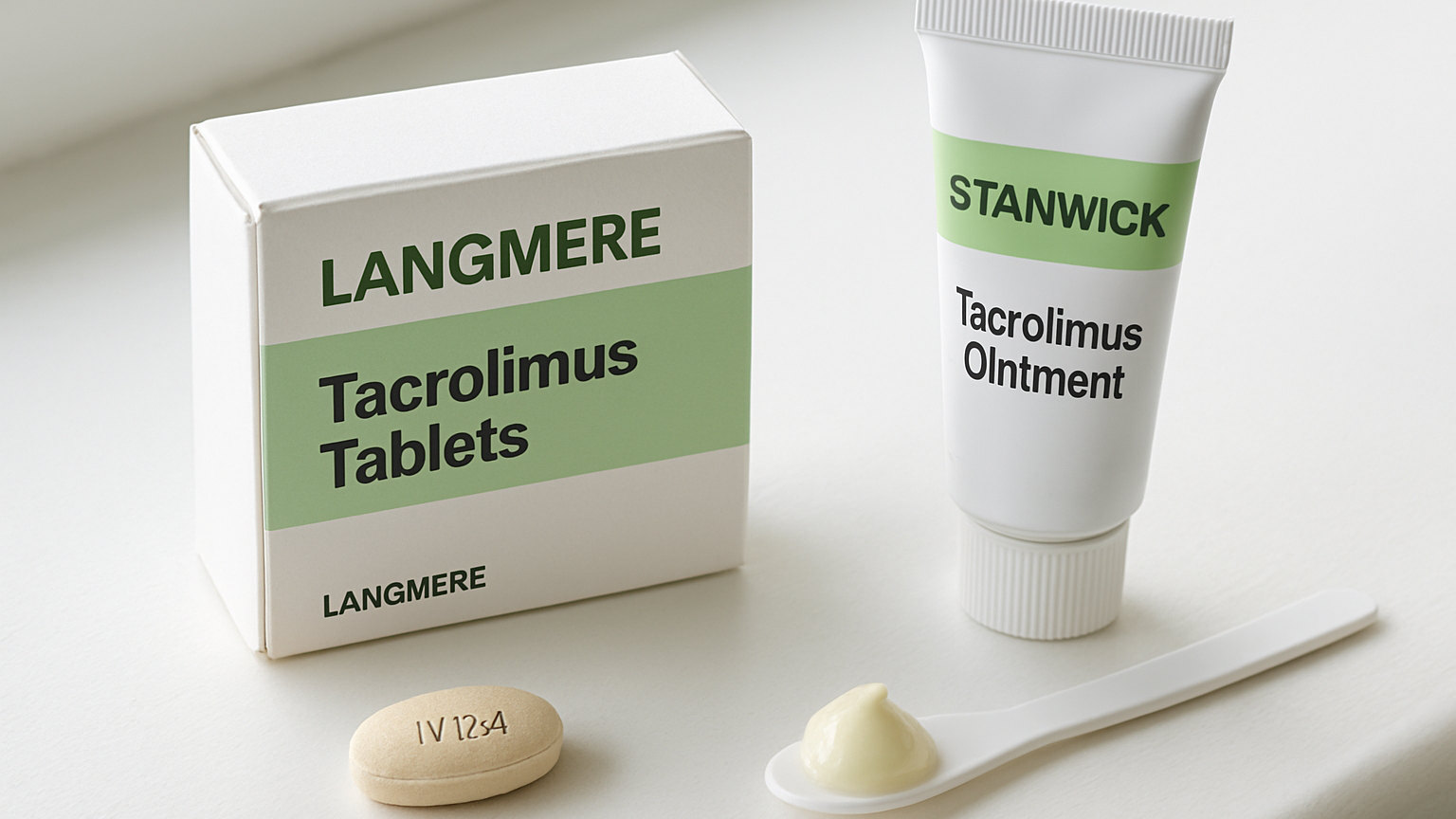
Tacrolimus suppresses the immune system by blocking calcineurin, an enzyme T-cells need to activate. As tablets or capsules it prevents rejection after kidney, liver and other organ transplants, and it is one of the more demanding medicines to take correctly - blood levels are measured, the therapeutic window is narrow, and the brand must stay the same. As an ointment applied to skin, almost none is absorbed, and it is a well-established treatment for eczema with a very different risk profile.
Follow the plan your specialist gave you. This guide contains no doses.
Tablets: the brand must not change
Different tacrolimus products are not interchangeable. Immediate-release and prolonged-release preparations differ in how often they are taken and in how they are absorbed, and even products of the same type differ enough to shift blood levels.
The MHRA has issued specific advice that tacrolimus should be prescribed and dispensed by brand, and that switching requires careful supervision with level monitoring afterwards.
An accidental switch is a genuine cause of rejection or of toxicity. If your packaging looks different, query it before taking it. See why some medicines are prescribed by brand.
Blood levels
Tacrolimus levels are measured regularly, and the timing of the sample matters - usually a trough level taken immediately before a dose.
Do not take your morning dose before a level test unless told to, and tell the phlebotomist when you last took it. A sample taken at the wrong time produces a misleading result and a wrong dose adjustment.
Kidney function, potassium, glucose, magnesium and blood pressure are monitored alongside. See monitoring long-term medicines.
Grapefruit, and everything else
Tacrolimus is cleared by CYP3A4, so anything affecting that enzyme changes its levels substantially.
Avoid grapefruit and grapefruit juice entirely - the effect is large and long-lasting. See grapefruit and medicines.
Many medicines raise levels - some antifungals, some antibiotics including clarithromycin, some heart medicines, and boosters such as ritonavir. See ritonavir.
Others lower them, risking rejection - rifampicin, carbamazepine, and St John's wort, which must be avoided. See supplements that interfere with your medicines.
Check every new medicine with your transplant team, including anything bought over the counter. This is not a precaution to take selectively.
Side effects of the tablets
Kidney impairment is the most significant, and it is dose-related - which is much of why levels are monitored.
Others include tremor, headache, high blood pressure, raised potassium, low magnesium, and new-onset diabetes after transplant, which is common enough to be screened for.
Infection risk is raised, and so is the long-term risk of certain cancers - skin cancer in particular. Sun protection matters a great deal, and any new or changing skin lesion should be reported. See infection risk on immune-suppressing medicines.
Live vaccines are avoided. Inactivated vaccines are recommended.
The ointment is a different medicine in practice
Applied to skin, tacrolimus treats atopic eczema, and it is particularly useful on the face, eyelids and skin folds - sites where prolonged steroid use thins the skin.
It does not cause skin thinning, which is its main advantage over topical steroids. Our guide to steroid creams and potency covers why site matters there.
Systemic absorption is minimal through intact skin, so the monitoring, level testing and interaction concerns above do not apply in the same way.
The burning is expected
A burning or stinging sensation on application is very common in the first days and is the main reason people abandon it.
It typically settles within about a week as the skin improves. Applying it to skin that is already treated with an emollient, and avoiding alcohol around the time of application - which makes flushing worse - both help.
Knowing to expect it is usually what gets people through. See emollients.
Taking the tablets consistently
Tacrolimus is taken at the same times each day, usually twelve hours apart, and consistency matters more than with most medicines because levels are the thing being controlled.
Take it the same way relative to food each day - food reduces absorption, so switching between taking it with and without meals shifts your levels even if the dose has not changed. If you vomit shortly after a dose, contact your team rather than guessing whether to repeat it.
Sun and the ointment
Avoid sunbeds and minimise sun exposure on treated skin, and use sunscreen. A theoretical cancer concern led to a boxed warning in some countries; long-term studies have been broadly reassuring, but the sun advice remains sensible.
It is generally used intermittently rather than continuously - treating flares, then twice-weekly maintenance on problem areas - rather than applied indefinitely every day.
If this was useful, Letrozole: Breast Cancer and Fertility Use is worth reading next, and Conditions collects the rest.